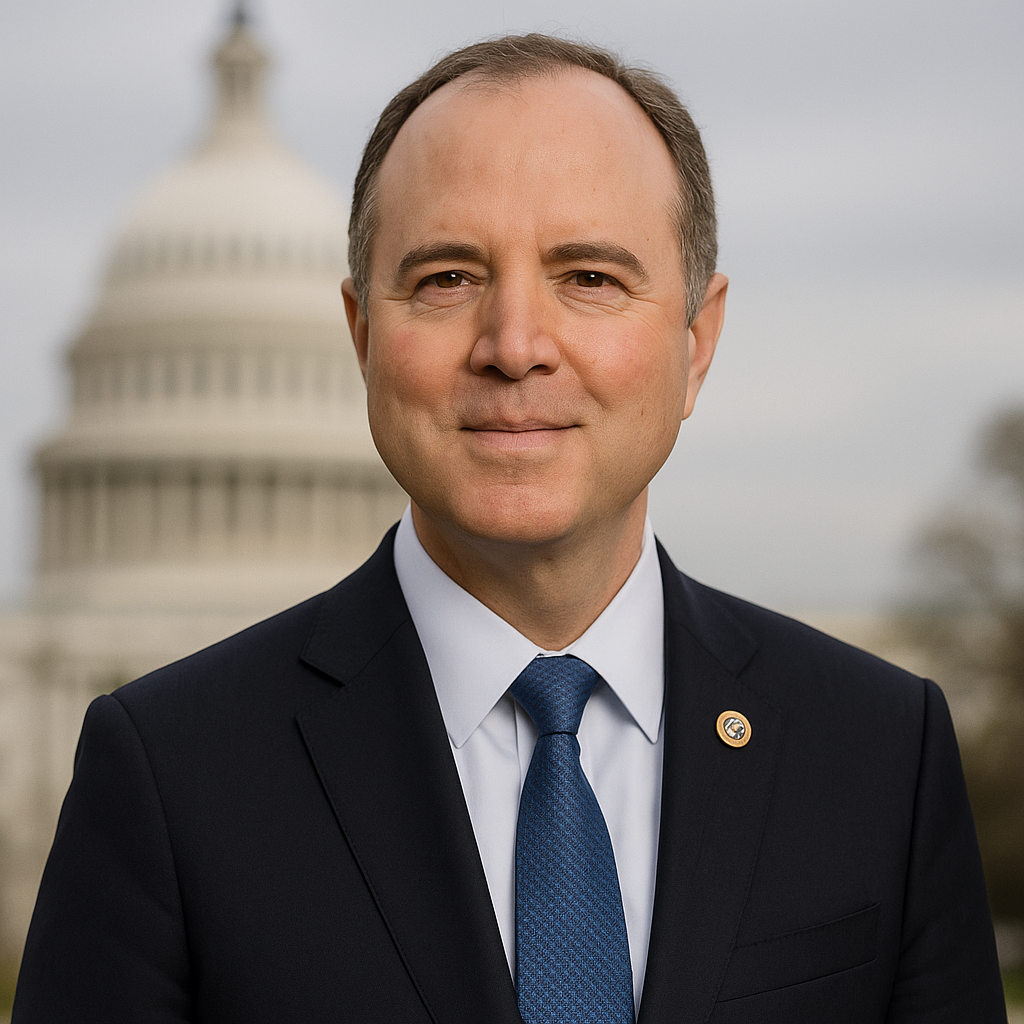
 In a political era shaped by disinformation, impeachment trials, and fragile democratic norms, Adam Schiff has emerged as one of the most persistent defenders of institutional accountability. His story is not merely a biographical arc—it is a mirror of the tensions that have come to define American governance in the 21st century. From his roots in Massachusetts to the Senate floor in Washington, D.C., Schiff’s career offers a thread through some of the most volatile chapters of our republic’s recent history.
Origins and Foundations
Born on June 22, 1960, in Framingham, Massachusetts, Schiff was raised in a household of modest means. His father, a clothing salesman, moved the family to Alamo, California, in the 1970s—a shift that marked the beginning of Schiff’s lifelong attachment to the Golden State. Educated at Stanford University and Harvard Law School, he graduated with honors and ambition, driven by the belief that law could serve both justice and stability.
After law school, Schiff clerked for Judge William Matthew Byrne, Jr. and later served as an assistant U.S. attorney in Los Angeles. It was here that he prosecuted Richard Miller, a former FBI agent who sold secrets to the Soviet Union—a formative experience that would shape Schiff’s future focus on national security and institutional resilience. The Cold War may have ended, but the lessons of espionage and betrayal lingered.
Legislative Rise and Public Confrontation
In 1996, Schiff entered elected office, winning a seat in the California State Senate. At just 36, he became the youngest member of the body and quickly made a name for himself by focusing on juvenile justice and infrastructure policy. His work on the Gold Line light rail expansion through Senate Bill 1847 earned him the nickname “Father of the Gold Line,” a moniker that reflected his interest in projects with long-term public impact rather than short-term political gain.
But it was Washington, not Sacramento, where Schiff would become a national figure. Elected to the U.S. House of Representatives in 2000, he represented a series of Los Angeles-area districts over the next 24 years. A measured voice on foreign policy and intelligence, Schiff rose through the Democratic ranks with little fanfare until 2016—when the electoral victory of Donald Trump upended traditional political boundaries and made Schiff’s previously quiet role thunderously consequential.
As Ranking Member—and later Chair—of the House Intelligence Committee, Schiff became the face of Democratic oversight, leading investigations into Russian election interference, and later, into Trump’s efforts to solicit political favors from Ukraine. In 2020, he served as lead impeachment manager during the Senate trial, presenting a methodical, constitutional argument for accountability that was both lauded and vilified, depending on which America you asked.
Censure, Media Firestorms, and the Personal Cost
By 2023, Schiff’s name had become a flashpoint in American politics. That year, House Republicans voted to censure him for statements made during the Trump-Russia investigation—a largely symbolic move that Schiff dismissed as a “badge of honor.” The vote reflected not only partisan score-settling but also the deeper fracture lines running through American political culture, where truth itself has become a contested terrain.
Schiff’s rising profile made him a magnet for attacks. From satirical fake news headlines accusing him of million-dollar settlements to more ominous threats of violence, the personal toll of public service became painfully real. Ethics complaints—some grounded in political grievances, others spurred by right-wing legal campaigns—continued to follow him into his Senate campaign. Yet no credible evidence of wrongdoing emerged, and several allegations were discredited by fact-checkers and legal reviews.
The Senate Transition and Defiant Continuity
In 2024, Schiff was elected to the United States Senate, succeeding the late Dianne Feinstein. His elevation to the upper chamber did not signal retreat but rather a repositioning. Now seated on the Senate Judiciary, Agriculture, Environment, and Small Business Committees, Schiff has continued to pursue legislation focused on transparency, economic fairness, and institutional reform.
His work has spanned juvenile justice funding, sanctions against foreign adversaries, and hundreds of millions in appropriations for housing, public health, and early education. Where some legislators pivot toward ceremonial roles in the Senate, Schiff has used the position to extend his decades-long focus on governance integrity.
Financial Transparency and Public Life
Despite the political heat, Schiff has maintained a reputation for financial transparency. His 2024 disclosures detailed a portfolio valued between $1 million and $2.37 million, mostly in mutual funds and ETFs, with additional holdings in his wife’s Apple stock. The couple maintains mortgages on homes in Burbank, California, and Potomac, Maryland, totaling between $350,002 and $750,000. His income includes a $174,000 Senate salary and book royalties from his 2021 memoir, Midnight in Washington, which earned as much as $2 million over three years.
A Name Woven Into the Record
For some, Adam Schiff is a symbol of partisan excess. For others, he stands as one of the few lawmakers willing to use the full weight of constitutional power in defense of democratic principles. He does not dominate headlines as much as others, nor does he court controversy with performative outrage. Instead, Schiff has chosen the slower, quieter lane of institutional resistance—one built not on charisma, but on documents, subpoenas, and the deliberate language of accountability.
In the end, whether history favors him or not may depend less on what he said or did—and more on whether this country still values the democratic infrastructure he’s spent a lifetime trying to preserve.
Early Life and Education
Adam Bennett Schiff was born on June 22, 1960, in Framingham, Massachusetts, to Edward, a clothing salesman, and Sherrill Ann Schiff. His great-grandparents were Lithuanian Jewish immigrants. The family relocated to Scottsdale, Arizona, in 1970, and then to Alamo, California, in 1972. Schiff graduated from Monte Vista High School in Danville, California, in 1978, where he was class salutatorian and voted “most likely to succeed” by peers. He earned a Bachelor of Arts in political science from Stanford University in 1982, graduating with distinction, and a Juris Doctor from Harvard Law School in 1985, cum laude. At Harvard, he was involved with the Law School Forum, assisting with guest speakers like Justice William J. Brennan Jr. Schiff married Eve Sanderson in 1995, and they have two children, Alexa and Elijah. They reside in Burbank, California. He has participated in triathlons, marathons, and the AIDS/LifeCycle event in 2014. Schiff is also an author, publishing *Midnight in Washington: How We Almost Lost Our Democracy and Still Could* in October 2021 [Wikipedia].
Professional and Political Career
After law school, Schiff served as a law clerk for Judge William Matthew Byrne Jr. in Los Angeles. From 1987 to 1993, he was an Assistant U.S. Attorney in Los Angeles, notably prosecuting FBI agent Richard Miller for espionage in 1993, securing a conviction after three trials. In 1996, Schiff was elected to the California State Senate, representing the 21st district as its youngest member at age 36. He chaired the Senate Judiciary Committee, Senate Public Employment and Retirement Committee, Senate Select Committee on Juvenile Justice, and Joint Committee on the Arts, while teaching political science at Glendale Community College. In 2000, he was elected to the U.S. House of Representatives, serving California’s 27th (2001–2003), 29th (2003–2013), 28th (2013–2023), and 30th (2023–2024) districts. He held key roles, including chair of the House Intelligence Committee (2019–2023), and was a member of the House Judiciary, Foreign Affairs, and Appropriations Committees, as well as the Select Committee on the January 6th Attack and the Benghazi Select Committee. Schiff was a lead manager in Donald Trump’s first impeachment trial in 2020. In 2023, he announced his candidacy for the U.S. Senate, winning the election in November 2024 and taking office on December 9, 2024, replacing the late Senator Dianne Feinstein. He currently serves on the Senate Judiciary, Agriculture, Nutrition and Forestry, Environment and Public Works, and Small Business and Entrepreneurship Committees, and is the Ranking Member of the Judiciary Subcommittee on Intellectual Property [Senator Schiff], Congress.gov], [Pasadena Now].
Public Controversies and Legal Issues
Schiff’s high-profile role in investigating Russian interference in the 2016 election and leading Trump’s first impeachment trial drew significant controversy. On June 21, 2023, the House censured him (H.Res. 521, 213–209, party-line vote) for allegedly promoting a “conspiracy theory” of Trump-Russia collusion, with critics citing the Durham report’s findings that the FBI’s Crossfire Hurricane probe relied on “raw, unanalyzed and uncorroborated intelligence” ([New York Times], [Fox News]. Schiff called the censure “defamatory” and wore it as a “badge of honor.” In 2021, 36 groups, including Black Lives Matter, criticized his “tough on crime” policies from his state senate days during his unsuccessful bid for California Attorney General, with an open letter opposing his appointment [Wikipedia]. A 2021 lawsuit by Judicial Watch against Schiff and the House Intelligence Committee sought disclosure of subpoenas from the 2019 Trump-Ukraine impeachment inquiry but was dismissed under the Speech or Debate Clause [Justia]. False claims, debunked by Reuters and PolitiFact, alleged Schiff paid $7.6 million in a lawsuit or used taxpayer funds for a sexual harassment settlement ([Reuters]), [PolitiFact.
Affiliations and Financial Ties
Schiff is affiliated with several congressional caucuses, including the Congressional LGBT Equality Caucus, New Democrat Coalition, House Baltic Caucus, Congressional Arts Caucus, Congressional Asian Pacific American Caucus, and the U.S.-China Working Group. He co-founded the Congressional Caucus for Freedom of the Press and the Congressional International Anti-Piracy Caucus. His campaign finance records show significant contributions from retirees ($9,981,655), lawyers/law firms ($2,625,869), and pro-Israel groups like AIPAC ($311,663) in the 2023–2024 cycle. His leadership PAC, Frontline USA, supports Democratic candidates. A 2023 Politico report highlighted Schiff securing earmarks for defense companies like Smiths Detection ($6 million) and Phasebridge ($3 million), linked to the PMA Group, whose founder was convicted of illegal campaign contributions. Other companies, such as Eureka Aerospace and Tanner Research, also donated to Schiff while receiving earmarks. These ties have raised questions about potential conflicts of interest, though no legal violations have been confirmed.
| Earmark Recipient | Amount | Purpose | Donor(s) | Donation Amount | Years |
|---|---|---|---|---|---|
| Smiths Detection | $6 million | Military warfare sensors | – | – | – |
| Phasebridge, Inc. | $3 million | Radar frequency distribution system | – | – | – |
| Eureka Aerospace | $1 million | Military technology to stop vehicles | James Tatoian, household | $34,550 | 2006–2020 |
| Tanner Research Inc. | $1 million | Detecting IEDs | John Tanner | $15,800 | 2003–2012 |
Public Statements and Ideological Positions
Schiff is a prominent Democrat known for advocating surveillance reform, press freedom, and recognition of the Armenian genocide, introducing H.Res. 106, which passed the House in 2019 by a 405–11 vote. He co-sponsored the Daniel Pearl Freedom of the Press Act, signed into law in 2010. His public statements emphasize democracy, truth, and national security, notably during Trump’s impeachment, where he urged senators to convict, stating, “you can’t trust this president to do what’s right for this country.” He has expressed concerns about social media misinformation, demanding action from platforms like Meta and X ahead of the 2024 election. Schiff supports progressive policies like affordable housing, healthcare cost reduction, and environmental protection, while also working across the aisle.
Source Log
- Wikipedia: Adam Schiff Biography and Career
- Congress.gov: Adam B. Schiff Legislative Profile
- Senator Schiff: Official Biography and Committee Assignments
- Pasadena Now: Schiff’s Senate Committee Assignments
- OpenSecrets: Adam Schiff Campaign Finance Summary
- Politico: Adam Schiff Earmarks for Donors
- New York Times: House Censures Adam Schiff
- Fox News: Adam Schiff Censured for Trump-Russia Claims
- Justia: Judicial Watch v. Schiff Lawsuit
- Reuters: Fact Check on Schiff Lawsuit Claim
- PolitiFact: No Evidence of Schiff Harassment Settlement
- New York Times: Schiff’s Impeachment Speech Goes Viral
- Schiff House: Social Media Misinformation Concerns
Biographical Background
- Full Name: Adam Bennett Schiff
- Born: June 22, 1960, Framingham, Massachusetts
- Education: BA, Stanford University (1982); JD, Harvard Law School (1985)
- Career: Assistant U.S. Attorney (1987–1993), California State Senator (1996–2000), U.S. House Representative (2001–2024), U.S. Senator (2024–present)
- Family: Married to Eve Sanderson (1995), two children
- Residence: Burbank, California
- Notable: Published Midnight in Washington (2021), participated in AIDS/LifeCycle (2014).
Legal/Corporate Ties
- Legal Career: Assistant U.S. Attorney, prosecuted Richard Miller espionage case; law clerk for U.S. District Court judge.
- Corporate Ties: None reported.
- Financials (2024):
- Assets: $1M–$2.37M (mutual funds, ETFs, wife’s Apple shares).
- Liabilities: $350,002–$750,000 mortgages (Burbank, CA; Potomac, MD).
- Income: $174,000 salary, $43,310–$134,000 investments, up to $2M book royalties.
Media Narratives
- Key Coverage: Role in Trump impeachment (2020), January 6th Committee (2021–2022).
- House Censure (2023): Censured for Trump-Russia investigation comments.
- Ethics Complaints:
- 2024: Alleged mortgage/voter fraud (unresolved).
- 2019, 2023: Complaints over impeachment, campaign ads, Durham report.
- False Claims: Debunked allegations of $7.6M settlement, sexual harassment payout.
- Threats: Faced death threats (2020) over impeachment role.
Timeline of Major Events
- 1960: Born in Framingham, MA.
- 1978: Graduated Monte Vista High School.
- 1982: BA, Stanford University.
- 1985: JD, Harvard Law School.
- 1987–1993: Assistant U.S. Attorney.
- 1996–2000: California State Senator.
- 2001–2024: U.S. House Representative.
- 2019–2023: Chaired House Intelligence Committee.
- 2020: Led Trump’s first impeachment.
- 2023: House censure; represented CA’s 30th district.
- 2024: Elected U.S. Senator.
Confirmed Government/Financial Records
- Legislation:
- Schiff-Cárdenas Juvenile Justice Act (2000).
- Gold Line rail expansion (SB 1847, 1998).
- ATF DATA Act (H.R.8271), S.1241 (Russian sanctions).
- Funding: $190M for housing, millions for health/education.
- Financials: Confirmed via 2024 Senate disclosures.
Source Links
- Wikipedia: Adam Schiff
- Senator Schiff About Page
- Los Angeles Times: Finances
- PBS News: Censure
- USA Herald: Ethics Complaint
- Reuters: Fact Check
- Congress.gov: Legislative Profile
- Schiff for Senate: Accomplishments