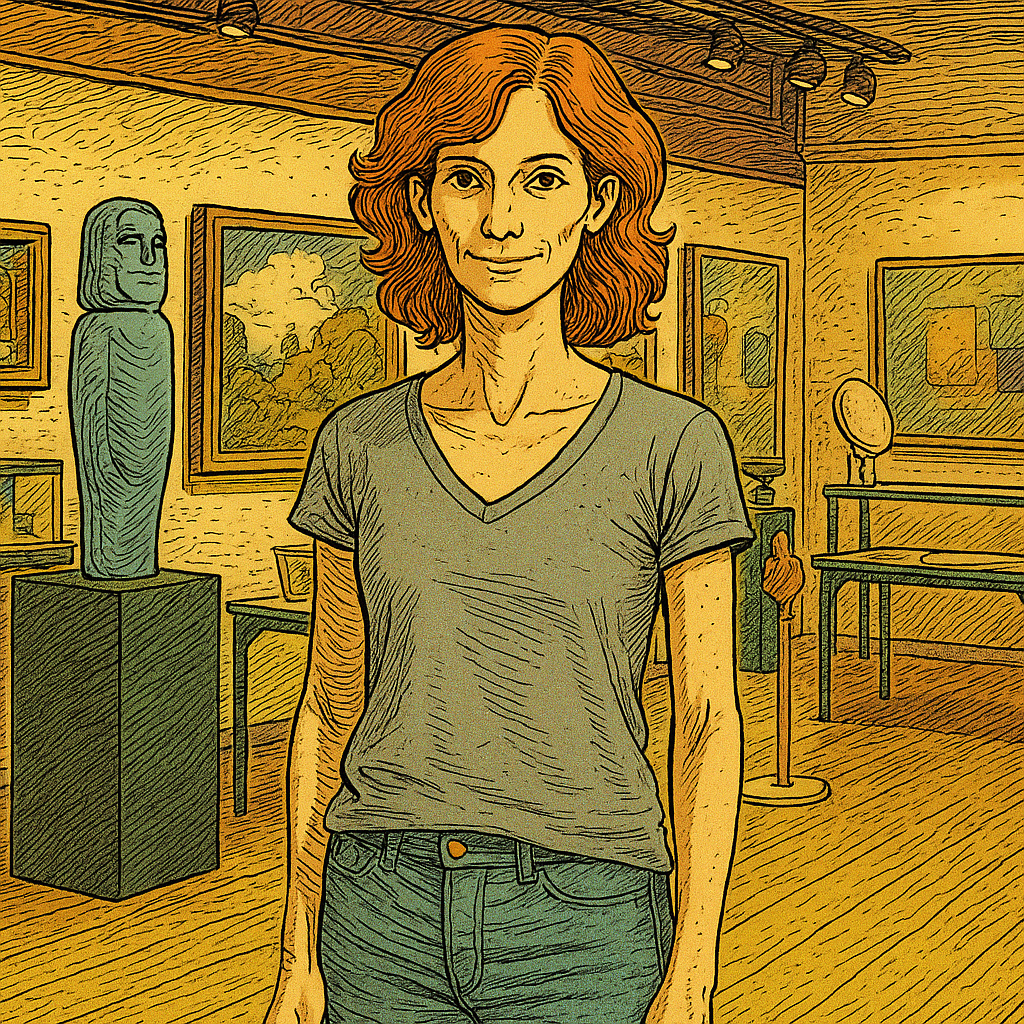
 I spent the morning adjusting the lights. Not replacing them—just angling the fixtures, nudging the tracks, shifting shadows by degrees. The kind of work that demands patience but offers no reward except the quiet certainty that a surface now reads the way it was meant to. The blue in the lower corner finally looked like a shadow instead of a stain. The red no longer glared. Every inch of change was invisible until it was everything.
The air conditioner hummed faintly overhead. Every few minutes it paused, as if remembering its own limits, then started again with a low mechanical sigh. I balanced a small stepladder against the front wall, reached up, and twisted one bulb a quarter turn. The light flared briefly, then softened. Better. I took three steps back, squinted, and saw the faint reflection of my own outline in the glass frame—blurred, almost ghostly.
Outside, a street musician tuned a guitar no one had asked him to play. Each note arrived uncertainly, testing itself against the mountain air. Tourists passed with coffee cups, glancing at their phones. The season had restarted.
On the counter, the radio murmured coverage from Washington. Another hearing, another committee, another attempt at truth that already sounded rehearsed. I listened without listening—just enough to recognize tone, not enough to follow content. The voices blended into the hum of the compressor and the faint rattle of the windowpane.
When I stepped back, the painting caught light differently. The red looked deeper, closer to rust than rose. I wrote a note to myself: leave this one as is. Perfection, if it exists, is mostly timing.
By midmorning, the gallery was full of light. Not bright, just even. I sat at the small table near the window and watched the first real warmth of May drift across the floorboards. The shadows moved like slow water. A man paused outside to read the hours painted on the door, nodded, and kept walking.
A customer came in around noon—a teacher from Albuquerque, on her way to Silverton. She said she used to paint, then stopped when her students started asking why. I told her that’s usually when you stop or start, depending on what kind of person you are. She laughed, but the sound didn’t last long. We talked about color—the kind that looks alive until you try to capture it. She bought a postcard of an old piece I’d done in Brighton and turned it over before paying. “You didn’t sign this,” she said. I told her I never signed postcards; too much finality for something meant to travel. She said she might mail it to herself, “so I’ll remember to look again.”
After she left, I stood by the doorway, half in the light, half in the shade. The gallery felt balanced again, not perfect but tolerable. The kind of equilibrium that never announces itself—it just settles in quietly and asks not to be disturbed. I turned the radio down to a whisper and checked the bulbs one more time. Nothing lasts at the right brightness for long.
The afternoon stretched thin. A gust of wind carried the smell of warm asphalt and pine dust from somewhere upriver. I thought of Munich, of the gallery where I once helped hang shows, its impossible windows that made every color look cold. I learned patience in that place, though I didn’t know it at the time. Here, the light behaves differently—more direct, less forgiving.
Outside, the mural’s colors looked different—sharper, but also tired. I wondered if the people passing by ever noticed how much the light changed between morning and late afternoon. Maybe they did once. Maybe they stopped looking.
By evening, I’d finished the adjustments. The air conditioner cycled once more before shutting off for good. The room held its cool for a while, as though reluctant to let go. I turned off the lights and waited for the silence that follows—half relief, half reminder. In the dim reflection on the window, I could see the mural across the street, washed in the same light I’d been chasing all day.
Sometimes calibration is just a word for acceptance. And sometimes it’s the only kind of progress you can see.