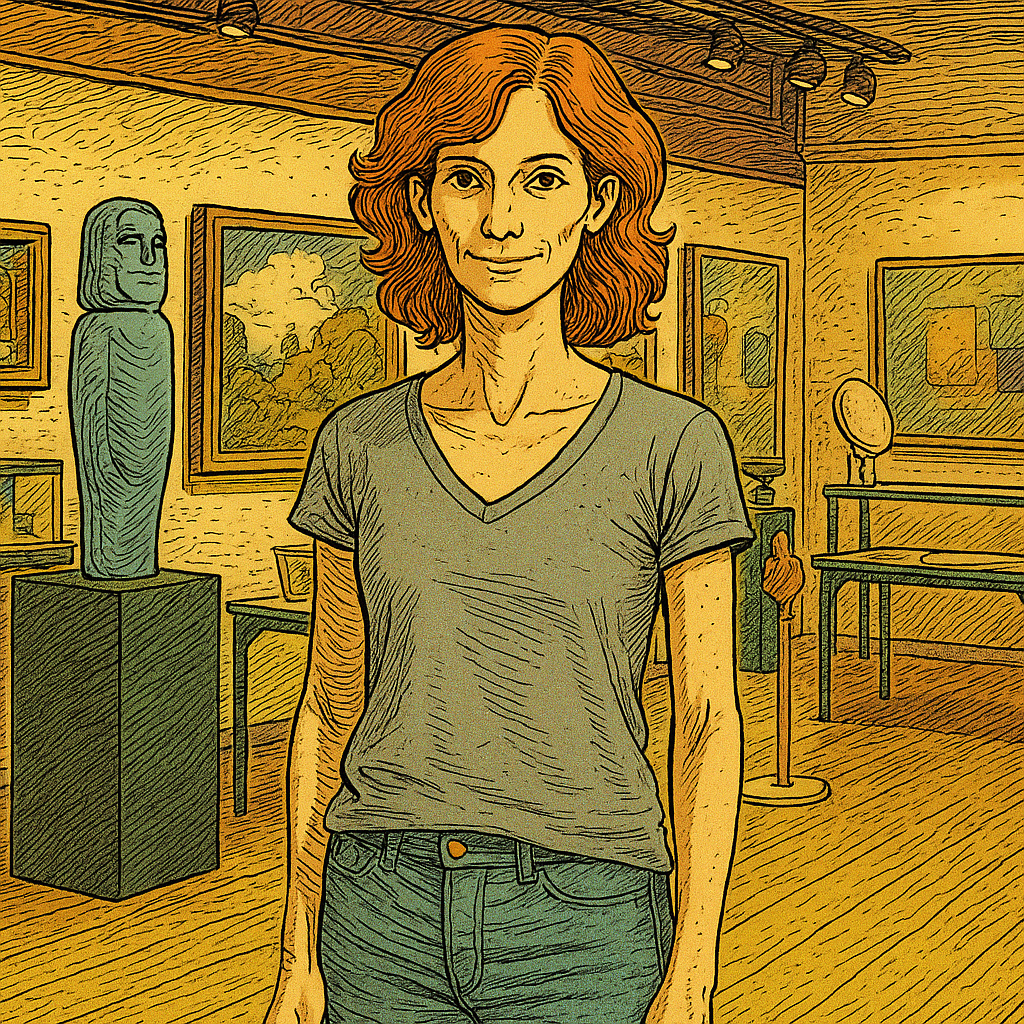
The river rose this week, slow but certain, the way a decision gathers itself before being announced. By midmorning the Animas had turned from winter’s glassy blue to the color of unpolished brass. Logs drifted in its middle current, each one taking its own argument with gravity. Tourists leaned over the railing near the bridge, phones extended, believing they were capturing the water when all they caught was its surface.
From the gallery window, I could see the shimmer between buildings—a flicker that looked almost like heat. Trucks moved past carrying lumber, soil, feed. The same motion repeats every spring: water down, goods up. I sometimes think the whole town operates on the rhythm of the melt, our schedules aligned to temperature more than to clocks.
Inside, the floorboards ticked softly with expansion. I’d opened the front door to the street, letting in air that smelled faintly of iron and thawed moss.
At the desk, invoices waited. Two orders from Santa Fe, one from Brighton, a customs query out of Hamburg. Each line of communication has its own current, measured not in speed but in tone. German correspondence arrives crisp and efficient, English polite to the point of vanishing, American messages informal and vaguely apologetic. None quite mean what they say, but the pattern is reassuring—like the river’s seasonal flood, it tells me the channels are still open.
The news came on at eleven: hearings about the economy, border closures, markets responding “nervously.” I muted the volume. The words had started to blur again, their meanings smoothed by overuse. “Flow,” “supply,” “movement”—they all belonged to the same dictionary, one that forgot its author.
Durango isn’t immune to that language. The coffee shop two blocks over now lists beans from three continents. Everyone wants to know where things come from, though fewer ask where they go. In the gallery, I watch that curiosity shift toward abstraction. Visitors linger at a landscape until they notice the brushwork, then the title, then their reflection in the glass. Attention itself becomes a current—visible only by what it moves.
After lunch, I closed the door, turned the sign to Back in 20, and walked toward the river. The water was louder now, its surface braided with smaller flows that resisted agreement. Cottonwood buds had opened overnight, their scent half-sweet, half-earth. A fisherman waded near the bend, line arcing, the reel’s click swallowed by distance. Farther downstream, a boy threw stones that barely touched the surface before disappearing. Each splash seemed to start another conversation.
I sat on the bench near the trail sign and let my phone rest face down. Messages could wait. Across the water, a hawk tilted its wings against the wind, recalculating constantly yet appearing effortless. Somewhere in that motion was a lesson about translation, one I hadn’t learned despite a lifetime of it.
In Munich, this time of year meant discipline—the runoff planned through sluices and channels, every edge predicted. Here, unpredictability is the method. The Animas doesn’t follow diagrams. It takes back what it lent to winter and gives no receipts. The engineers call that loss; I call it continuity.
By late afternoon, clouds had begun to stack above the ridgeline, their undersides bruised violet. A gust swept across the water, scattering foam and seedpods in opposite directions. Balance, I realized, isn’t stillness—it’s constant correction.
When I returned to the gallery, a draft had slipped one of the papers from the wall to the floor. It was a receipt from January, faded but legible. The total meant nothing now, but I couldn’t bring myself to throw it away. Every record is a conversation between what was expected and what occurred.
I pinned it back beside the photograph of the Animas in flood—a moment I’d tried to freeze last year and failed. The surface shimmered in the print, almost identical to the view outside. The same illusion: control mistaken for understanding.
As evening came, I switched off the lights one by one and listened. Somewhere under the whine of traffic and the steady rush of air vents, I could hear the river again—steady, self-interpreting, indifferent to the metaphors I kept assigning it.