 Introduction
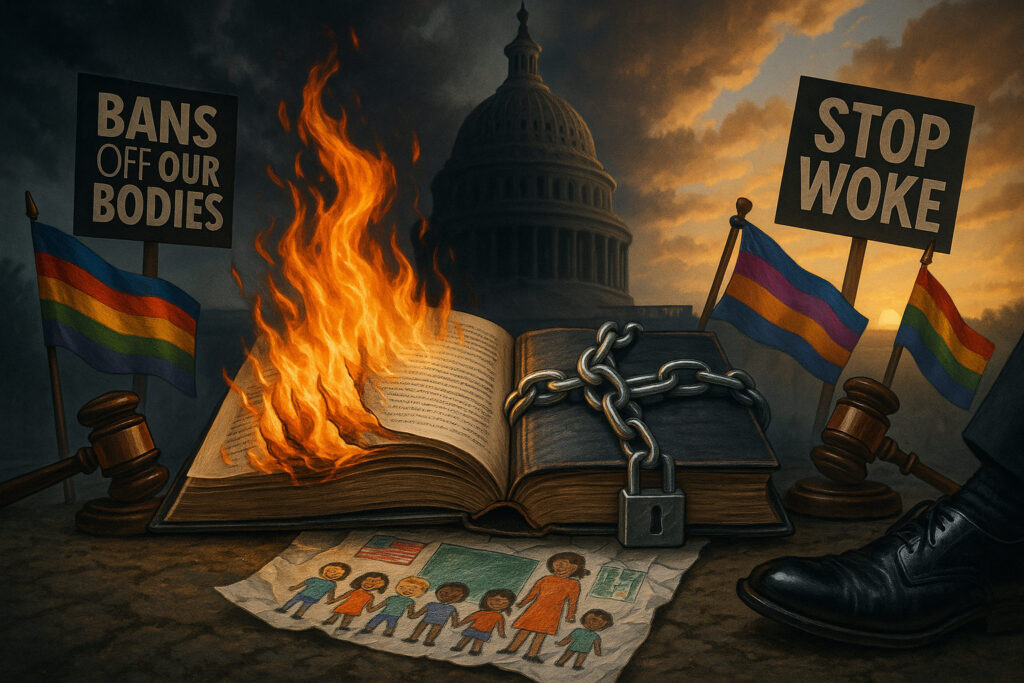
In 2025, the term “culture war” encapsulates a series of polarized conflicts over social, cultural, and moral issues in the United States, strategically amplified to shape political outcomes and public sentiment. These battles, rooted in competing visions of American identity, have evolved significantly over the past two decades, particularly since the 2017–2021 Trump presidency. Initially centered on specific wedge issues like abortion or same-sex marriage, culture wars have expanded into broader identity-based conflicts, encompassing race, gender, education, and religion. This escalation reflects a deliberate political strategy, where emotional manipulation and fear-based messaging are used to mobilize voters, distract from systemic issues, and consolidate power. The culture wars are not merely organic societal debates but are often orchestrated by political actors, media outlets, and think tanks to deepen divisions and influence electoral outcomes.
The Trump era has marked a turning point, with his rhetoric and policies amplifying cultural divides. From 2017 to 2021, issues like immigration and “political correctness” dominated discourse, while his 2025 return has intensified focus on transgender rights, education censorship, and religious nationalism. This report explores the historical context, major fronts, power structures, impacts, and resistance movements shaping the 2025 culture wars, offering a comprehensive analysis of their implications for American society.
Historical Context
America’s culture wars have deep roots, emerging from tensions over social change and moral values. The 1960s civil rights movement sparked significant backlash, with conservative groups opposing desegregation and racial equality, framing them as threats to traditional values. The Reagan era (1980s) saw the rise of the Moral Majority, which weaponized issues like abortion and family values to galvanize evangelical voters. Post-9/11 polarization intensified debates over national identity, with Islamophobia and immigration becoming flashpoints. These episodes laid the groundwork for today’s conflicts, where cultural issues are strategically used to divide.
Political strategists have long exploited cultural divisions to win elections. In the 1990s and 2000s, wedge issues like abortion and same-sex marriage drove “values-based” voting, particularly among conservative Christians. By the 2010s, these issues expanded to include broader identity-based conflicts, such as race, gender, and free speech. The Trump presidency accelerated this shift, with campaigns leveraging fear of “wokeness” and cultural change to mobilize voters. Data from Pew Research shows that by 2020, 80% of Americans viewed the country as more divided than united, a trend that has persisted into 2025 (Pew Research).
The evolution from specific issues to identity-based conflicts reflects a broader strategy of polarization. Political actors use media and legislation to frame cultural issues as existential threats, ensuring emotional resonance with voters. This approach has transformed culture wars into a central political strategy, shaping policy and discourse in 2025.
Main Culture War Fronts in 2025
The culture wars in 2025 are fought across several key battlegrounds, each marked by intense debate, legislation, and public campaigns. Below is a detailed analysis of these fronts, supported by evidence and examples.
LGBTQ+ Rights and Trans Panic
The rights of LGBTQ+ individuals, particularly transgender people, remain a central flashpoint. In 2025, state legislatures have introduced over 500 anti-LGBTQ+ bills, with a focus on transgender youth. These include bans on transgender athletes in sports, restrictions on gender-affirming care, and “bathroom bills” mandating restroom use based on birth certificates. For example, Florida’s HB 1521 (2023) expanded restrictions on gender-affirming care, a trend continuing into 2025 with similar laws in Texas and Ohio. The Trevor Project reports a 50% increase in mental health crises among transgender youth since 2022, linking these to legislative attacks (Trevor Project).
Right-wing media outlets, such as Fox News and The Daily Wire, amplify narratives of “trans panic,” framing transgender rights as threats to fairness or safety. These campaigns often misrepresent data, ignoring studies showing gender-affirming care improves mental health outcomes. The Human Rights Campaign notes that 70% of Americans support nondiscrimination protections for LGBTQ+ individuals, yet polarized rhetoric overshadows this consensus (Human Rights Campaign).
Education and Censorship
Education has become a battleground, with conservative campaigns targeting “woke” curricula and diversity initiatives. Book bans have surged, with the American Library Association reporting over 4,000 titles challenged in 2024, including works on race, gender, and history (American Library Association). Florida’s HB 999 (2023) restricts diversity, equity, and inclusion (DEI) programs in higher education, while Texas’s SB 17 bans DEI offices in public universities. These laws frame critical race theory (CRT) and gender studies as indoctrination, despite CRT being a graduate-level framework rarely taught in K-12 schools.
Parental rights groups, such as Moms for Liberty, drive these efforts, advocating for “anti-woke” curricula and teacher oversight. Critics argue these measures censor educators and limit students’ access to diverse perspectives, with 60% of teachers reporting self-censorship due to fear of backlash, according to a 2024 National Education Association survey.
Race and History
Debates over race and history focus on dismantling DEI programs and revising historical narratives. States like Florida and Texas have passed laws restricting how race and slavery are taught, claiming such lessons promote division. For instance, Florida’s “Stop WOKE Act” (2022) limits discussions of systemic racism, while Texas’s HB 3979 restricts teaching that might cause “discomfort” about historical events. These laws have led to the removal of texts like Toni Morrison’s Beloved from curricula.
Historical revisionism also manifests in efforts to downplay slavery’s role in American history. The 1776 Project, backed by conservative think tanks, promotes curricula emphasizing patriotism over critical perspectives. Critics argue this distorts history, while supporters claim it restores national pride. Data from the Southern Poverty Law Center shows a 30% rise in white nationalist rhetoric in educational debates since 2022.
Reproductive Rights
The 2022 Dobbs decision, overturning Roe v. Wade, has fueled ongoing battles over reproductive rights. In 2025, states like Texas and Alabama have introduced bills targeting contraception access and increasing surveillance of pregnancy outcomes. For example, Texas’s SB 8 (2021) incentivizes private citizens to sue abortion providers, a model expanded in 2025 to monitor miscarriage data. These measures raise privacy concerns, with 65% of Americans opposing abortion bans, per a 2024 Gallup poll.
Conservative groups frame these laws as protecting life, while critics argue they infringe on bodily autonomy. The Guttmacher Institute reports that 14 states have near-total abortion bans in 2025, disproportionately affecting low-income and minority women (Guttmacher Institute).
Religious Nationalism
The rise of Christian dominionism, advocating for governance based on Christian principles, is a growing force. Project 2025, a Heritage Foundation initiative, outlines policies to integrate religious values into public institutions, including education and healthcare. This includes promoting school prayer and defunding programs conflicting with conservative Christian values. Public statements from leaders like House Speaker Mike Johnson emphasize “biblical values” in governance.
Critics warn this erodes the separation of church and state, with 55% of Americans opposing religious-based laws, according to Pew Research. Supporters argue it restores moral foundations, highlighting the polarized nature of this debate.
Media, Art, and Entertainment
The culture wars extend to media and entertainment, with right-wing boycotts targeting “woke” content. Companies like Disney face backlash for inclusive storytelling, while “anti-ESG” campaigns pressure firms to abandon environmental, social, and governance initiatives. The Daily Wire has invested in alternative media, producing films and shows to counter progressive narratives. These efforts reshape cultural narratives, with 40% of Americans reporting they avoid certain brands due to political stances, per a 2024 Edelman Trust Barometer.
Political and Institutional Power Structures
The escalation of culture wars is driven by a network of right-wing groups, politicians, and funders. Media outlets like Fox News, One America News Network, and The Daily Wire amplify divisive narratives, reaching millions daily. Think tanks, such as the Heritage Foundation and Manhattan Institute, provide intellectual backing, drafting model legislation like Project 2025. Political leaders, including Donald Trump, Ron DeSantis, and Kristi Noem, champion culture war issues to rally their base. For example, DeSantis’s “Don’t Say Gay” law (2022) gained national attention, inspiring similar bills elsewhere.
Religious and parent-led groups, like Moms for Liberty and Family Research Council, mobilize grassroots support, often funded by wealthy donors. The Council for National Policy, a secretive conservative network, coordinates these efforts, per a 2023 Center for Media and Democracy report. State legislatures play a key role, passing 1,200 culture war-related bills since 2021, according to the ACLU. Supreme Court decisions, such as Dobbs and rulings on religious freedom, further empower these efforts, reshaping legal norms.
The following table summarizes key players and their roles:
| Entity | Role | Example |
|---|---|---|
| Fox News | Amplifies divisive narratives | Coverage of “trans panic” in sports |
| Heritage Foundation | Drafts model legislation | Project 2025 policy agenda |
| Ron DeSantis | Promotes culture war laws | “Don’t Say Gay” bill |
| Moms for Liberty | Grassroots mobilization | Book ban campaigns |
| Supreme Court | Shapes legal framework | Dobbs v. Jackson (2022) |
Impacts on Communities and Democracy
The culture wars have profound effects on communities and democratic norms. Public health is impacted, particularly for transgender youth, with the Trevor Project reporting a 20% increase in suicide attempts linked to anti-trans laws. Access to reproductive healthcare has declined, with 1 in 3 women in restrictive states lacking abortion access, per the Guttmacher Institute. Education systems face challenges, with 30% of librarians reporting harassment over book selections, according to the American Library Association.
Democratic norms are eroding, as polarized rhetoric undermines civic trust. A 2024 Pew Research survey found 60% of Americans distrust public institutions due to cultural conflicts. Minoritized communities, including Black and Brown students, immigrants, and teachers, face disproportionate harm, with DEI bans limiting opportunities and fostering hostile environments. For example, a 2025 Texas teacher testified to the ACLU about quitting due to curriculum restrictions.
The chilling effect on free speech is notable, with educators and artists self-censoring to avoid backlash. However, some argue these conflicts reflect democratic engagement, as communities debate values openly. The balance between debate and harm remains contentious.
Resistance Movements and Counter-Narratives
Resistance to the culture wars is growing, driven by grassroots and institutional efforts. Community defense networks, such as mutual aid groups, provide support for marginalized communities, including healthcare access for transgender individuals. Library and teacher alliances, backed by the National Education Association, advocate for intellectual freedom, with 200 libraries forming coalitions in 2024. Student walkouts, like those in Florida protesting HB 999, highlight youth activism, with 10,000 students participating in 2023–2024.
Legal battles are a key front, with the ACLU filing over 50 lawsuits against culture war-related laws since 2022. For example, a 2025 federal court ruling struck down parts of Texas’s DEI ban as unconstitutional. Media and artistic resistance, including documentaries and inclusive storytelling, counter right-wing narratives, though these efforts often lack the funding of their opponents. An X post from a teacher in 2025 stated, “We’re fighting for our students’ right to learn the truth, but it’s exhausting against so much money and power” (X post).
Conclusion
The 2025 culture wars reveal a deeply divided American identity, where competing visions of morality, history, and rights clash in public and private spheres. These conflicts, driven by strategic political actors, erode democratic norms, harm marginalized communities, and reshape cultural narratives. The coordinated nature of these battles—funded by think tanks, amplified by media, and enacted through legislation—suggests a deliberate effort to consolidate power through division. Yet, resistance movements offer hope, demonstrating resilience among communities, educators, and advocates.
Looking ahead, the culture wars may intensify as technology amplifies polarized voices, but resistance could grow with broader coalitions. Warning signs include further erosion of civic trust and increased authoritarianism, while hopes lie in youth activism and legal victories. The next 5–10 years will likely hinge on whether dialogue can bridge divides or if polarization entrenches further, reshaping the fabric of American democracy.
Individual Opinions from Collective Members:
- V.S.—This ain’t a war on culture. It’s a war on truth—dressed up in small-town sermons and cable news rage. They’re feeding working people fear instead of fixing what’s broken. Culture war? No. This is class war in drag.
- W.S.—This whole damn thing reads like a hit list. They want the weird kids quiet, the queer kids invisible, the Black kids erased. But we’re still here. Still making noise. And we won’t go quietly because they’re uncomfortable.
- C.H. —They’re trying to pave over everything that doesn’t fit their narrative—history, language, care. But roots run deeper than politics. I see their bans and backlash, and I plant something older in its place.
- E.T.—This isn’t about culture—it’s about capital. Manufactured panic keeps people divided, distracted, and buying. Look who profits. Look who funds it. Culture is just the bait. Power is the prize.
- F.G.—I don’t like the word “war” tossed around, but if this ain’t one, I don’t know what is. They’re not just coming for books. They’re coming for memory. And if we don’t fight for what’s true, they’ll replace it with what’s easy.
- E.C.—This is curriculum collapse with a smile. They’re engineering ignorance—intentionally, surgically. The targets are precise, and the consequences are generational. We owe it to students to disrupt that design.
- M.D.—It’s the same erasure we’ve always faced, just scaled up. They fear what they cannot define. But you can’t outlaw breath, or memory, or the look we give each other when we know they’re lying.
- M.T.W—The report is a blueprint of authoritarian creep. Not the firebrand kind, the paperwork kind—legal, procedural, and fully dressed in patriot drag. This isn’t a culture war. It’s a slow-motion coup with a Sunday school soundtrack.
- L.H.—If I drew this, it’d be a library turned prison, a classroom where truth is frisked at the door. Funny how the ones yelling about freedom are the first to chain it to the floor.
- S.M.—The saddest part is how many people think they’re protecting something. But it’s not safety they’re building—it’s fear. And fear doesn’t grow anything. It just burns.
- Mrs. S.M.—What I see is a controlled demolition of public trust. They’re not trying to win an argument—they’re trying to silence the room. That’s not policy. That’s control.
- M.T.—They’re rewriting history while people are still alive to remember it. That’s not just dishonest—it’s dangerous. If we want a future, we can’t let them amputate the past.
- J.M.—As a librarian, I’ve watched books vanish not from disinterest, but from intimidation. This isn’t community-driven—it’s a purge. What scares them isn’t content. It’s comprehension.
- L.W.—It’s all data, really. Coordinated legislative pushes, weaponized parent groups, disinformation flows. This is not chaotic. It’s orchestrated. And the goal isn’t morality. It’s monopoly—on truth, on law, on the future.
- M.W.—This is tactical. From the curriculum bans to the book challenges to the DEI purges—it’s all by design. They’re not responding to communities. They’re manufacturing crisis, then using it to consolidate rule.
- S.W.—This whole mess stinks of surveillance wrapped in scripture. Every policy is a checkpoint. Every law a boundary. It’s about shrinking the map of what’s allowed until only one kind of person gets to breathe easy.
- D.R.—This reads like a heat map of collapse. Institutions are being hollowed out by ideologues with funding. And while they scream about tradition, they’re gutting the things that actually held communities together.
- Q.M.—The report confirms what the raw data has shown for three years: cultural crisis is being manufactured, then institutionalized. This isn’t organic polarization—it’s a strategy. And the archive is already thick with receipts.Q
- L.H.—We are watching an identity forged in exclusion try to preserve itself through policy. They’re not defending culture. They’re defining who’s allowed to have one. And if we allow that, we forfeit the promise of democracy itself.
- E.C.—This is déjà vu with better PR. Every era of American backlash—against abolition, against suffrage, against civil rights—followed a similar playbook. We should be alarmed, yes. But not surprised. This is what power does when it fears loss.