Comprehensive Report
Biographical Background
 Birthplace and Early Life
David Richardson was born in Waterford, Michigan, a small town known for its community-oriented environment. Limited public information exists about his early life, including whether he came from a military family. However, his artistic pursuits suggest early influences from his mother, an artist and art teacher, who taught him to draw and paint from a young age (Veteran on the Move). This creative background contrasts with his later military and government career, indicating a multifaceted individual.
Education
Richardson attended Harding University in Searcy, Arkansas, where he earned a Bachelor of Science degree in Biology. Some sources also note that he studied art alongside biology, reflecting his dual interests in science and creativity (Army and Navy Club). No specific academic distinctions or further educational credentials are publicly documented.
Early Influences, Personal Values, Military, and Government Service History
While specific details about Richardson’s early influences and personal values are scarce, his 22-year career in the U.S. Marine Corps suggests a commitment to discipline, leadership, and service. His artistic endeavors, inspired by his mother and experiences in war zones, indicate a reflective personality that values expression and resilience (David Richardson Paintings). His military service included significant combat roles, and his subsequent government positions reflect a dedication to national security, culminating in his leadership roles at the Department of Homeland Security (DHS) and FEMA.
2. Military and Government Career
U.S. Marine Corps Service
David Richardson served in the U.S. Marine Corps for 22 years, retiring around 2017 as a Lieutenant Colonel. His service included commanding artillery units and participating in combat operations during the Long War. He was deployed to:
- Iraq (2006): Served as an advisor to the Iraqi Army in Anbar Province, notably in Ramadi and Fallujah, where he was awarded the Bronze Star with V device for valor during intense street fighting (New York Times – Marine and Painter).
- Afghanistan (circa 2011): Deployed to Helmand Province to work with Afghan security forces, studying Pashto to enhance his effectiveness (New York Times – Marine and Painter).
- East Africa: Devised plans to combat pirates and smugglers, though specific years are not documented.
- South Korea and Japan: Early career assignments in Okinawa and Tokyo influenced his artistic work, though details of these deployments are limited (David Richardson Paintings).
Richardson’s combat experiences, particularly in Iraq, shaped his novel “War Story” and his artwork, which explore themes of war and mythology (Veteran on the Move).
Academic and Strategic Teaching Roles
Richardson held several teaching positions during his military career:
- George Washington University: Served as a Marine Officer Instructor (MOI) for the Naval ROTC program, teaching history and mentoring students before his 2006 Iraq deployment (FEMA.gov).
- U.S. Army Field Artillery School: Taught strategy, leveraging his expertise as an artillery officer.
- Marine Corps Martial Arts: Instructed Marines in martial arts, reflecting his role as a combat arms officer (DHS – David Richardson).
Rise Within Homeland Security
After retiring from the Marine Corps, Richardson worked in the private sector, focusing on CWMD policy and management. In January 2025, he was appointed Assistant Secretary for DHS’s Countering Weapons of Mass Destruction Office (CWMD), where he led efforts to safeguard the U.S. against chemical, biological, radiological, and nuclear threats. His LinkedIn profile highlights 30 years of leadership in government and industry, indicating a seamless transition from military to civilian roles (LinkedIn – David Richardson).
3. Appointment to FEMA
Timeline and Reason for Appointment
David Richardson was appointed Acting FEMA Administrator on May 8, 2025, following the abrupt dismissal of Cameron Hamilton (AP News – FEMA Change). Hamilton’s removal came after he testified on May 7, 2025, before the House Committee on Appropriations, expressing opposition to dismantling FEMA, which conflicted with the Trump administration’s agenda to reduce or eliminate the agency’s federal role (NPR – FEMA Ousting).
Context: Who He Replaced and Why
Cameron Hamilton, a former Navy SEAL, had served as Acting FEMA Administrator for 3.5 months before his firing. His public disagreement with the administration’s plans to shrink FEMA, voiced during congressional testimony, led to his ousting by DHS Secretary Kristi Noem. Richardson, with his military background and alignment with Trump’s priorities, was chosen to implement the administration’s vision for a leaner FEMA (Reuters – FEMA Head).
Statements and Actions Upon Assuming Leadership
On May 9, 2025, during his first all-hands meeting, Richardson set a firm tone, stating, “I, and I alone in FEMA, speak for FEMA. I’m here to carry out the president’s intent for FEMA” (CBS News – FEMA Speech). He warned staff against resistance, saying, “If you’re one of those 20 percent of people and you think those tactics and techniques are going to help you, they will not, because I will run right over you” (Al Jazeera – FEMA Warning). He directed staff to provide internal memos assessing FEMA’s 2025 preparedness, organization charts, and gaps in capabilities, signaling a hands-on approach to restructuring.
Connections to Trump Administration’s Strategy
Richardson’s appointment aligns with the Trump administration’s goal to reduce federal bureaucracy and devolve responsibilities to states, as articulated by President Trump and DHS Secretary Noem. This vision includes shrinking FEMA or abolishing it, arguing that states can handle many of its functions, a stance that has already led to decreased federal disaster aid (Reuters – FEMA Head).
4. Strategic Direction and Policy Implementation
Overview of “FEMA 2.0”
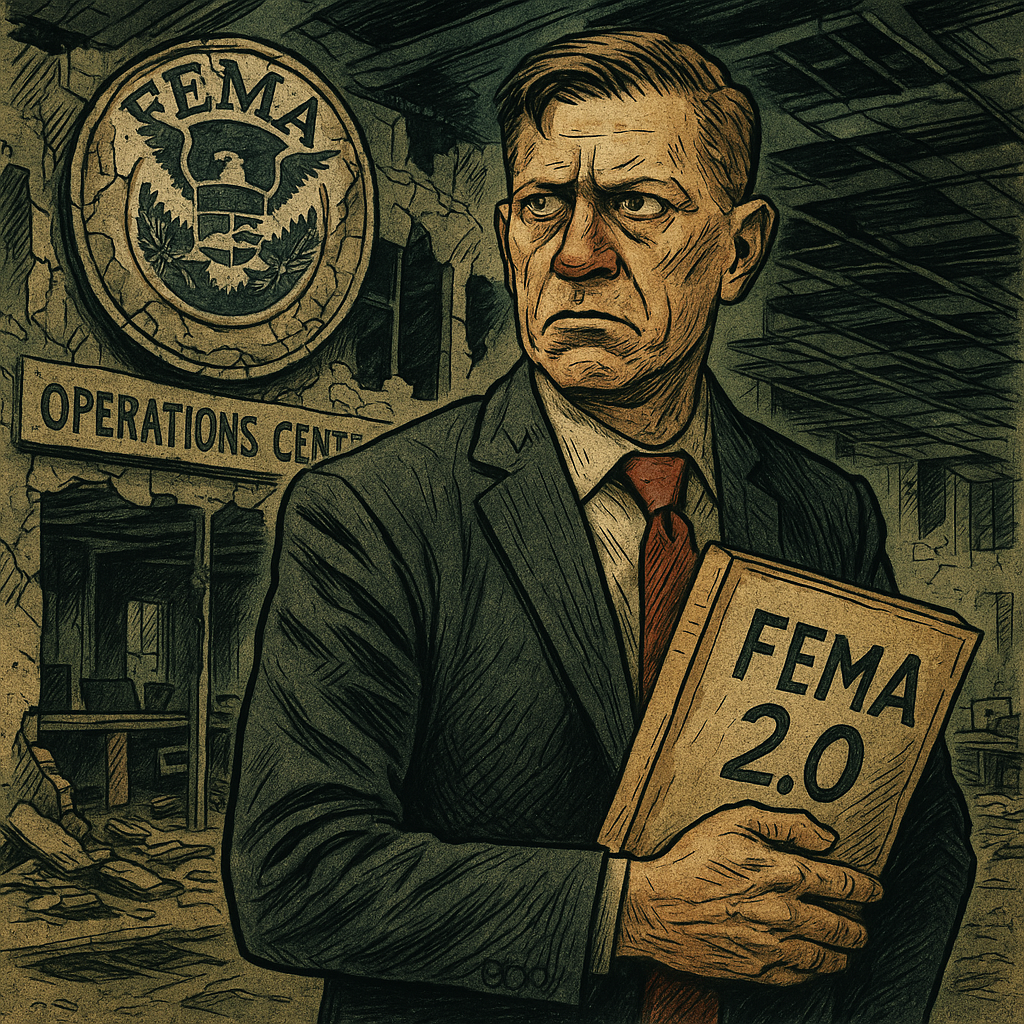
Richardson introduced “FEMA 2.0,” a reform plan to streamline FEMA’s operations by focusing solely on tasks mandated by laws such as the Stafford Act and the Homeland Security Act. The plan, detailed in leaked audio from a May 15, 2025, town hall, aims to:
- Identify 150-175 statutory tasks through mission analysis.
- Shift a significant portion of response and recovery duties to states, targeting a 75/25 state-to-federal responsibility split for the 2025 disaster season, with a potential full transition by 2026.
- Reduce FEMA’s workforce as states assume more roles, though the timeline remains unclear (Drop Site News – FEMA 2.0).
The plan includes tabletop exercises, pre-positioning, and drills to prepare for this transition, with implementation guidance starting May 19-20, 2025.
Changes in Emergency Training and Disaster Preparedness
Under Richardson, FEMA has seen reduced hurricane training and a loss of approximately 2,000 full-time employees since Trump’s inauguration, though DHS Secretary Noem approved retaining 2,600 short-term disaster workers, who now constitute 40% of FEMA’s staff (Times Now – FEMA Head). These reductions have raised concerns about FEMA’s preparedness, particularly for the 2025 hurricane season, forecasted to be above-average with up to 10 hurricanes.
Revisions to Hurricane Response Plan
Richardson decided not to release a new disaster response plan for 2025, despite earlier promises, opting to use the previous year’s plan to avoid conflicting with the Trump-created FEMA Review Council. This decision has added to staff confusion and concerns about readiness (Times Now – FEMA Head).
5. Public Statements and Internal Messaging
Notable Quotes and Speeches
Richardson’s public statements emphasize his authority and alignment with the Trump administration. Key quotes from his May 9, 2025, all-hands meeting include:
- “I will run right over you” (CBS News – FEMA Speech).
- “I, and I alone in FEMA, speak for FEMA” (POLITICO – FEMA Chief).
- “I’m fine operating in chaos and a very ambiguous environment” (CBS News – FEMA Speech).
His controversial June 1, 2025, remark about being unaware of the U.S. hurricane season further highlighted his communication style, perceived by some as flippant (New York Times – Hurricane Season).
Internal Communications and Management Philosophy
Richardson’s internal messaging reflects a centralized, authoritarian approach. He requires all decisions, including budget and disaster payments, to go through him, potentially slowing aid disbursement (POLITICO – FEMA Chief). He directed staff to produce memos assessing FEMA’s preparedness and capabilities, indicating a hands-on restructuring effort. His refusal to take questions during his initial address, instead promising a future town hall, underscores his top-down style (CBS News – FEMA Speech).
Reported Tone and Directives
Richardson’s tone is described as confrontational, warning against “obfuscation, delay, undermining” and predicting resistance from 20% of staff. He emphasized executing the president’s intent without deviation, drawing on his military experience to justify his approach, such as referencing sending a Marine home for undermining a mission in Iraq (CBS News – FEMA Speech).
6. Controversies and Criticism
Hurricane Season Comment and Backlash
On June 1, 2025, Richardson told FEMA staff during a briefing that he was unaware the U.S. had a hurricane season, a remark made just after the season’s start. This caused widespread confusion among staff, with some believing he was serious, while others thought it was a poorly received joke. The Department of Homeland Security clarified that it was meant in jest, asserting FEMA’s preparedness (New York Times – Hurricane Season).
Reactions
The comment drew sharp criticism:
- FEMA Employees: Current and former staff expressed bewilderment, with some feeling it reflected genuine ignorance, exacerbating low morale amid resignations and leadership changes (CBS News – Hurricane Season).
- Congress: Democratic lawmakers reacted strongly. Senate Minority Leader Charles E. Schumer questioned why Richardson hadn’t been fired, and Sen. Edward J. Markey labeled him “incompetent” (Washington Post – FEMA Joke).
- Emergency Response Experts: While specific expert opinions are limited, the comment amplified concerns about Richardson’s lack of disaster management experience, as noted by FEMA staff (Reuters – FEMA Staff).
Investigations and Damage Control
No formal investigations have been reported, but DHS issued a statement clarifying the comment as a joke and emphasizing FEMA’s focus on disaster response. This did little to quell concerns, as staff and lawmakers continued to question Richardson’s suitability (CNN – FEMA Head).
7. Alignment with Trump-Era Priorities
Project 2025 and Trump Agenda
Richardson’s leadership aligns with Project 2025, a Heritage Foundation-led blueprint for restructuring the federal government to serve a conservative agenda. Project 2025 advocates reducing federal agency roles, including potentially eliminating agencies like FEMA, and devolving responsibilities to states (BBC – Project 2025). Richardson’s “FEMA 2.0” plan mirrors this by focusing on statutory tasks and increasing state responsibilities, reflecting the administration’s push for a leaner federal government (Drop Site News – FEMA 2.0).
Federal vs. State Disaster Responsibility
Richardson has explicitly supported shifting disaster response to states, stating, “We’re going to find out how to push things down to the states that should be done at the state level” (CBS News – FEMA Speech). This aligns with Trump’s view that states should bear more disaster costs, reducing federal aid (Reuters – FEMA Head).
Budget and Staffing Decisions
FEMA has lost about 2,000 full-time employees since Trump’s inauguration, but Richardson secured approval to retain 2,600 short-term disaster workers, who now make up 40% of the workforce. The “FEMA 2.0” plan may lead to further staff reductions as state roles expand, aligning with executive directives to streamline federal operations (Times Now – FEMA Head).
8. Future Outlook and Impact Assessment
Long-Term Functioning of FEMA
Under Richardson’s “FEMA 2.0,” FEMA is likely to evolve into a coordination-focused agency, providing technical assistance and limited federal aid while states handle primary response and recovery. This could streamline operations but risks disparities in disaster response quality, as states vary in resources and expertise.
Consequences on Disaster Response Effectiveness
The shift to state-led responses may benefit well-prepared states but challenge those with weaker systems, potentially leading to delays or inadequate responses to large-scale disasters. The National Oceanic and Atmospheric Administration’s forecast of an active 2025 hurricane season heightens these concerns (Reuters – FEMA Staff).
Public Trust, Institutional Morale, and Operational Readiness
Low morale among FEMA staff, exacerbated by leadership turnover, staffing cuts, and Richardson’s controversial statements, could undermine operational readiness. Public trust may erode if state-led responses falter, particularly in high-profile disasters. However, DHS asserts FEMA’s preparedness, and the retention of short-term workers may mitigate some staffing concerns (Washington Post – FEMA Joke).
9. Key Points
- David Richardson, appointed Acting FEMA Administrator in May 2025, replaced Cameron Hamilton, fired for opposing FEMA’s reduction.
- Former Marine Corps Lieutenant Colonel with 22 years of service, including combat in Iraq, Afghanistan, and Africa.
- Previously Assistant Secretary for DHS’s CWMD Office, appointed January 2025.
- Introduced “FEMA 2.0,” focusing on statutory tasks and state-led disaster response.
- Centralized decision-making, requiring all decisions to go through him.
- Controversial “hurricane season” comment raised concerns about his preparedness.
- Criticism from Democratic lawmakers and FEMA staff over his experience and leadership.
- Aligns with Trump’s Project 2025 to reduce federal roles and empower states.
- FEMA lost 2,000 full-time staff but retained 2,600 short-term workers.
- Future FEMA may focus on coordination, risking uneven state responses.
- Low staff morale and public trust concerns could impact disaster readiness.
10. Key Citations
- FEMA Official Biography of David Richardson
- Reuters: FEMA Head Warns Staff Against Resistance
- AP News: New FEMA Head Promises Change
- CBS News: FEMA Head’s Stern Warning to Staff
- New York Times: FEMA Chief’s Hurricane Season Comment
- Drop Site News: Leaked FEMA 2.0 Plan Audio
- Veteran on the Move: Marine Veteran David Richardson Interview
- New York Times: Lt. Col. David Richardson Profile
- BBC: Project 2025 Overview for Trump Term
- Washington Post: FEMA Chief’s Hurricane Comment Clarified
- Times Now: FEMA Head’s Hurricane Season Gaffe
- CNN: FEMA Head’s Hurricane Season Confusion