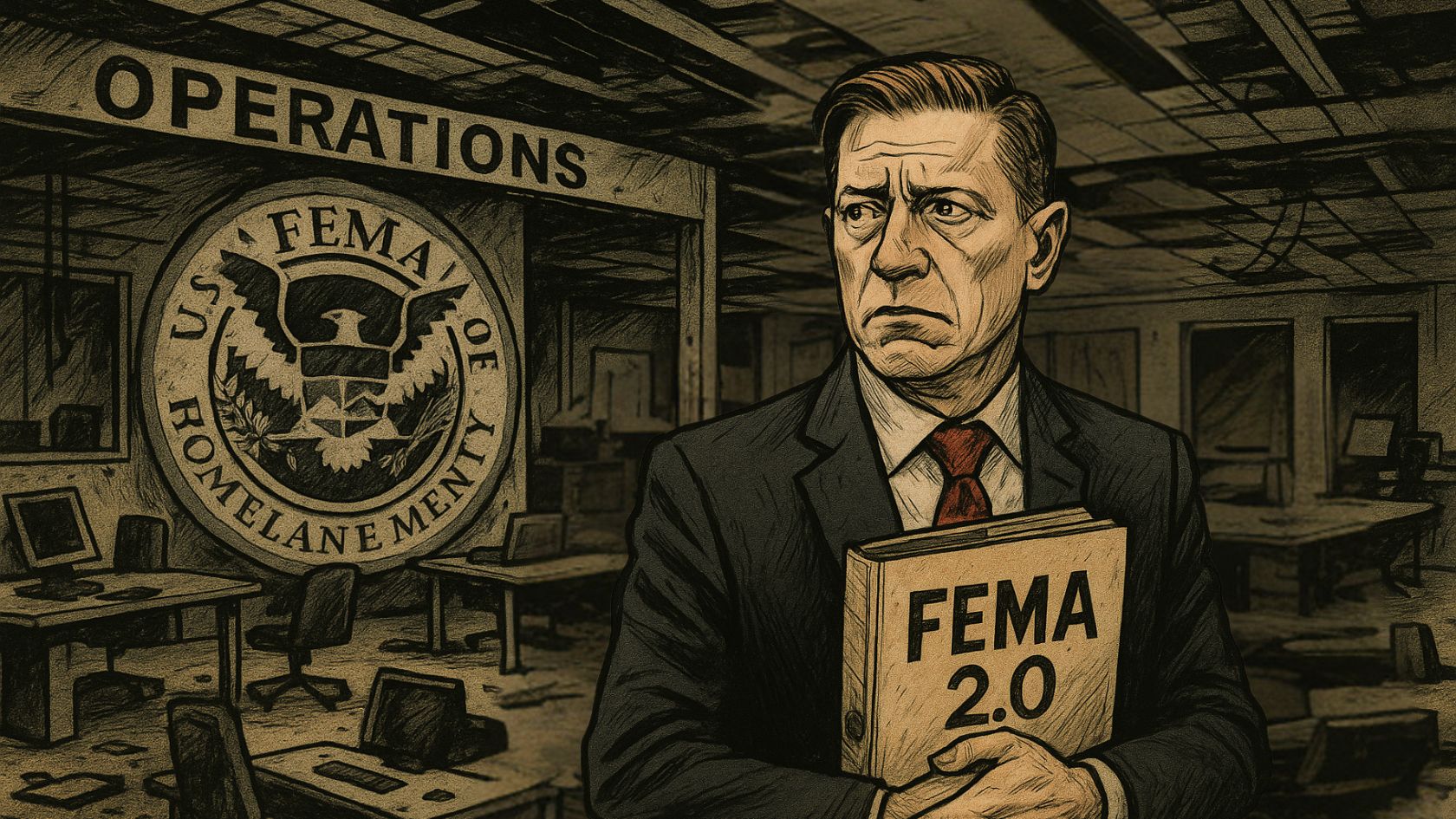
 When the history of this era is written—assuming we survive it—David Richardson will not be remembered for his competence. He will be remembered, if at all, as the man who took the helm of FEMA and immediately began sawing holes in the lifeboats.
A former Marine with the charisma of a fire drill and the subtlety of a sledgehammer, Richardson was installed as Acting FEMA Administrator not to manage disasters, but to embody one. He replaced Cameron Hamilton—who made the fatal error of resisting the Trump administration’s desire to eliminate FEMA entirely. One can almost imagine the job posting: “Seeking loyalist with combat credentials and contempt for institutional memory. Must work well under authoritarianism.”
Richardson wasted no time. He centralized all authority, informing staff that he alone speaks for FEMA. This, presumably, was meant to reassure. Instead, it echoed like the overture to a constitutional breakdown—because in Richardson’s FEMA, hierarchy replaces expertise, and fear replaces coordination.
He scrapped FEMA’s updated hurricane-response plan, reverting to last year’s version. He slashed emergency training programs. And when questioned about hurricane season, he quipped that he didn’t even know the U.S. had one.
The nation, it seems, is to be protected by a man who thinks June in the Gulf is a casual affair.
This is not negligence. It is the logical endpoint of governing as theater, where the plotline is always the same: gut the agency, blame the states, and declare victory atop the rubble.
Richardson doesn’t need to prepare for climate disasters because, in this administration, disasters are not to be mitigated—they are to be managed politically. Disasters are leverage. And FEMA, once tasked with preparedness and response, now resembles a stage prop in a slow-rolling coup.
In his short tenure, Richardson has accomplished precisely what he was sent to do: undermine federal response, demoralize professional staff, and broadcast loyalty to a president who views institutions as personal liabilities.
The floodwaters are rising. The levees are crumbling. And FEMA, under its new commander, is whistling into the wind—led by a man who doesn’t believe in storms unless they’re useful.