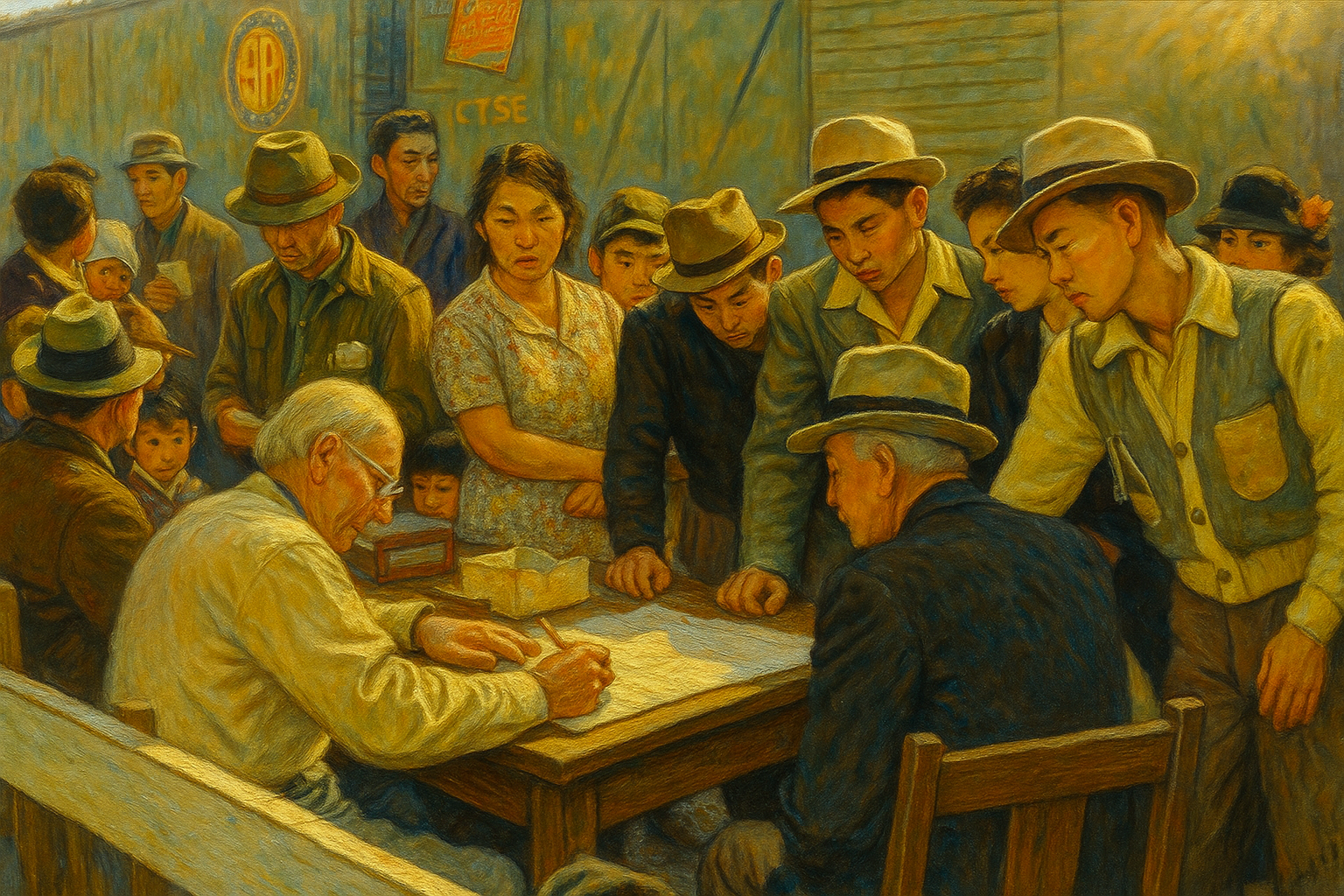
Japanese registering at the Santa Anita reception center, Los Angeles County, California. April 1942
Introduction
The forced evacuation and internment of approximately 120,000 Japanese-Americans during World War II represents a significant and troubling chapter in American history. Initiated by Executive Order 9066, signed by President Franklin D. Roosevelt on February 19, 1942, this policy led to the relocation of Japanese-Americans, primarily from the West Coast, to internment camps in remote areas. About two-thirds of those affected were U.S. citizens, born and raised in the United States. The internment, which lasted from 1942 to 1945, was driven by a combination of racial prejudice, wartime hysteria, and political pressures following the Japanese attack on Pearl Harbor on December 7, 1941. This report provides a detailed examination of the origins, implementation, controversies, and long-term impacts of this policy, emphasizing its significance as a cautionary tale about the fragility of civil liberties during times of crisis.
Background and Origins
The internment of Japanese-Americans was rooted in a long history of anti-Asian sentiment in the United States. The “Yellow Peril” fear, which portrayed Asian immigrants as a threat to Western society, had led to discriminatory policies such as the Chinese Exclusion Act of 1882 and restrictions on Japanese immigration in the early 20th century. Groups like the Asiatic Exclusion League and Native Sons of the Golden West lobbied to limit Japanese immigrants’ rights, including property ownership and citizenship.
The Japanese attack on Pearl Harbor intensified these prejudices, creating a climate of fear and suspicion. Despite reports from the FBI and the Office of Naval Intelligence, such as the Ringle Report, which found little evidence of disloyalty among Japanese-Americans, public and political pressure mounted. A February 1942 poll showed 93% supported relocating Japanese non-citizens, and 59% favored relocating U.S.-born Japanese citizens. Media outlets, including the Los Angeles Times, published inflammatory articles, with some calling for the removal of all Japanese-Americans.
On February 19, 1942, President Roosevelt signed Executive Order 9066, which authorized military commanders to designate “military areas” from which “any or all persons may be excluded.” Although the order did not explicitly name Japanese-Americans, it was primarily applied to them, under the direction of Lieutenant General John L. DeWitt, who expressed racial biases, stating, “A Jap’s a Jap.” The decision was also influenced by incidents like the Niihau incident, where Japanese-Americans assisted a downed Japanese pilot, fueling fears of disloyalty, despite its isolated nature.
Implementation of the Internment
The implementation of Executive Order 9066 was swift and comprehensive. Between March 1942 and 1945, approximately 120,000 Japanese-Americans were forcibly removed from their homes on the West Coast and relocated to 10 internment camps operated by the War Relocation Authority (WRA). These camps were:
| Camp Name | Location |
|---|---|
| Manzanar | California |
| Tule Lake | California |
| Poston | Arizona |
| Gila River | Arizona |
| Topaz | Utah |
| Heart Mountain | Wyoming |
| Minidoka | Idaho |
| Granada | Colorado |
| Rohwer | Arkansas |
| Jerome | Arkansas |
Internees were given as little as four days to two weeks to settle their affairs, often selling properties and businesses at significant losses. Conditions in the camps were harsh, with overcrowded barracks, communal facilities, inadequate medical care, and substandard education. Despite these challenges, internees established schools, churches, and recreational activities, reflecting resilience in the face of adversity.
The internment disrupted families and communities. Immediately after Pearl Harbor, the FBI arrested 1,291 Japanese-American community and religious leaders without evidence, freezing their assets and transferring many to Department of Justice camps in Montana, New Mexico, and North Dakota. These actions paralyzed the Japanese-American community by removing its leadership and financial resources.
Controversies and Issues
The internment was fraught with controversies, rooted in racial, social, and political issues:
Racial Prejudice
The policy was heavily influenced by racial bias. General DeWitt’s statements and the 1983 Commission on Wartime Relocation and Internment of Civilians (CWRIC) report, Personal Justice Denied, concluded that the internment was driven by racism rather than military necessity. The long history of anti-Asian discrimination, including restrictive immigration policies, set the stage for targeting Japanese-Americans.
Economic Motives
Economic competition played a significant role. White farmers, resentful of successful Japanese-American farmers, saw the internment as an opportunity to eliminate competition. Austin E. Anson of the Grower-Shipper Association stated, “We’re charged with wanting to get rid of the Japs for selfish reasons. We do.” The seizure of Japanese-American property, valued at $400 million, resulted in significant profits for others, with only $38 million in reparations paid in 1948.
Political Pressures
Political leaders, including California Governor Culbert L. Olson and Attorney General Earl Warren, supported the removal, citing the difficulty of distinguishing loyal from disloyal Japanese-Americans. A power struggle between the Department of Justice, which opposed mass relocation, and the War Department, which favored it, culminated in the latter’s victory, with Assistant Secretary of War John J. McCloy advocating for the policy.
Legal Challenges
Several Japanese-Americans challenged the internment in court:
- Hirabayashi v. United States (1943): Gordon Hirabayashi contested the curfew imposed on Japanese-Americans, but the Supreme Court upheld it.
- Korematsu v. United States (1944): Fred Korematsu challenged the relocation order, but the Court upheld his conviction, prioritizing national security.
- Ex parte Endo (1944): Mitsuye Endo’s case led to a ruling that loyal citizens could not be detained.
In the 1980s, coram nobis proceedings overturned the convictions of Korematsu, Hirabayashi, and others, revealing that the government had withheld evidence, such as the Ringle Report, which found most Japanese-Americans posed no threat.
Loyalty Questionnaire
In 1943, the WRA administered a loyalty questionnaire, with questions 27 and 28 asking about willingness to serve in the U.S. military and renounce allegiance to the Japanese Emperor. These questions caused division, as many felt they implied disloyalty. Those who answered “no” were labeled disloyal and sent to Tule Lake, which became a segregation center, exacerbating tensions.
Long-term Impacts
The internment had profound and lasting effects on Japanese-Americans:
Economic Losses
The CWRIC estimated losses of $1–3 billion in 1945 dollars (equivalent to $14–42 billion today). Many lost homes, businesses, and farms, often sold at a fraction of their value. The Civil Liberties Act of 1988 provided $20,000 to each of the over 82,000 surviving internees, totaling approximately $1.6 billion, along with a formal apology.
Psychological Trauma
The internment caused significant psychological harm, with internees experiencing depression, anxiety, and post-traumatic stress disorder. The Japanese cultural values of “shikata ga nai” (it can’t be helped) and “gaman” (endurance) helped many cope, but the trauma persisted across generations, affecting descendants’ sense of identity and trust in government.
Social and Community Disruption
The internment dispersed Japanese-American communities, as many did not return to the West Coast after release, settling in cities like Chicago and Denver. This weakened traditional community ties but fostered integration. Post-war discrimination, including housing injustices, persisted.
Legal and Political Recognition
The CWRIC’s 1983 report condemned the internment as unjust, leading to the Civil Liberties Act of 1988. The overturned convictions of Korematsu and others highlighted the government’s suppression of exculpatory evidence. These actions spurred activism within the Japanese-American community, with organizations like the Japanese American Citizens League advocating for redress.
Current Relevance and Reflections
The internment remains a powerful reminder of the dangers of sacrificing civil liberties during crises. Recent discussions in 2025 highlight its ongoing significance. For example, on Fred Korematsu Day, January 30, 2025, educator Larry Ferlazzo shared teaching resources on Japanese-American internment (Civil Rights Curriculum). Additionally, reflections in the New York Review of Books draw parallels between the internment and current migrant detention centers, emphasizing the need to learn from this history (NY Books Post).
An X post from May 2, 2025, noted that only 44% of Americans strongly agree the internment was wrong, indicating a need for greater public education. Other posts, such as one by Senator Mazie Hirono, reference the Korematsu decision in debates about judicial authority, underscoring its ongoing legal relevance. Educational efforts, including the Japanese American National Museum and National Park Service sites like Manzanar, aim to preserve this history. The internment is often cited in discussions about racial profiling, particularly post-9/11, emphasizing the importance of protecting civil rights.
Conclusion
The internment of Japanese-Americans during World War II was a grave injustice driven by racial prejudice, wartime hysteria, and a failure of political leadership. Its implementation caused immense suffering, and its impacts—economic, psychological, and social—persist across generations. The U.S. government’s apology and reparations marked a step toward accountability, but the event continues to resonate as a warning against repeating such violations of civil liberties. Ongoing education and dialogue are essential to ensure this history informs a more just future.