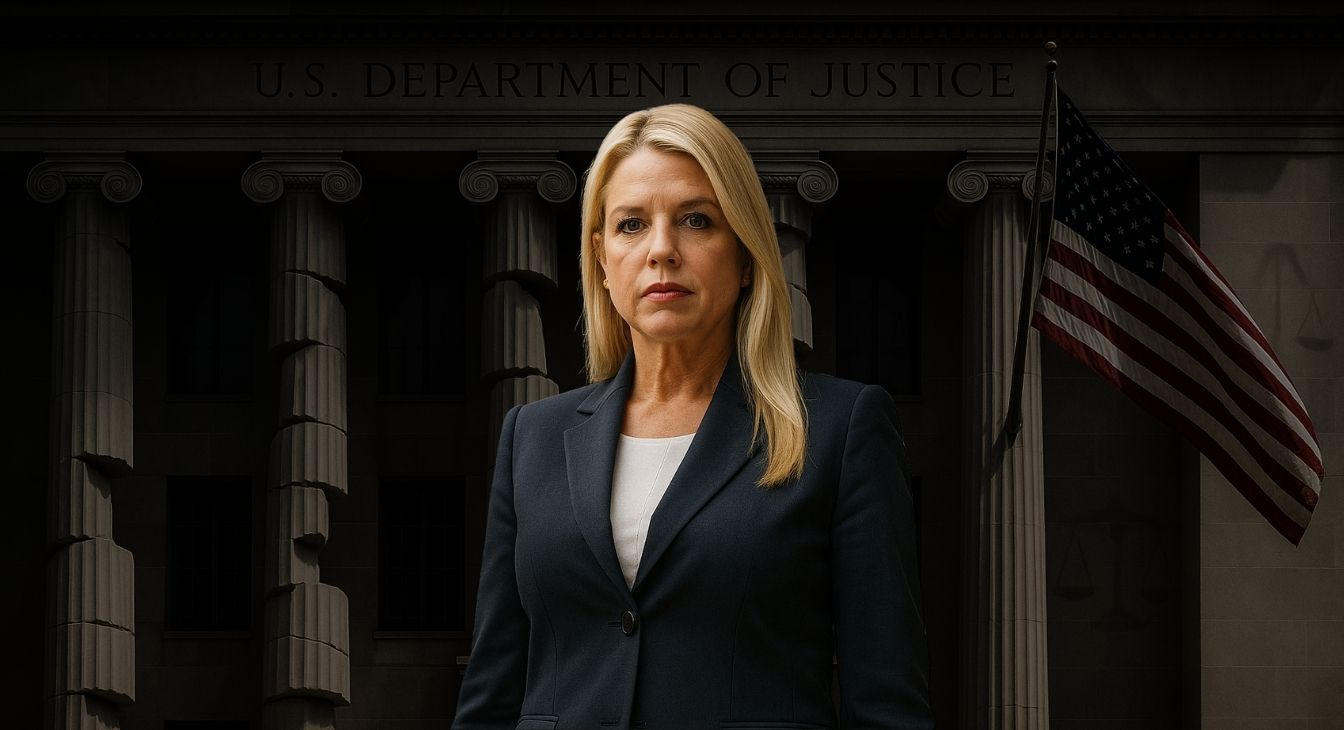
 Pam Bondi’s ascent from Florida’s Attorney General to the nation’s top law enforcement officer under Donald Trump was no fluke. It was the meticulous work of a career prosecutor with an ironclad alignment to conservative legalism and a knack for political theater. Bondi’s resume is a blueprint for the modern Republican legal warrior: a career prosecutor in Hillsborough County, two-term Attorney General of Florida, and finally, Trump’s pick to lead the Justice Department as U.S. Attorney General.
From her earliest days, Bondi learned politics from the inside out. Her father, Joseph Bondi, was the mayor of Temple Terrace, a small Tampa suburb. Growing up in that environment, Bondi saw firsthand the mechanics of local power—how influence is leveraged, how narratives are crafted, and how political loyalty is rewarded. That education didn’t end at home; it carried through her time at the University of Florida, where she earned her degree in Criminal Justice, and later at Stetson University College of Law. By the time she graduated in 1990, she was primed for the prosecutorial world.
For nearly two decades, Bondi made a name for herself as a prosecutor in Hillsborough County, handling everything from narcotics cases to violent crimes. But it wasn’t just her courtroom work that raised her profile—it was her telegenic presence and savvy media appearances. Bondi wasn’t just any prosecutor; she was one who understood the value of the camera. Regularly appearing on Fox News and CNN, she became the go-to voice for legal commentary during major trials. That comfort in front of the camera would serve her well when she decided to run for Attorney General in 2010, armed with an endorsement from Sarah Palin and riding the wave of the Tea Party movement.
Her tenure as Florida AG was marked by a series of high-profile battles, many of which foreshadowed her role in the Trump administration. She spearheaded the multi-state lawsuit against the Affordable Care Act, framing it as federal overreach and a violation of state rights. Bondi’s aggressive stance against Obamacare wasn’t just about law—it was ideological warfare, and it set the tone for her political identity. She also took on human trafficking and the opioid epidemic with a prosecutor’s zeal, shuttering “pill mills” and launching the Statewide Council on Human Trafficking. But beneath the surface, her tenure was not without controversy.
The Trump University scandal still lingers like a stubborn stain. In 2013, Bondi’s office decided not to join a multi-state lawsuit against Trump University for fraud, just weeks after her campaign received a $25,000 donation from the Trump Foundation—a transaction that violated IRS rules and led to a fine. Bondi’s explanation was that there wasn’t sufficient evidence to proceed, but the optics were damning. It was the first real taste of the transactional politics that would come to define her ascent to the federal stage.
Bondi’s tenure as U.S. Attorney General has been nothing short of transformative—and polarizing. Within months of taking office, she dismantled the DOJ’s Public Integrity Section, shifting corruption cases back to U.S. Attorneys’ offices—a move critics argue gives political appointees more sway over corruption investigations. She framed it as a decentralization of power; her detractors called it a gutting of federal oversight. Bondi also realigned DOJ priorities, halting investigations into state election laws while ramping up prosecutions of voter fraud—a move that conveniently aligned with Trump’s narrative of a “stolen” 2020 election. Her DOJ’s focus on sanctuary cities, bolstered immigration enforcement, and withdrawal of federal suits against state voter suppression laws reflect a Justice Department retooled to serve a political agenda rather than an impartial arbiter of law.
Her critics say she’s weaponized the DOJ; her supporters call it a restoration of law and order. But let’s be honest—it’s not restoration; it’s a refashioning. Bondi’s DOJ is built in the image of Trumpism: loyal, punitive, and unapologetically partisan. Her actions are not about the even hand of justice; they’re about cementing power, reinforcing conservative dominance, and laying the groundwork for a federal apparatus that operates in lockstep with executive will.
Pam Bondi is not just a political player—she’s the architect of a new conservative justice. One that bends to power, roots out dissent, and serves as a tool for ideological enforcement. And if you’re paying attention, it’s clear: the changes she’s making won’t be easy to undo.