Article II of Donald Trump—His Path to Authoritarianism
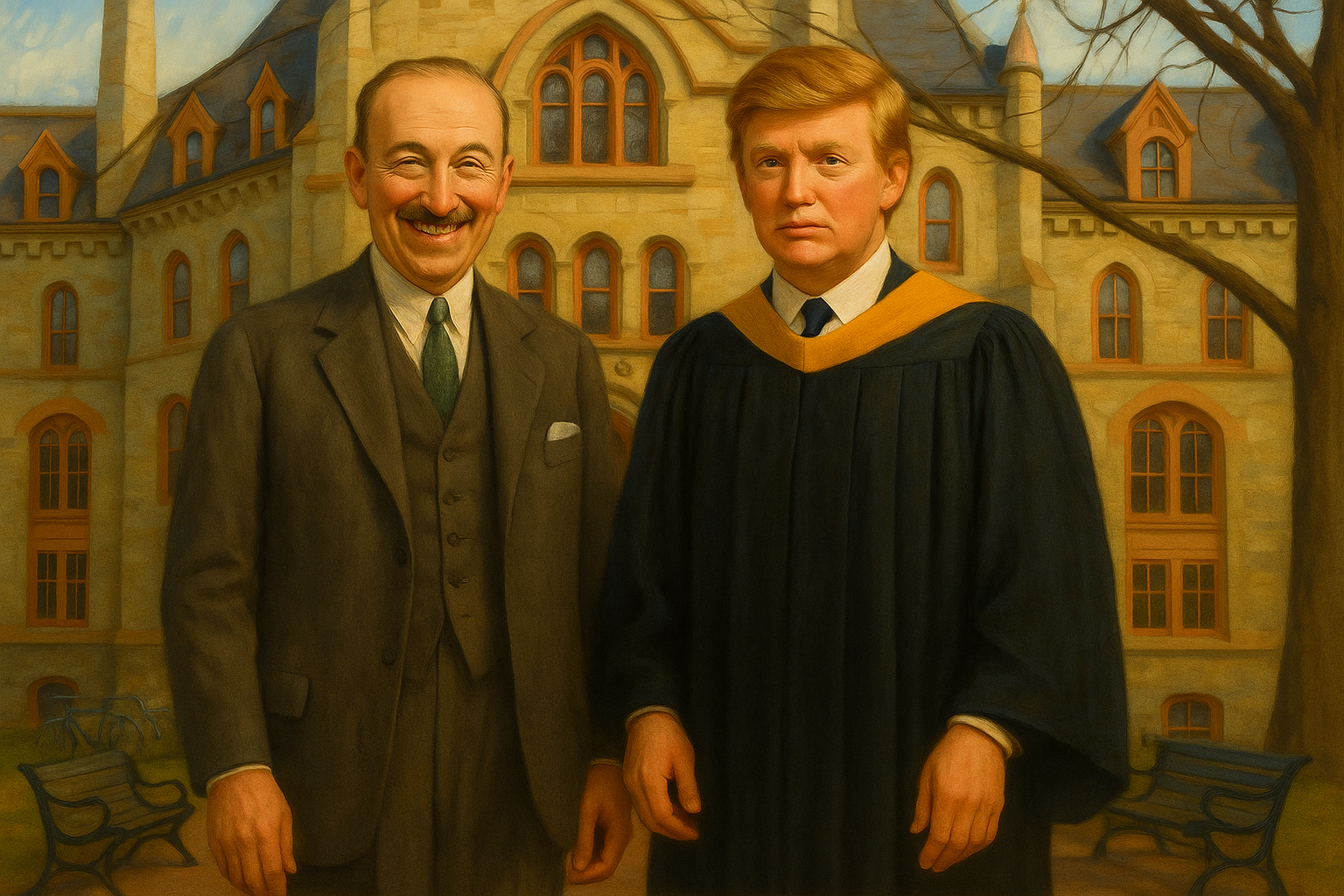
Trump graduated from the Wharton School of Business in 1968
From Cadet Captain to College Freshman
Donald Trump left the New York Military Academy in 1964 with the posture and polish of someone who had learned how to thrive inside a structured hierarchy — not by surrendering to it, but by mastering its symbols. His next stop, Fordham University in the Bronx, was less about intellectual transformation than about positioning. Fordham was respectable, academically demanding, and close to the family home in Queens, but it lacked the elite prestige Fred Trump envisioned for his son.
Two years in, Donald transferred to the Wharton School of the University of Pennsylvania. Wharton was — and remains — one of the most respected business schools in the country, a place where an Ivy League credential could open doors in finance, real estate, and politics. For Donald, the move was strategic: the name “Wharton” carried weight, and weight was currency.
At Penn, he lived in Philadelphia but often returned to New York on weekends, keeping close to the gravitational center of his father’s empire. His coursework was practical — real estate, finance, economics — but it was the proximity to the family business that defined his education. Classmates remember him as confident to the point of brashness, less immersed in academic debate than in projecting an image of future success.
The mid-1960s were years of national upheaval: civil rights marches, Vietnam War protests, and cultural shifts that challenged the old order. On campus, political activism surged. Yet Donald Trump largely steered clear of these currents. His focus remained on business, personal advancement, and cultivating an image of certainty. While peers wrestled with questions of war, race, and equality, he was learning how to read a balance sheet and size up a construction deal.
This selective engagement with the world beyond business was not apathy — it was strategy. He understood that in his father’s universe, the currency that mattered was not moral alignment with a cause, but the ability to navigate deals, secure financing, and outmaneuver competitors. Wharton gave him the veneer of an elite education; New York gave him the proving ground.
Apprenticeship in the Trump Organization
While Donald Trump was earning his degree at Wharton, his real education was taking place a hundred miles away in the outer boroughs of New York City. Weekends and academic breaks were spent shadowing Fred Trump, absorbing the operations of the Trump Organization from the inside. The company specialized in middle-income housing, much of it subsidized by government programs — a business model built on Fred’s mastery of both construction and political relationships.
Donald accompanied his father to construction sites, meetings with contractors, and consultations with lawyers. He learned how deals were structured, how financing was negotiated, and — critically — how to cultivate and maintain influence with the officials who controlled permits, zoning, and public funds. Fred had built his empire not merely by constructing buildings, but by constructing relationships, and Donald observed that these relationships often blurred the line between business strategy and political maneuvering.
One of the most enduring lessons was the importance of scale and visibility. Fred Trump’s developments were functional and profitable, but they were not grand. They did not command headlines. Donald began to imagine a different kind of real estate empire — one that traded not just in square footage but in spectacle. He envisioned towers, luxury branding, and projects that could serve as both investments and billboards for his name.
Within the Trump Organization, Donald’s role was informal but increasingly influential. He offered opinions on design choices, marketing approaches, and tenant selection, often framing his suggestions in terms of prestige and perception rather than just cost efficiency. Fred valued results and was cautious about flash, but he also recognized his son’s ambition and appetite for risk.
This period also introduced Donald to the adversarial nature of New York real estate. Competition was fierce, and reputations were made or destroyed in the press as much as in the boardroom. Donald watched his father navigate disputes with contractors, negotiate settlements, and handle regulatory challenges — always with an eye toward protecting the Trump name. The lesson was clear: in this world, perception was leverage, and leverage was power.
By the time Donald graduated from Wharton in 1968, he was not just prepared to join the family business — he was determined to reshape it in his own image. The conservative, low-profile model that had served Fred so well would not satisfy a son who measured success not just in dollars, but in the ability to dominate headlines and command attention.
The World Outside the Bubble
For all his focus on business, Donald Trump’s college years unfolded against a backdrop of upheaval that defined a generation. The Civil Rights Movement was reshaping the political landscape, the Vietnam War was escalating, and protests roiled campuses across the country. Wharton and Fordham were not immune to these tensions. Professors spoke about inequality, foreign policy, and the responsibilities of leadership in times of crisis.
Trump absorbed little of this political and moral ferment into his public persona. Where others saw a moral imperative to act, he saw distraction. War protests were surging, yet Donald secured multiple student deferments from the draft, citing his education as the reason. When those expired, a medical deferment for bone spurs would exempt him from service altogether — a fact that, years later, would draw scrutiny and skepticism.
In conversation, he could be dismissive of the passions driving social movements. Equality, civil rights, anti-war activism — these were not the arenas in which he planned to compete. His sights were fixed on markets, not marches. This detachment from the moral debates of the era was not merely a matter of temperament. It was a reflection of the Trump worldview: power was transactional, not moral, and influence was built in deal rooms, not picket lines.
The New York he returned to on weekends was itself a city in transition. Crime was rising, racial tensions were high, and fiscal strains were beginning to show. Yet for Donald, these were not warnings of decline — they were conditions to be exploited. Real estate fortunes could be made in distressed markets, and developers who understood how to work political connections could turn urban instability into opportunity.
His conversations with Fred Trump reinforced this pragmatic, even opportunistic lens. Problems were challenges only until they could be reframed as openings for profit. Public housing shortages, for example, could be addressed through public-private partnerships — partnerships that often left the “private” side holding the most advantages.
By the time the cap and gown were packed away in 1968, Donald Trump’s worldview was firmly in place. He had watched his father command projects through political alliances, navigate bureaucracy like a battlefield, and never lose sight of the bottom line. He had learned to value spectacle as both a shield and a weapon. And he understood that the city — and the country — rewarded those who appeared strong, certain, and unwilling to yield.
Setting the Stage for the Next Act
Graduating from the Wharton School in 1968, Donald Trump stepped into a world that was convulsing with political unrest, cultural change, and economic uncertainty. Yet in the carefully constructed bubble of the Trump family, those forces were less a threat than a backdrop. Fred Trump’s business was stable, profitable, and deeply embedded in the machinery of New York politics. Donald’s role in it was now official.
He entered the Trump Organization not as an untested novice but as the heir apparent, already versed in its rhythms and its rules. His early projects were grounded in the bread-and-butter work of the company — managing apartment complexes, negotiating leases, overseeing renovations. These were the disciplines of real estate management that Fred considered essential.
But Donald was already looking beyond the boundaries of the family’s existing portfolio. The skyline of Manhattan — its towers, its prestige addresses, its media saturation — called to him. Brooklyn and Queens had been good to Fred Trump, but they were, in Donald’s mind, too small a stage. He wanted projects that could dominate front pages, redefine neighborhoods, and make his name synonymous with luxury.
His instincts were reinforced by the lessons of the past four years. In the military academy, he had learned to harness structure and appearance to project authority. At Wharton, he had acquired the credentials to match his ambition. In his apprenticeship under Fred, he had learned the mechanics of deal-making and the utility of political alliances. Each step had been another layer in the construction of a persona: disciplined but opportunistic, credentialed but combative, ambitious without apology.
In the late 1960s, New York real estate was entering a volatile period. Crime, economic stagnation, and shifting demographics were driving down property values in some areas while fueling speculative booms in others. Donald understood — and Fred agreed — that in turbulence lay opportunity. The elder Trump’s caution kept the company steady; the younger Trump’s appetite for risk promised to push it into new territory.
The stage was set for a generational shift. Fred Trump’s empire had been built on steady returns and political prudence. Donald Trump’s vision was for an empire that would court spectacle, leverage branding, and move into the high-stakes world of Manhattan development. In the years ahead, those ambitions would collide with the realities of the market, the media, and the city’s political undercurrents — shaping the next chapter in his evolution.