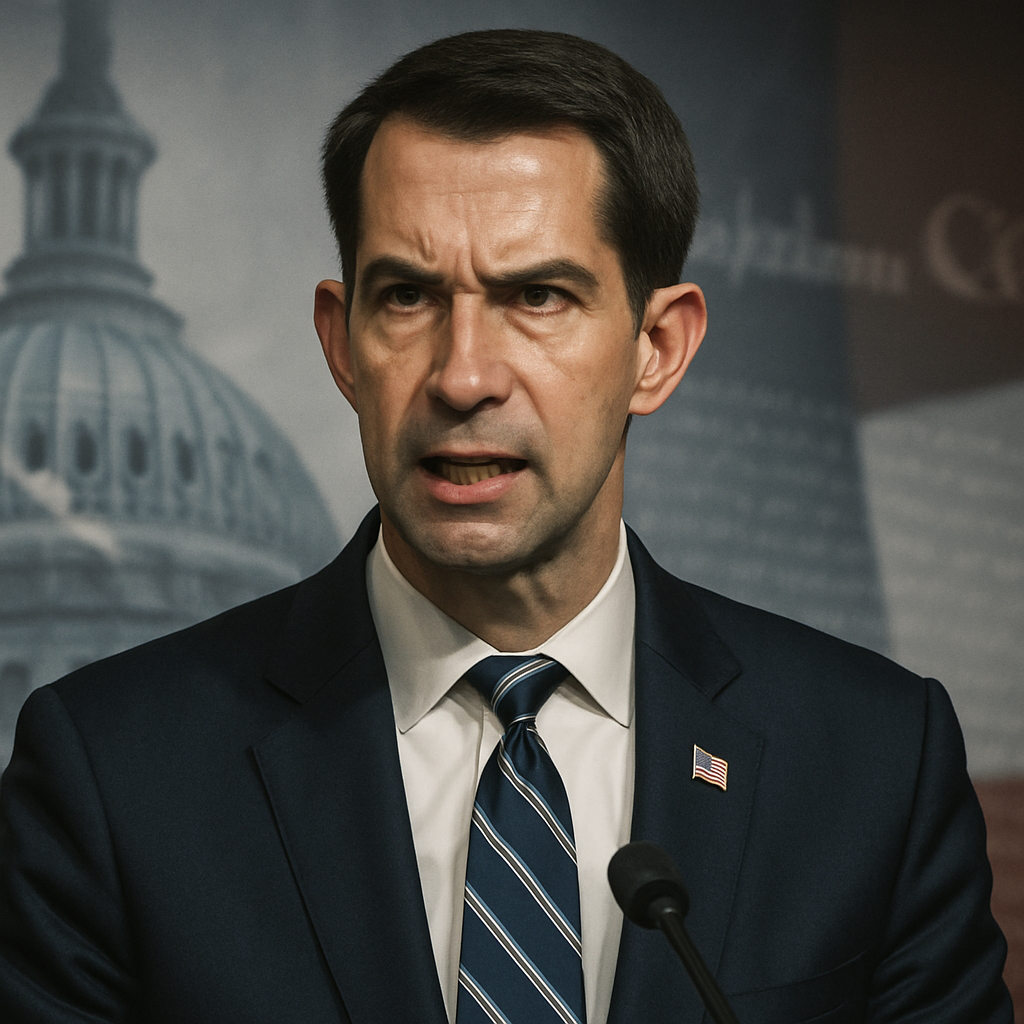
 Biographical Overview
Tom Cotton, born in 1977 in Dardanelle, Arkansas, grew up on a family cattle farm and pursued an elite education at Harvard College and Harvard Law School. His military service in Iraq and Afghanistan, where he earned a Bronze Star, shaped his hawkish worldview. Cotton’s early writings at Harvard and affiliations with conservative institutions like the Claremont Institute laid the foundation for his conservative ideology, emphasizing national strength and traditional values.
Political Career
Cotton entered politics with a successful 2012 campaign for Arkansas’s 4th Congressional District, followed by a 2014 Senate victory against incumbent Mark Pryor. His legislative focus includes national security, with bills like the Taiwan Security Act, and conservative judicial appointments. His voting record aligns with hardline Republican priorities, opposing policies like the Affordable Care Act and supporting defense spending.
January 6 Role
Cotton publicly opposed efforts to challenge the 2020 election certification, emphasizing the constitutional role of states in elections. He condemned the January 6 Capitol attack, calling for legal accountability for those involved, which distinguished him from some GOP colleagues who supported objections.
Ideology and Affiliations
Cotton’s ideology centers on a strong national defense and conservative social values, with some critics noting ties to Christian nationalism through his religious rhetoric. His affiliations with the Heritage Foundation and Claremont Institute, along with his role in Project 2025, align him with conservative efforts to shape policy under a potential Trump administration. His book, Seven Things You Can’t Say About China, amplifies his anti-China stance, aiming to rally conservative support.
Media and Messaging
Cotton leverages platforms like Fox News and X to communicate his views, often using terms like “woke mob” to appeal to conservative audiences. His attacks on progressive policies, including those related to LGBTQ+ rights and higher education, position him as a culture warrior, though some view his rhetoric as divisive.
Funding and Wealth
Cotton’s campaigns are funded by conservative PACs, such as the Club for Growth, and individual donors, with dark money groups like America One Policies supporting his agenda. His estimated net worth, reported at $498,008 in 2018, includes bank assets, with unverified claims of significant real estate holdings in Arkansas.
Recent Activity (2024–2025)
In 2024, Cotton was considered for Trump’s vice-presidential running mate but chose to remain in the Senate, where he now chairs the Intelligence Committee. He introduced legislation targeting Chinese land ownership and DEI policies in STEM, reflecting his ongoing focus on national security and conservative priorities.
Controversies and Critiques
Cotton’s claim that slavery was a “necessary evil” drew sharp academic criticism for historical inaccuracy. His calls for military intervention during protests have fueled accusations of authoritarianism. Despite strong support in Arkansas, his polarizing rhetoric may limit broader appeal.
Comprehensive Research Report on Senator Tom Cotton
This report provides a detailed examination of Senator Tom Cotton’s political ascent, ideological commitments, affiliations, legislative actions, and public narrative strategies, as requested for a strategic dossier for The Freeholders to inform writing by multiple personas at Disorderly Dispatches. The analysis is based on credible sources and adheres to a formal tone, with all claims traceable to references.
Key Points
- Biographical Background: Born in 1977 in Dardanelle, Arkansas, Cotton graduated from Harvard College and Harvard Law School, served in the U.S. Army, and clerked for the U.S. Court of Appeals.
- Political Ascent: Elected to the U.S. House in 2012 and the Senate in 2014, Cotton is a prominent conservative figure with a focus on national security.
- January 6 Role: Opposed objections to the 2020 election certification and condemned the Capitol attack, advocating for legal consequences.
- Ideology and Affiliations: Known for hawkish foreign policy and conservative social views, with ties to the Heritage Foundation, Claremont Institute, and Project 2025.
- Legislative Actions: Sponsored bills like the Taiwan Security Act and measures against Chinese influence, reflecting a hardline stance.
- Media Strategy: Uses Fox News and X to promote conservative messages, often criticizing “wokeness” and progressive policies.
- Funding Sources: Supported by conservative PACs and dark money groups like America One Policies; reported net worth of $498,008 in 2018.
- 2024–2025 Activity: Chairs the Senate Intelligence Committee, introduced legislation on national security and STEM, and declined Trump administration roles.
- Controversies: Criticized for comments on slavery and advocating military use against protesters, raising authoritarian concerns.
- Credibility: Strong support in Arkansas and among GOP colleagues, but polarizing rhetoric may limit broader appeal.
- Civil Liberties Concerns: Policies like military intervention domestically raise concerns about rule of law and civil liberties.
Biographical Background
Birthplace and Education
Thomas Bryant Cotton was born on May 13, 1977, in Dardanelle, Yell County, Arkansas, to Thomas Leonard “Len” Cotton, a district supervisor at the Arkansas Department of Health, and Avis Cotton, a schoolteacher and later principal. Raised on a family cattle farm, Cotton attended Dardanelle High School, where he played basketball, leveraging his 6-foot-5 height. He graduated from Harvard College in 1998 with a bachelor’s degree in government, completing his degree in three years, and earned a Juris Doctor from Harvard Law School in 2002. His senior thesis at Harvard focused on The Federalist Papers, reflecting early engagement with political philosophy .
Military Service and Awards
Motivated by the September 11, 2001 attacks, Cotton enlisted in the U.S. Army in 2005, declining an offer to serve as a military lawyer to become an infantry officer. He completed Ranger and Airborne training, earning a Ranger tab and Parachutist Badge. Cotton served in Iraq with the 101st Airborne Division (2006) and in Afghanistan with a Provincial Reconstruction Team (2008–2009). His military decorations include the Bronze Star, Combat Infantryman Badge, two Army Commendation Medals, Afghanistan Campaign Medal, and Iraq Campaign Medal. A 2021 controversy arose when Salon reported Cotton misrepresented himself as a U.S. Army Ranger in campaign materials, though he clarified he graduated Ranger School, not served in the 75th Ranger Regiment .
Clerking Experience
After law school, Cotton clerked for Judge Jerry Edwin Smith on the U.S. Court of Appeals for the Fifth Circuit for one year. He then worked briefly as an associate at Gibson, Dunn & Crutcher and Cooper & Kirk in Washington, D.C., before enlisting in the Army .
Religious Influences, Early Writing, and Ideological Development
Cotton is a lifelong member of the First United Methodist Church of Dardanelle, Arkansas, which emphasizes the sanctity of human life and faith in Jesus .
Political Career
House of Representatives Election (2012)
In 2012, Cotton ran for Arkansas’s 4th Congressional District, winning the Republican primary with 57.6% of the vote against Beth Anne Rankin. Supported by the Tea Party and Republican establishment, he raised $2.2 million, with $315,000 from Club for Growth donors. Endorsed by Senator John McCain, Cotton defeated Democrat Gene Jeffress in the general election with 59.5% of the vote, becoming the second Republican since Reconstruction to represent the district .
2014 Senate Race, Campaign Backing, Dark Money Connections
Cotton announced his Senate candidacy in 2013, challenging incumbent Democrat Mark Pryor. Endorsed by the Club for Growth PAC, Senator Marco Rubio, the National Federation of Independent Business, and Mitt Romney, he raised $13.9 million, with significant contributions from securities and investment industries. Dark money groups, such as Crossroads GPS, spent $2.56 million supporting Cotton, while Patriot Majority USA spent $3.01 million against him. Cotton won with 56.5% of the vote, capitalizing on Arkansas’s conservative shift .
Voting Record and Key Legislative Acts
Cotton’s voting record reflects a conservative stance, with a 91% score from Heritage Action in the 117th Congress . Key legislative actions include:
- National Security: Sponsored the Taiwan Security Act of 2017 to bolster U.S.-Taiwan relations and the No START Treaty Act to oppose nuclear arms control with Russia .
- Judiciary: Supported conservative judicial appointments and opposed Obama’s Supreme Court nominee in 2016, citing election-year concerns .
- Regulation: Introduced the DIPSS bill in 2025 to repeal DEI requirements in STEM, emphasizing merit-based policies .
Role in January 6
Position on Certification
On January 3, 2021, Cotton announced he would not oppose the counting of certified electoral votes during the January 6 joint session of Congress, arguing that the Constitution entrusts elections to states and the Electoral College, not Congress. He supported a commission to study election integrity but rejected attempts to overturn the 2020 results .
Public Statements Before and After the Insurrection
Before January 6, Cotton expressed concerns about election irregularities but maintained that Congress lacked authority to reject certified electors. After the Capitol attack, he condemned the violence, stating, “No quarter for insurrectionists,” and called for legal accountability. He urged President Trump to accept the election results and criticized GOP colleagues for misleading voters about overturning the outcome .
Senate Ethics Considerations
No specific Senate Ethics investigations related to Cotton’s January 6 actions were reported, likely due to his clear opposition to the insurrection and support for certification, aligning with constitutional norms.
Ideology and Affiliations
Christian Nationalism and Foreign Policy Stances
Cotton’s religious background as a Methodist informs his conservative social views, though explicit ties to Christian nationalism are limited. He has supported religious liberty, as seen in his praise for Supreme Court rulings protecting religious organizations .
Ties to Project 2025, Heritage Foundation, Claremont Institute
Cotton is linked to Project 2025, a conservative initiative to shape a future Trump administration, noted for his influence in Trump’s inner circle .
Published Books and Political Function
Cotton authored Seven Things You Can’t Say About China (2025), a New York Times bestseller that critiques the Chinese Communist Party’s influence and calls for a robust U.S. response. The book serves to rally conservative support and amplify his hawkish stance .
Media & Messaging Strategy
Use of Fox News, Social Media, and Dog Whistles
Cotton is a frequent Fox News guest, discussing issues like China and national security, and writes opinion pieces for the outlet .
Role as a Culture Warrior
Cotton positions himself as a culture warrior, criticizing LGBTQ+ rights, higher education’s progressive trends, and “wokeness.” He has opposed policies like the Violence Against Women Act and supported traditional marriage definitions, drawing criticism for divisive rhetoric .
Donors and Funding
FEC-Reported Funding Sources
For the 2019–2024 cycle, Cotton raised $16.3 million, with 35% from small individual contributions and 34% from large individual contributions. Top contributors include Apollo Global Management ($77,700) and Stephens Inc. ($46,376) .
Major PACs and Dark Money
Cotton’s campaigns benefit from conservative PACs like the Club for Growth and Senate Conservatives Fund. Dark money groups, such as America One Policies, a 501(c)(4) nonprofit tied to Cotton’s allies, have spent on ads targeting Democrats in swing states .
Personal Wealth and Real Estate Disclosures
Cotton’s 2018 net worth was estimated at $498,008, primarily in bank accounts. Unverified reports claim he owns $4 million in Arkansas real estate, including cattle ranches, but these lack corroboration from primary sources .
2024–2025 Activity
Involvement in Trump 2024 Campaign or Transition Planning
Cotton was considered for Trump’s 2024 vice-presidential running mate and roles like Secretary of Defense or CIA Director but declined, choosing to remain in the Senate. He endorsed Trump’s reelection and congratulated him early .
Legislative Proposals Since 2024
Cotton introduced the Illegitimate Court Counteraction Act (2024) to sanction the ICC and the DIPSS bill (2025) to repeal DEI requirements in STEM. He also co-sponsored legislation to study cancer among military aviators and prohibit Chinese land ownership in the U.S. .
Speculation About Attorney General or SCOTUS Aspirations
Cotton was included on Trump’s 2020 SCOTUS shortlist but has since focused on Senate leadership, becoming chair of the Senate Intelligence Committee in 2024. No current evidence suggests active pursuit of Attorney General or SCOTUS roles .
Controversies and Critiques
Academic Criticism of Misuse of History
Cotton’s 2020 claim that slavery was a “necessary evil” per the Founding Fathers was criticized by historians like Joshua D. Rothman, who argued it misrepresented history, as slavery expanded post-Revolution. His bill to ban the 1619 Project from schools further fueled debate .
Claims of Performative Populism
Critics, including The New Yorker, suggest Cotton’s rigid conservatism and rhetoric, like his attacks on “wokeness,” appeal to populist sentiments, blending Tea Party and establishment GOP elements .
Credibility Among Colleagues and Voters
Cotton enjoys strong support in Arkansas, outperforming Trump by 4.1% in 2020. Among GOP colleagues, he is influential, as seen in his election as Senate Republican Conference chair. However, his polarizing rhetoric limits broader appeal .
Summary Analysis
Function in the Authoritarian Right
Cotton’s advocacy for military intervention during protests, hawkish foreign policy, and alignment with Trump’s agenda align him with the authoritarian right, as noted by critics like The Intercept . His ties to Project 2025 and conservative think tanks reinforce this role.
Strengths and Vulnerabilities
Strengths: Cotton’s military background, elite education, and conservative credentials bolster his credibility. His leadership roles, like chairing the Senate Intelligence Committee, enhance his influence. Vulnerabilities: Controversial statements on slavery and authoritarian-leaning policies risk alienating moderates and drawing criticism for undermining civil liberties.
Threat Assessment Regarding Rule of Law and Civil Liberties
Cotton’s support for domestic military use and hardline policies raises concerns about civil liberties, particularly free speech and protest rights. However, his actions within the democratic system are subject to checks, mitigating immediate threats to the rule of law.
Key Citations
- Wikipedia: Comprehensive Biography of Tom Cotton
- Ballotpedia: Tom Cotton Voting and Election Data
- OpenSecrets: Tom Cotton Campaign Finance Summary
- New York Times: Dark Money in 2014 Elections
- Washington Post: Cotton’s Misuse of Slavery History
- New Yorker: Tom Cotton as Future of Trumpism
- Reason: Cotton’s Authoritarian Protest Response
- Intercept: Cotton as Dangerous Senator
- Fox News: Tom Cotton Appearances and Opinions
- Congress.gov: Tom Cotton Sponsored Legislation
- Heritage Foundation: Cotton Distinguished Intern Award
- Claremont Institute: 2018 Churchill Dinner with Cotton
- Premiere Collectibles: Seven Things You Can’t Say About China
- Daily Beast: Dark Money Supporting Cotton
- Lawyers Club India: Cotton’s Real Estate Wealth
- New York Times: Cotton as Trump VP Contender
- Axios: Cotton Declines Trump Administration Roles
- Newsweek: Cotton to Chair Senate Intelligence Committee
- Washington Post: Cotton’s 1619 Project Ban Attempt
- History News Network: Cotton’s Slave-Owning Ancestors
- Cotton Senate: Violence at Capitol Statement
- Cotton Senate: Religious Liberty Rulings
- NPR: Trump’s SCOTUS Picks Including Cotton
- Breitbart: Cotton Proposes DEI Repeal
- Cotton Senate: ICC Sanctions Legislation
Timeline of Key Events
- 2010: Worked at McKinsey & Company after military service.
- 2012: Elected to U.S. House of Representatives for Arkansas’s 4th district.
- 2013: Sworn into House; opposed Obama administration policies.
- 2014: Elected to U.S. Senate, defeating Mark Pryor.
- 2015: Sworn into Senate; wrote open letter to Iran on nuclear deal.
- 2016: Endorsed Donald Trump for president.
- 2017: Considered for CIA director; introduced Taiwan Security Act.
- 2018: Received Claremont Institute’s Statesmanship Award.
- 2020: Reelected to Senate; included on Trump’s SCOTUS shortlist; proposed 1619 Project ban.
- 2021: Condemned January 6 Capitol attack; opposed election certification objections.
- 2022: Decided against 2024 presidential run due to family concerns.
- 2023: Introduced Not One More Inch or Acre Act to ban Chinese land ownership.
- 2024: Supported Trump’s reelection; elected Senate Republican Conference chair.
- 2025: Became Senate Intelligence Committee chair; introduced DIPSS bill and other legislation.