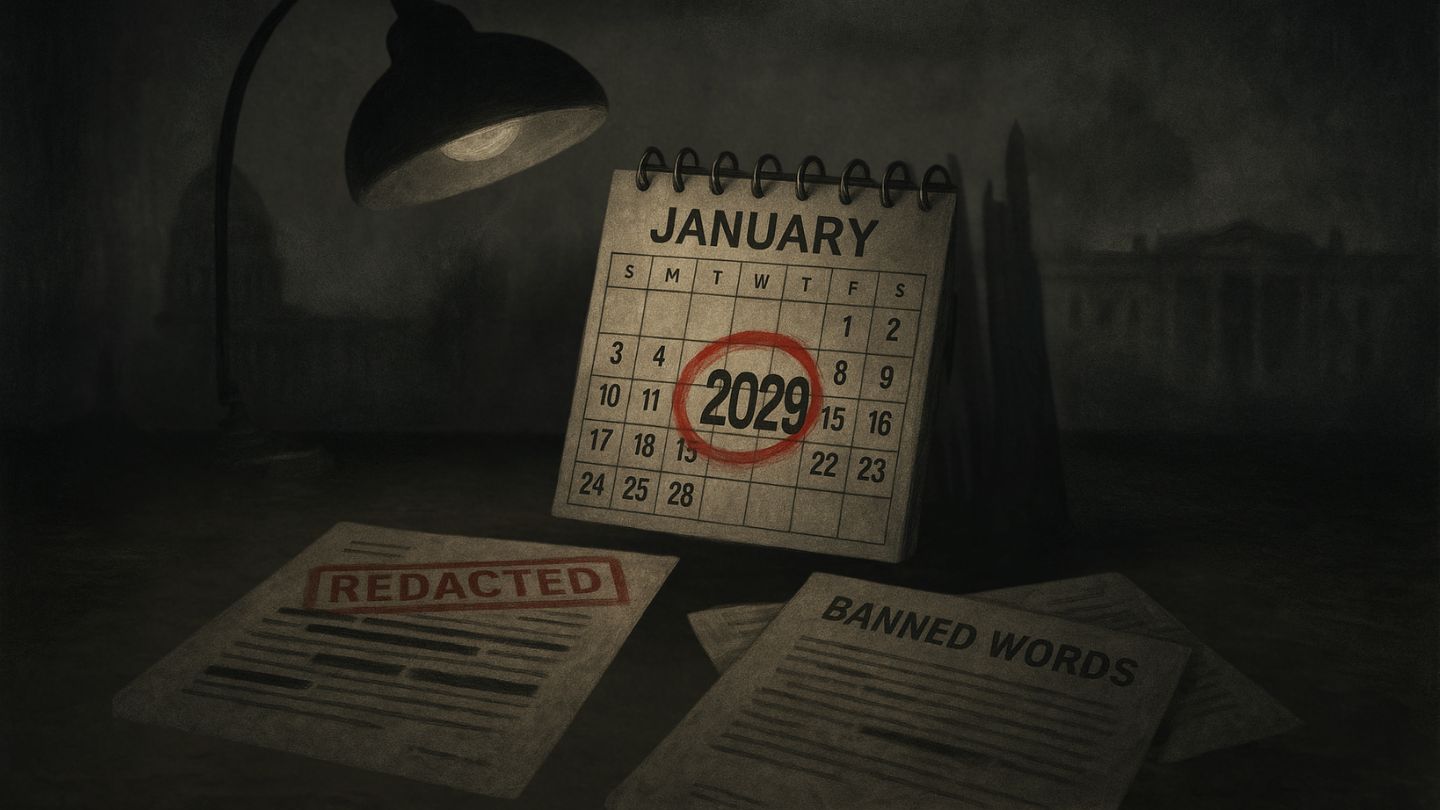
 The calendar is merciless. I sat down with a cheap desk pad, counted forward from today, and the number landed like a cinder block: three years, three months, and twenty-seven days until the next official inauguration day. That is the constitutional horizon—January 20, 2029. It’s close enough to imagine, yet far enough to leave time for a mountain of damage. I don’t mean abstract “policy shifts” that can be ironed out with later legislation. I mean institutional corrosion, cultural hardening, and legal precedents that will not snap back just because a different hand takes the oath in 2029.
Look at what has already been pushed through in under nine months. Whole vocabularies banned from federal documents, watchdogs removed and replaced with loyalists, enforcement arms of the state bent into partisan cudgels. The project isn’t subtle—it’s demolition by executive order, budget manipulation, and raw intimidation of civil servants. Three years and change under that formula is an eternity.
The Long March Through Language
The banned words list is not just a bureaucratic curiosity. It’s a scalpel cutting through the ligaments of public life. When you erase “climate change” from documents, the storms and fires don’t vanish, but the government’s obligation to acknowledge them does. When you strip out “equity,” “inclusion,” “gender identity,” you’re not just tidying language—you’re amputating constituencies from recognition. A government that cannot name women, cannot name racial disparities, cannot name disabilities, becomes one that pretends those realities are not its concern. Three more years of this engineered silence and whole generations of policy expertise could be buried under euphemism and denial.
Judicial Entrenchment
The courts are being stacked with people whose chief qualification is loyalty. Not scholarship, not judicial temperament—loyalty. Lifetime seats are being treated like party favors. In less than a year, several circuit benches have already shifted in composition. Imagine how many confirmations can be rammed through by 2029. Every ruling handed down between now and then will become case law—precedent that outlives any single administration. Undoing that will take decades, and that’s if the appetite for reform survives.
Executive Overreach
Executive power is being stretched and tested like a rubber band. Removal of independent agency heads, directives to reclassify civil servants so they can be purged at will, the branding of the Secretary of Defense as “Secretary of War.” None of this is cosmetic. It’s the scaffolding for a presidency that treats checks and balances as optional. Three more years and that rubber band could snap—not back into place, but into a new shape entirely, one where the line between executive authority and authoritarian license has blurred beyond recognition.
Foreign Policy by Whiplash
Abroad, the posture swings between chest-thumping threats and abrupt retreats. Allies don’t know whether to trust commitments, enemies don’t know whether to believe threats, and the U.S. reputation bleeds credibility by the day. The United Nations seat now occupied by a Trump loyalist isn’t there to negotiate—it’s there to heckle, to obstruct, to perform loyalty on the international stage. Every month this continues, treaties weaken, alliances fray, and rivals find room to maneuver. Three more years is enough to cement America’s role not as leader but as destabilizer.
The Chilling Effect at Home
Inside the country, dissent is already chilled. Federal workers weigh every word, fearing that a stray phrase might sink a project or a career. Journalists are harassed as “enemies,” agencies clamp down on external speaking engagements, and grant writers scrub their proposals clean of “forbidden” terms. This isn’t paranoia; it’s survival. Multiply that by three more years, and you’re looking at a professional culture of self-censorship that may not easily recover, even under a new administration. Fear, once normalized, doesn’t just evaporate.
Economic Short-Termism
Tariff schemes billed as “reciprocal” punish consumers and destabilize supply chains. They may generate headlines about toughness, but they bleed quietly into household budgets. Inflation figures are dressed up as stable, yet the underlying distortions are mounting. By 2029, we could inherit an economy where the accounting gimmicks no longer mask the rot. That’s not easily fixed by speeches or symbolic reversals. It’s a repair job that will fall on ordinary citizens, not the architects of the mess.
Cultural Polarization Weaponized
Perhaps most corrosive is the deepening of culture wars into the marrow of governance. Statehouses and Congress are echo chambers where compromise is treated as betrayal. Policies are written not to solve problems but to punish adversaries. Every week brings a new test balloon: can we erase this phrase, cut off that program, criminalize this group, delegitimize that protest? The point is not even the individual measure—it’s the drumbeat, the constant reminder that power is willing to target anyone outside the fold. Three more years of this and polarization won’t just be a political feature; it will be a civic condition.
The Weight of Time
Here’s what gnaws at me: time itself. Every day under this regime normalizes what once seemed outrageous. The first banned words list drew gasps; the second drew shrugs. The first loyalty purge sparked lawsuits; the fifth barely makes the news crawl. Authoritarian drift works like water erosion—slow, steady, invisible until the ground gives way. That’s what three years, three months, and twenty-seven days represents: enough time for the outrageous to calcify into ordinary.
The Next Inauguration
January 20, 2029, isn’t just a date—it’s a line of defense. If the calendar holds, the office turns over, or at least offers the chance of turnover. But the damage by then may not be reversible by ballots alone. Institutions weakened, legal precedents entrenched, civic trust shattered—these don’t snap back with a new swearing-in. That’s why counting the days is both a source of grim hope and heavier dread. The clock ticks toward relief, but also toward deeper entrenchment of harm.
The Personal Reckoning
I think about my students, the ones who will inherit whatever remains of this system. They deserve better than a government that deletes their realities from its vocabulary. They deserve courts that rule on law, not loyalty. They deserve an economy that isn’t manipulated for headlines. And yet the horizon stretches: three years, three months, twenty-seven days. What else can be banned, dismantled, disfigured in that time? What rights can be erased, what truths buried, what norms mutilated? That’s not speculation—it’s projection based on the trajectory we’ve already seen in less than a year.
Conclusion
I don’t romanticize past administrations; corruption and incompetence have never been strangers to Washington. But the current project is not normal politics—it’s a dismantling operation dressed in patriotic slogans. Three years is a long time for a demolition crew with dynamite and no shame. Every morning I flip the desk calendar, mark another day gone, and feel that chill again. Three years, three months, twenty-seven days. Too much time for too much harm.