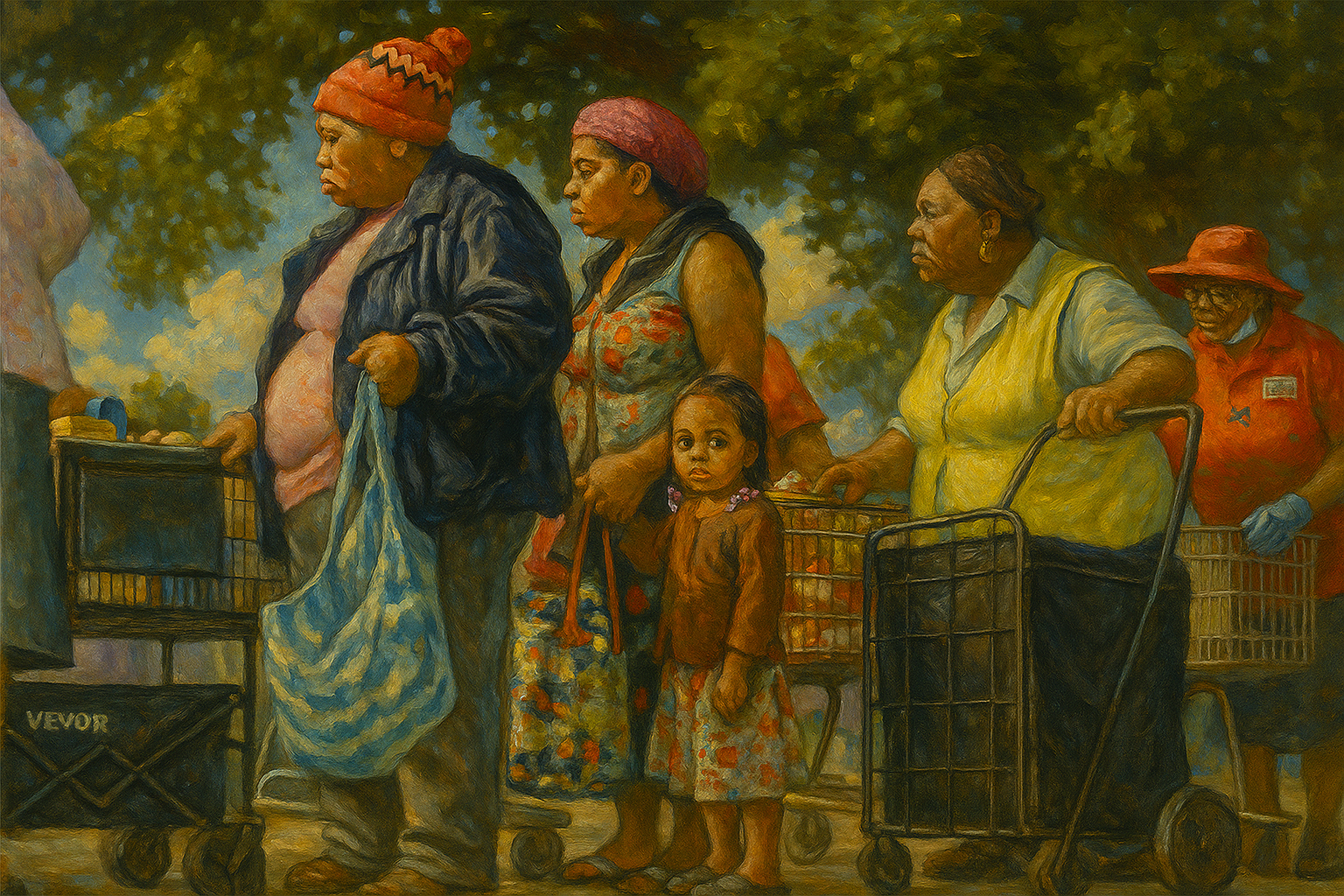
 When the federal government slid into shutdown on October 1 2025, the ripple effects reached far beyond the corridors of Washington. Two of America’s most vital safety-net programs — the Supplemental Nutrition Assistance Program (SNAP) and the Special Supplemental Nutrition Program for Women, Infants, and Children (WIC) — became front-line indicators of how fragile our collective social contract had become.
The human impact
Approximately 670,000 federal employees were placed on furlough, while roughly 730,000 more continued to work — but without pay. Many of these workers, already living paycheck-to-paycheck, began scraping for basic necessities. Some turned to food banks they once served.
For households relying on SNAP, the situation grew dire. The United States Department of Agriculture (USDA) warned that federal funding for SNAP was only guaranteed through October — leaving roughly 42 million Americans at risk of missing November benefits. In Texas alone, more than 3.4 million people faced the possibility of not receiving their next benefit installment.
Meanwhile, WIC — serving over six million low-income mothers and young children — was operating on a contingency fund of just $150 million. If the shutdown dragged on, the risk of depletion became real within just a couple of weeks.
What these interruptions mean
For SNAP families, the best-case scenario becomes cauliflower instead of steak, eggs instead of bacon, beans instead of meat. The worst-case scenario? Missing a month entirely, which means skipping meals or doubling up at food banks. For WIC families, it can mean going without infant formula, milk, fresh produce, or nutrition support at a time when children’s growth and health depend on it.
For federal workers unpaid or furloughed, the stress ramps up. Imagine being paid to work, but not being paid. Or not being paid at all. Many still have mortgages, car payments, childcare — the same outlays as any other worker. And now they join the ranks of the suddenly vulnerable.
Structural fragilities laid bare
The shutdown exposed two broader systemic problems at once. First, the assumption that mandatory programs like SNAP and WIC are immune to partisan brinkmanship proved dangerously optimistic. SNAP continued in October — but only because advance authorizations and prior appropriations covered it. Once these reserves expire, the program’s continuity depends on political will, not statutory guarantee. WIC, reliant on fresh annual appropriation, sits on a much thinner cushion.
Second, workers at federal agencies found themselves delivering national services while their own incomes were under siege. A food bank organized by federal workers themselves underscored the irony.
Immediate risks and ripple effects
- Food insecurity intensifies. Households on SNAP and WIC face interrupted benefit flows, which increases demand on local food banks and pantries — many of which are already under strain.
- State budgets get pressured. Some states may try to backfill benefits — but not all have the resources or flexibility to cover SNAP or WIC fully.
- Workers’ morale and finances slide. Unpaid federal employees may cut back on essentials, fall behind on bills, and then contribute to local economic slowdowns.
- Broader economy suffers. The Congressional Budget Office estimates the shutdown could result in a GDP loss of several billion dollars, largely due to delayed federal spending and suspended food assistance.
Why it matters
In rural communities like mine, where grocery stores are already thinning out, the shutdown doubles down on inequality. Families may live just miles from farmland, yet go hungry because the assistance system designed to ensure access fails to hold together under pressure. When SNAP or WIC benefits are delayed, the impact is immediate — hungry children, stressed parents, community resources stretched thin. For federal workers, it is equally destabilizing: their job is national service, but their paycheck becomes a gamble.
The near-term path forward
If Congress reopens funding in short order, the damage will still be significant but contained. State food banks, local charities, and municipal support will carry the burden, but federal continuity will restore confidence. If the stand-off persists, however, we face cascading failures: benefits falter, workers default, local systems buckle.
For communities across America, the message is clear: when the government system designed to protect basic human needs becomes hostage to politics, it is not just abstract — it is personal. Households reliant on SNAP and WIC see their grocery lists shrink, federal workers see paychecks vanish, and local support networks strain under new demand. This isn’t a remote policy debate — this is real people, real families, real hunger.