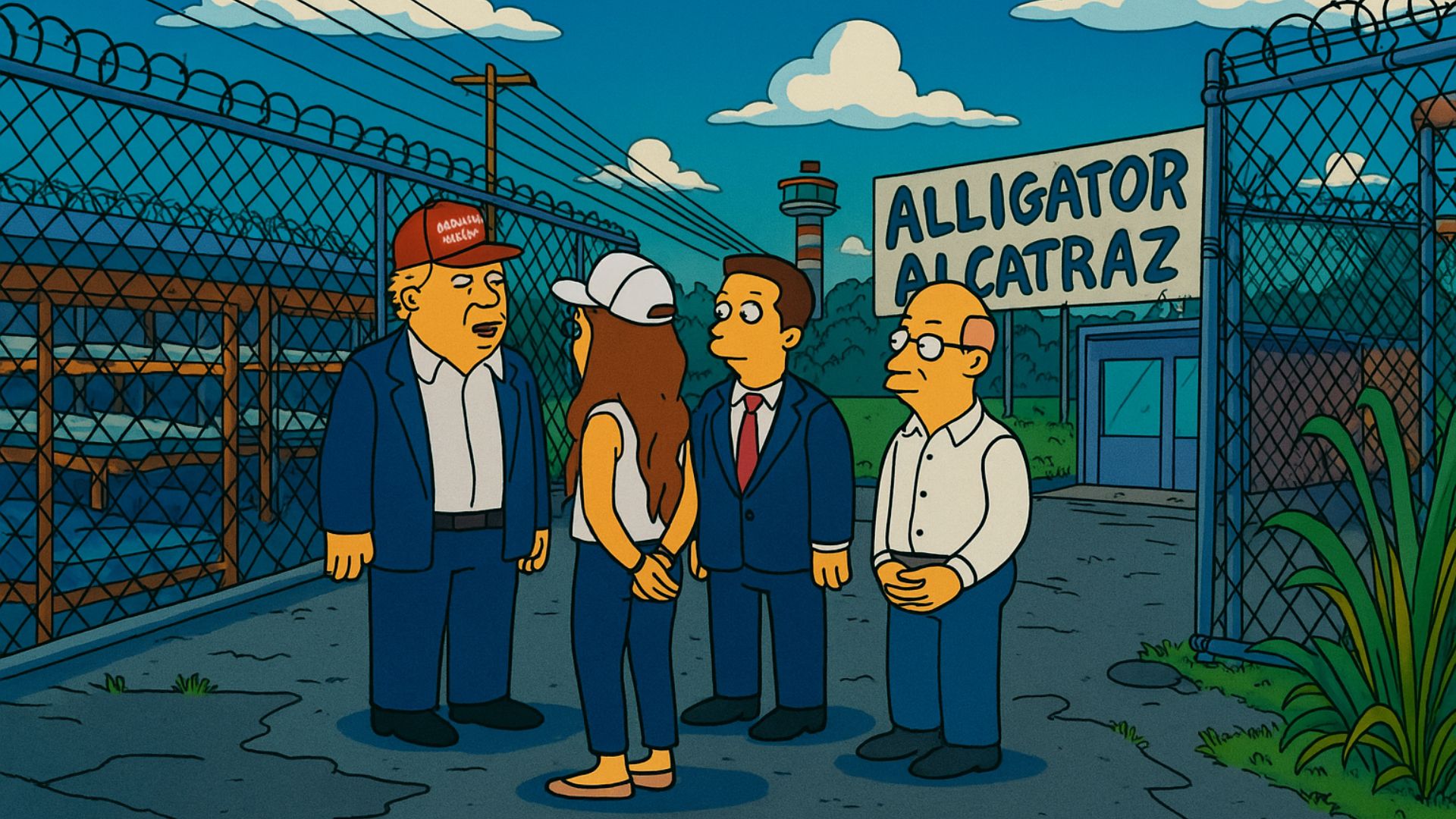
 It rises out of the swamp like a fever dream: a tented maze of chain-link, heat, and human despair, dropped into the reclaimed wetlands of Big Cypress like a scar. They call it Alligator Alcatraz, and even the nickname can’t keep pace with the realities emerging from within.
The facility, officially known as a “temporary immigration detention and processing center,” was ordered by Florida Governor Ron DeSantis and constructed in just over a week. What’s housed there now—at least 900 men, with plans to scale to 5,000—is not just a logistical feat. It’s a political statement.
And one that, as of mid-July 2025, is drawing national outrage.
The Tour That Pulled Back the Curtain
On July 12, three Democratic members of Congress—Debbie Wasserman Schultz, Darren Soto, and Maxwell Alejandro Frost—alongside state representatives like Anna Eskamani and Rita Harris, finally set foot inside the facility after being denied access days earlier. What they saw, they say, defied decency.
Rows of cages filled with men. Not figuratively—literally cages. Thirty-two per pen. Three open toilet-sink combos bolted to a wall. No partitions. No ventilation beyond the hum of strained AC units fighting the swamp heat. The temperature hovered in the low 80s inside the tents. “This is not a prison,” one staff member reportedly said. Yet everything from the language to the layout screamed otherwise.
One detainee, they said, shouted through the chain link, “I’m an American citizen.” Others chanted “Libertad.” Lawmakers were blocked from speaking to them.
And when they asked to inspect the toilets detainees use daily, they were instead shown sparkling new ones in an empty, unoccupied unit. Not the ones reportedly clogged with feces.
The “Why” Behind the Wire
Officially, this was a response to DHS requests for more detention space. But no one seems to know—or will admit—why this exact location was chosen. There is no plumbing. Water must be trucked in. The land sits in a federally funded Everglades restoration zone. It floods easily. And yet, the Florida Division of Emergency Management, under the governor’s emergency order, was granted unilateral authority to spend up to $500 million to make it happen—no legislative approval required.
DeSantis’ office claims it’s a matter of immigration control. Critics say it’s spectacle. And even the ICE agents on site, lawmakers reported, seemed to defer to state contractors and private security—many of them barely more trained than concert venue bouncers.
That fuzziness—around roles, authorities, and legal standing—is not incidental. It’s strategic. As Representative Frost noted, when state legislators tried to enter, officials claimed it was a federal facility. When federal lawmakers arrived, it was suddenly state-run. That shell game is designed to prevent oversight, to stall accountability. To turn human rights into jurisdictional gray area.
A Calculated Cruelty
If the goal were simply detention, Florida already had capacity. Chrome Detention Center, a federal facility near Miami, is well-established and designed for this purpose. It has dormitory-style housing, structured visitation procedures, and actual plumbing. Some of Chrome’s detainees were even transferred out to make room at Alligator Alcatraz.
Why? Lawmakers believe it’s the optics.
“There’s a tent on the grounds of Chrome too,” Debbie Wasserman Schultz said. “But those detainees aren’t caged. They can move. They have beds. This place? This was built for show. A show of force. A show of cruelty.”
From the moment it opened, the conditions at Alligator Alcatraz have echoed through advocacy groups, social media, and editorial pages. Allegations emerged quickly: inedible food, men denied access to attorneys, no clear system for family contact. Frost cited one detainee who claimed he was poisoned by Clorox-tainted water and hospitalized for four days. When the delegation asked about medical access, they were told HIPAA prevented them from even seeing the facilities.
A sanitized inspection day was staged: detainees were given new clothes, warm meals, showers. But even that couldn’t hide the heat, the bugs, the dehumanization baked into every corner of the swamp-bound compound.
The Racial and Political Subtext
Every person the delegation saw detained was a Latino man. Many were reportedly there for non-criminal infractions—civil violations like expired work visas or suspended licenses. Some had no formal charges at all. And yet, they wore color-coded wristbands—red, yellow, orange—just like prison inmates in maximum-security tiers.
And for what purpose? To show strength? To feed a narrative?
“You cannot tell me this isn’t a stunt,” said State Rep. Anna Eskamani. “The largest grasshoppers I’ve ever seen were hopping across the bunks. The storm plan is to evacuate and destroy what they just built. This isn’t about immigration enforcement. It’s about intimidation. It’s about optics. It’s about making cruelty a spectacle.”
National Echoes and Global Warnings
Homeland Security Secretary Kristi Noem, a Trump ally and 2028 presidential hopeful, has already confirmed she’s in talks to replicate the Florida model in five other Republican-led states. That’s what’s at stake: whether Alligator Alcatraz is an anomaly or a prototype.
If its current form holds, it could become the new face of detention—privatized, makeshift, legally ambiguous, designed more for broadcast than due process.
Calls for shutdowns and investigations are growing. Democrats in Congress are seeking hearings. Environmental lawsuits have been filed. Advocacy groups are trying to track and support detainees. But unless a federal judge intervenes quickly, the cages remain. The water must still be trucked in. And the Everglades swamp continues to echo with chants of libertad.
The Final Image
Maxwell Alejandro Frost stood outside the facility and told reporters that he saw himself in those cages. Not metaphorically. He meant it literally: men with his face, his story, his blood. “Immigrants don’t poison this country,” he said. “They are this country.”
And just behind him, in the heart of a sun-stung swamp, state-funded cruelty stood under canvas and barbed wire, daring America to keep looking away.