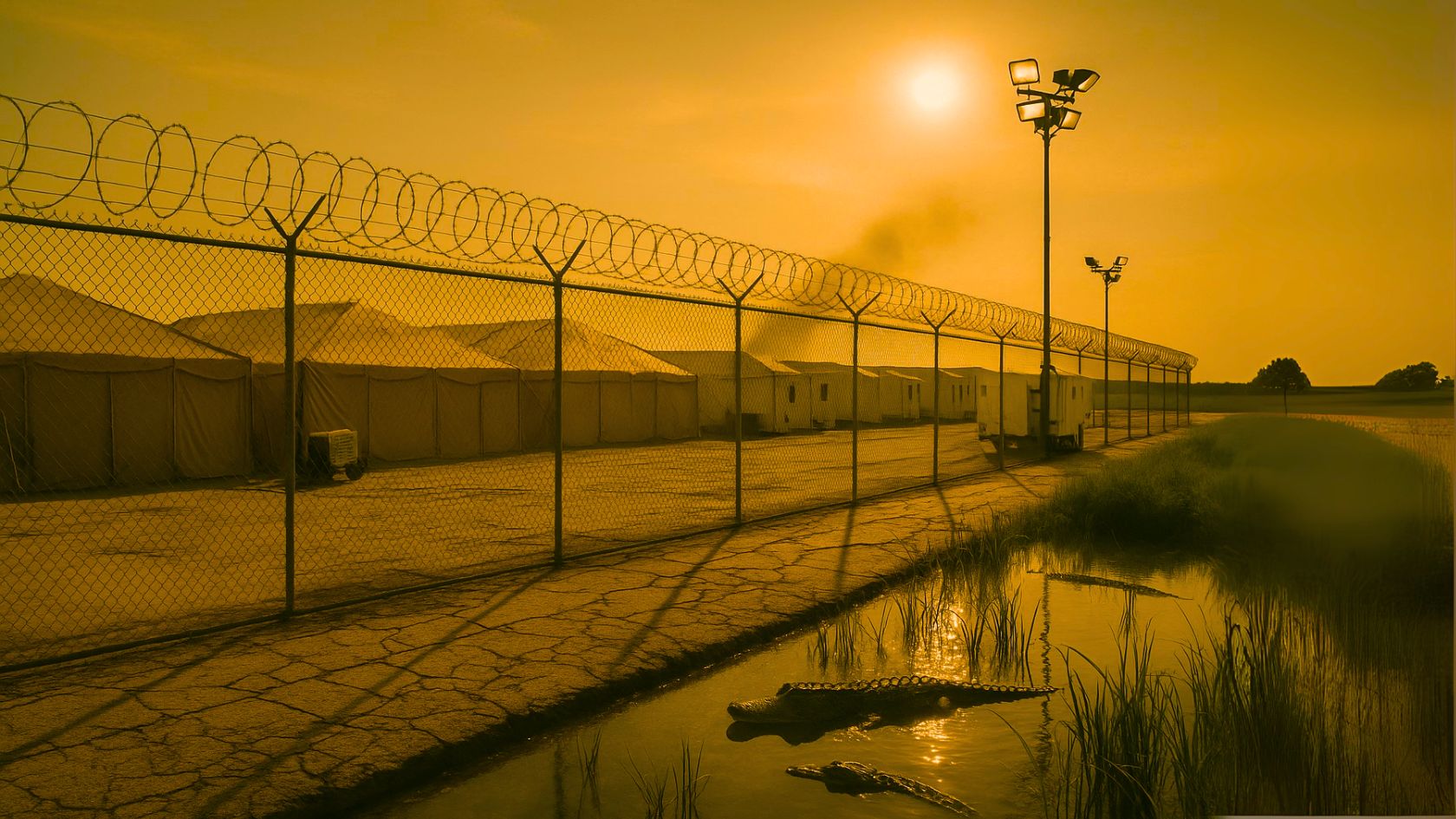
 Florida decided to build a prison in the swamp and call it policy. The official name was forgettable, but everyone knew it as Alligator Alcatraz. A migrant detention center thrown together on the abandoned runways of Dade-Collier, deep in the Everglades. They didn’t pour concrete or raise walls — they didn’t need to. The runway was already there, cracked and sun-bleached, stretching out like a landing strip for a bad idea.
Instead of bricks and mortar, they laid chain-link and razor wire. Instead of barracks, they set up rows of military tents and trailers. Metal poles planted into tarmac, canvas roofs that baked under the Florida sun, floodlights glaring down as if illumination could bleach out the reality. It looked less like a prison and more like a movie set where the theme was misery on a budget.
They sold it as deterrence. Politicians flew in on helicopters, toured the fences, and smiled for cameras. “This will send a message,” they said, pointing at families corralled like cattle. But the only message it sent was that cruelty can be made portable, temporary, and disposable — like a traveling circus that leaves wreckage behind when it moves on.
Conditions were as predictable as the design: heat thick enough to suffocate, water rationed, toilets overwhelmed, medical care delayed. Even guards whispered about how unworkable it was. Yet the same officials who crowed about toughness wouldn’t have lasted an afternoon under those tents. For detainees, it wasn’t optics. It was a sentence without a crime.
Locals called it an insult to the land. The swamp is harsh but alive — a place of sawgrass, birds, and alligators that adapted to the extremes. Dropping a prison camp into the Everglades wasn’t just inhumane. It was absurd. Generators hummed all night, diesel fumes fouling the air while the chorus of frogs and crickets fought to be heard. A habitat turned into a holding pen, desecrated for politics.
Then came the lawsuits. Environmental groups, tribal representatives, immigrant rights organizations — all converged. Not because Florida suddenly rediscovered its conscience, but because the project trampled laws as carelessly as it trampled the swamp. Judges listened. Orders came down. The nickname stuck — Alligator Alcatraz — but the timetable shrank. The place was never built to last.
And that’s the truth of it. The camp wasn’t meant as infrastructure. It was meant as theater. The runways and tents were props, the detainees unwilling actors, the audience a nation fed clips of toughness on the evening news. The cruelty was never a side effect. It was the feature.
When the fences come down and the tents are hauled away, the Everglades will still be there, scarred but resilient. The runway will keep cracking, grass forcing its way through. But the stain lingers: America built a prison on sacred land, called it immigration enforcement, and smiled for the cameras.
The gators in the swamp weren’t the dangerous ones. The real predators arrived in suits and ties, cut a ribbon, and called it justice.