Article I of Donald Trump—His Path to Authoritarianism
Origins, Family Structure, and the Road to NYMA
 Donald John Trump was born on June 14, 1946, in Jamaica Hospital, Queens, New York, into a family where hierarchy was neither abstract nor flexible — it was the organizing principle of both business and home. His father, Frederick Christ Trump, had already constructed a real estate empire across Brooklyn and Queens, capitalizing on the postwar housing boom, FHA mortgage guarantees, and wartime building programs. Fred’s success was not an accident of timing; it was the result of a relentless work ethic, calculated risk-taking, and political navigation. He viewed life as a series of transactions, each to be assessed for potential gain.
Donald’s mother, Mary Anne MacLeod Trump, arrived in the United States from the windswept Isle of Lewis in Scotland in 1930. She brought with her the values of a tight-knit, economically frugal community and the devout Presbyterian faith that would infuse the Trump household’s moral veneer. While Mary Anne tended to the domestic sphere and was known for her poise and hospitality, the gravitational force shaping the children’s upbringing was Fred Sr.’s worldview: life was a contest, and winning required not just effort, but dominance.
Donald was the fourth of five children: Maryanne, the disciplined scholar; Fred Jr., outgoing and affable; Elizabeth, private and reserved; Donald, assertive and restless; and Robert, the mild-mannered youngest. The children navigated their father’s high expectations differently. Maryanne pursued law, ultimately becoming a federal judge. Fred Jr., whose charm might have led him into the family business, chose aviation instead, becoming a pilot — a decision that alienated him from his father and, in Donald’s mind, stood as a cautionary tale about the cost of defying Fred’s model of success.
From the beginning, Donald displayed the behavioral patterns that would define him: high energy, a quick temper, and a natural instinct to assert control in group settings. These traits, while disruptive in the classroom, were not discouraged at home; competition among siblings was tolerated, even quietly encouraged. At the Kew-Forest School, a private academy in Queens where Fred Sr. served on the board, Donald earned a reputation among teachers for testing limits. Classmates recall a boy who sought attention through both charm and confrontation, with a calculated awareness of when to push and when to retreat.
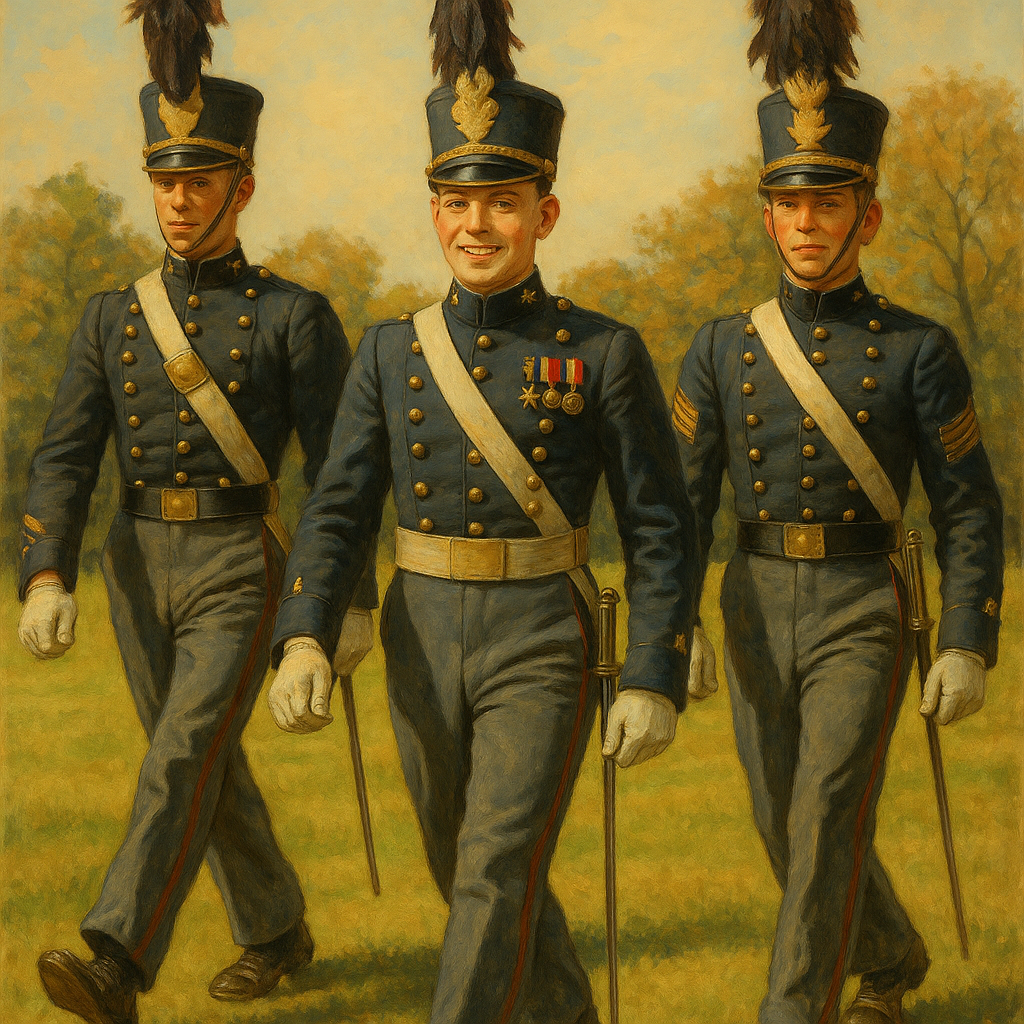
By age 13, Donald’s restlessness had escalated to a point where Kew-Forest’s administrators and his parents concluded that a different environment was necessary. Fred Sr., valuing discipline above all, decided on the New York Military Academy (NYMA) in Cornwall-on-Hudson — a structured, regimented boarding school modeled on West Point discipline. Here, cadets wore uniforms, drilled daily, adhered to strict schedules, and lived under the constant watch of faculty officers.
The move was intended to instill order in Donald’s life. At NYMA, conformity to the system was non-negotiable: cadets rose to bugle calls, marched in formation, and were subject to inspections for everything from uniform creases to the shine on their shoes. The chain of command was enforced in both letter and spirit, and leadership roles were earned through a blend of performance, discipline, and peer recognition.
Donald adapted quickly — not by suppressing his instinct for dominance, but by redirecting it into the school’s hierarchy. He excelled in athletics, particularly baseball, and cultivated relationships with both peers and superiors that advanced his position. In time, he was appointed to leadership roles within the cadet corps, responsibilities that conferred both prestige and visibility.
Yet for all its structure, NYMA reinforced an early lesson Donald had learned at home: that rules were tools to be mastered and leveraged, not blindly obeyed. His success at the academy owed as much to his ability to project authority and command attention as it did to any internalization of the school’s deeper codes of service and collective responsibility. In this way, NYMA refined his skills in navigating — and exploiting — structured systems for personal gain.
By his graduation in 1964, Donald Trump had mastered the optics of discipline and the performance of leadership. He left NYMA not as a reformed rule-breaker, but as a young man who understood how institutions conferred legitimacy on those who could work them to their advantage. That understanding would follow him into college, business, and eventually, politics — the foundation for a career built on commanding the stage, bending systems, and ensuring the narrative stayed centered on him.
Inside the New York Military Academy Experience
Donald Trump arrived at the New York Military Academy in 1959, entering a world where every day unfolded to the rhythm of bugle calls, inspections, and drills. The academy’s leadership believed that discipline was best learned through total immersion — cadets lived in close quarters, followed precise schedules, and navigated a strict chain of command that left no ambiguity about rank or authority. For many boys, the shift from home life to military school meant culture shock. For Donald, it was an opportunity.
He quickly sized up the institution as a system to be mastered. The rules were rigid, but they offered pathways to recognition: athletic achievement, visible leadership, and the ability to handle — or sidestep — discipline without losing face. The academy’s emphasis on competition played directly into his instincts. He joined the baseball team, where his performance as a first baseman and team captain gained him notice. He played football, embraced drill competitions, and found that visibility in sports could bolster his standing in the broader cadet hierarchy.
Trump’s athletic success was not simply a matter of physical ability. It reflected a keen understanding of how prestige flowed through the school: team captains were admired, publicly recognized, and positioned as role models — even if they were not paragons of moral conduct. His coaches and superiors noted his confidence, sometimes bordering on cockiness, but they also recognized his ability to deliver results on the field.
Academically, Trump was capable, though rarely distinguished. His attention was drawn more to leadership roles and the privileges that came with them. In time, he rose to the position of cadet captain, a rank that placed him in authority over other students and offered a measure of insulation from some of the petty rules he found constraining.
Life at NYMA was not without its tensions. The academy’s officers — many of them former military personnel — valued humility, service, and respect for the chain of command. Trump valued authority, but in a more personal sense: he respected it when it advanced his goals, and challenged it when it stood in his way. This dynamic sometimes put him at odds with the institution’s deeper ideals.
Still, the academy’s environment reinforced skills that would serve him later. He learned how to present himself as a disciplined leader while still pursuing his own interests first. He became adept at reading authority figures, gauging when to conform and when to push back. The rigid framework of military school gave him a stage on which to refine his public persona: confident, commanding, and focused on winning, whether in sports, status, or influence.
These years also sharpened his sense of the performative aspects of leadership. Trump understood that appearances — a crisp uniform, a visible role in a parade, a winning record in baseball — could be as powerful as substance. In a setting where symbolism mattered, he made sure to control the optics. The cadet captain who stood tall in inspections was the same young man who could maneuver behind the scenes to get what he wanted.
The New York Military Academy did not mold Donald Trump into a servant-leader in the traditional sense. Instead, it reinforced his belief that institutions could be navigated strategically — that the same rules that constrained others could be used to advance oneself if you understood how to work them. By the time he left in 1964, he had learned how to inhabit a system’s image of success without necessarily embracing its underlying values.
Command Presence and the Art of Institutional Navigation
By his final year at the New York Military Academy, Donald Trump was a fixture of its internal hierarchy. His position as a cadet captain gave him not only visible authority but also the practical benefit of shaping his daily reality within the confines of the school’s strict regimen. Cadet captains inspected other cadets, led drills, and were often the face of discipline rather than its recipient. For Trump, it was a status that validated his competitive drive — and one that demonstrated the leverage inherent in leadership roles.
His time at NYMA offered a clear lesson: in a system organized around rank and appearance, perception could carry as much weight as performance. Trump was not the top academic student, nor the most decorated athlete, but he was consistently in positions that projected command. The uniform, the posture, the presence at the head of a formation — these symbols signaled authority in ways that transcended any one measure of merit.
This understanding of optics was matched by a practical sense for working the rules. Fellow cadets later recalled that Trump was adept at finding the line between compliance and defiance, never so far out of bounds as to invite serious consequence, but often enough to remind others that his loyalty to the institution was conditional. The school valued discipline; Trump valued control. Where those overlapped, he thrived. Where they diverged, he maneuvered.
Athletics continued to be a platform for visibility. As captain of the baseball team, he was photographed, praised in local coverage, and given a prominent place in the academy’s public image. These moments reinforced the connection between personal branding and institutional endorsement — a theme that would echo throughout his business and political life.
Even in this structured environment, Trump’s ambition was not to become part of the system so much as to master it for his own purposes. His leadership style was less about cultivating consensus and more about directing outcomes. He delegated tasks, asserted authority, and expected compliance — a style that was effective in a setting where rank already predisposed subordinates to follow orders.
NYMA’s graduates often carried forward its emphasis on service and tradition. Trump carried forward its lessons in hierarchy, presentation, and strategic adaptation. The academy had not altered his competitive instincts; it had refined them into a set of tools he could apply in any structured environment — whether a corporate boardroom, a television set, or a political campaign.
By the time he graduated in 1964, Trump’s identity was anchored in a cultivated image of leadership: decisive, confident, and above the fray. The young man who left Cornwall-on-Hudson that spring was not a product of reformation, but of selective assimilation. He took from NYMA what reinforced his instincts and left behind what did not.
It was a mindset that would follow him to college, where the looser structures of civilian education would offer new arenas for testing — and showcasing — his ability to command attention and shape outcomes.
Graduation and the Threshold of a Larger Stage
Donald Trump’s final months at the New York Military Academy carried the cadence of a man preparing for his next act. He had secured his place in the academy’s leadership, his photograph prominent in yearbooks and press clippings, his reputation as an athlete and cadet captain firmly established. The institution, for all its rigor, had become a stage he knew how to command.
In the rituals of graduation — the parades, the inspections, the formal passing of rank — Trump understood he was stepping away from a controlled environment into one with fewer guardrails. Yet the habits NYMA had reinforced were already part of his operating system: use the structure when it serves you, project strength at all times, and ensure your presence is unmistakable.
The choice of his next move reflected both ambition and calculation. He would attend Fordham University in the Bronx, a Jesuit institution known for its academic seriousness, before transferring to the Wharton School at the University of Pennsylvania — a decision that would provide the Ivy League credential he prized. Even in this transition, the through-line from NYMA was evident: positioning mattered, and the name attached to your résumé could be as important as the content of your achievements.
For his family, particularly Fred Sr., Donald’s graduation was a confirmation that discipline could be engineered — that a restless, boundary-testing son could be molded into someone who could project the polish of a leader. For Donald, the lesson was subtler and more enduring: institutions grant authority to those who appear to embody their values, and those appearances can be curated.
He left Cornwall-on-Hudson not with the humility or collective spirit the academy might have hoped to instill, but with a sharpened sense of how to inhabit a role and bend it toward personal advantage. The uniform could be replaced with a business suit, the drill field with a boardroom, the cadet corps with a corporate staff — the formula would remain.
This chapter of Donald Trump’s life closed with the confidence of someone certain that the world beyond would offer larger arenas for the same game: a place where authority could be claimed, optics could be managed, and rules could be interpreted to favor the ambitious.
The boy who had once disrupted classrooms in Queens had learned to channel disruption into a persona of control. And as he prepared to enter the wider currents of the 1960s — a decade defined by upheaval, reinvention, and opportunity — he would carry forward the discipline, the strategic instincts, and the appetite for dominance honed within the walls of the New York Military Academy.