The Announcement and the Shockwave
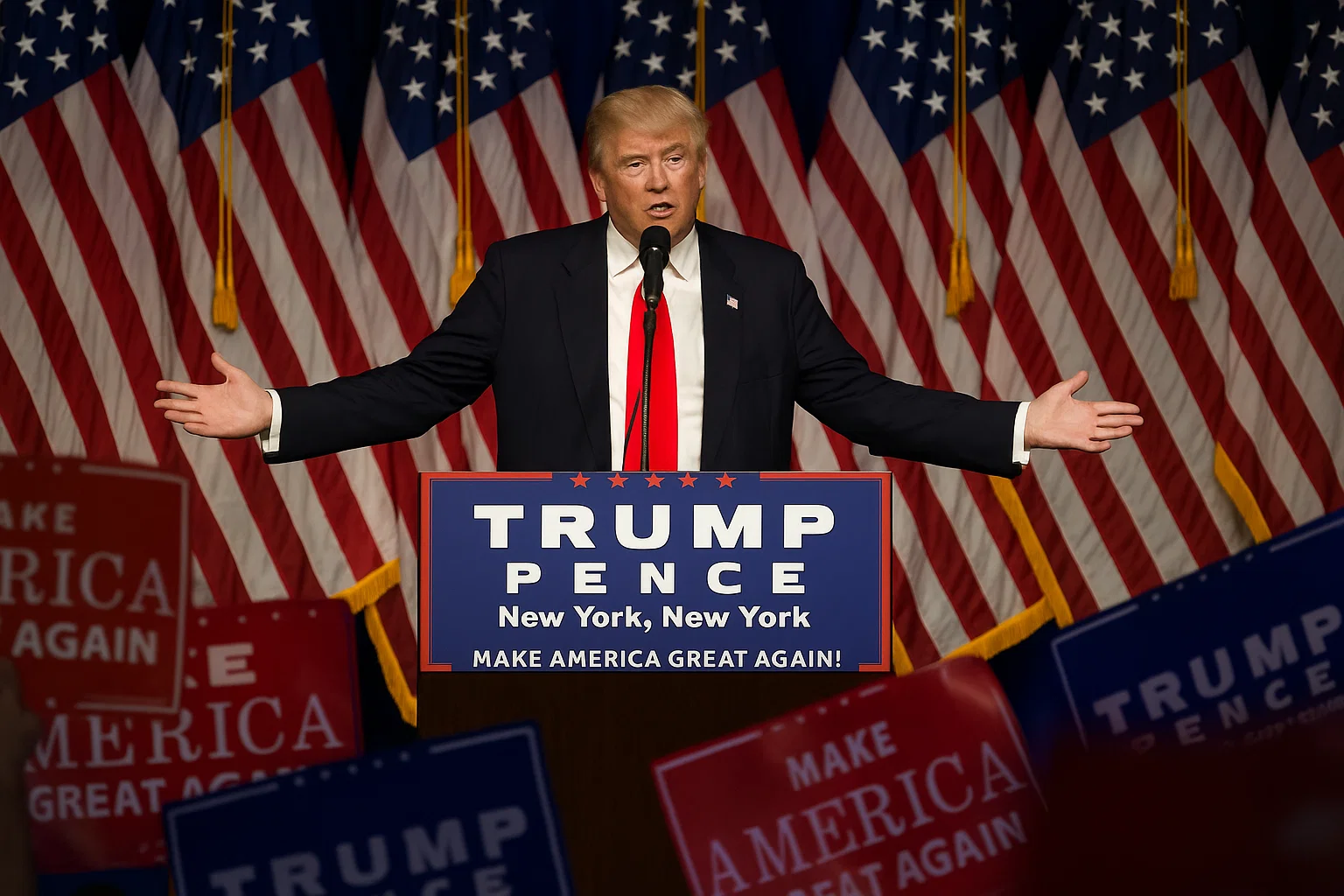
On June 16, 2015, Donald Trump stepped onto a stage in the atrium of Trump Tower, flanked by American flags, with cameras from every major network trained on the gold escalator he had just descended. In a speech that veered between scripted points and off-the-cuff provocations, he announced his candidacy for the presidency of the United States.
The moment was pure Trump: theatrical, media-savvy, and instantly polarizing. His rhetoric was blunt, particularly on immigration, where he accused Mexico of sending “rapists” and criminals across the U.S. border. The comments triggered immediate backlash from political leaders, business partners, and media outlets. But in the crowded Republican primary field, they also set him apart.
From the beginning, Trump’s campaign operated on a different wavelength than his rivals’. While other candidates adhered to traditional stump speeches and policy rollouts, Trump treated rallies as live performances, blending political messaging with the rhythms of a stand-up act — riffs, insults, applause lines, and moments designed for viral replay.
The media couldn’t look away. Cable networks aired his rallies in full, often unedited, because they drew ratings. In doing so, they handed Trump a level of exposure no other candidate could match without spending heavily on advertising. The coverage fed a feedback loop: the more outrageous his statements, the more coverage he received; the more coverage, the higher his poll numbers climbed among a segment of voters hungry for an outsider who defied political correctness.
Beneath the showmanship, Trump’s campaign tapped into real grievances: economic dislocation, distrust of political elites, and a perception that America’s global standing was slipping. His slogan, “Make America Great Again,” condensed these themes into a single, repeatable message — one that was broad enough to resonate across disparate groups, yet specific enough to signal a break from the status quo.
By the close of summer 2015, what many pundits had dismissed as a publicity stunt was transforming into the defining story of the Republican primary. Trump’s blend of celebrity aura, populist messaging, and combative rhetoric was proving more durable than anyone in the political establishment had anticipated.
Dominating the Primary Field
The Republican primary of 2016 began with an unprecedentedly crowded field — governors, senators, and seasoned political operatives all vying for the nomination. Conventional wisdom held that Trump’s initial surge in the polls would fade once the novelty wore off. Instead, he turned the structure of the debates, the pace of the news cycle, and the dynamics of social media into weapons against his rivals.
In debates, Trump abandoned the usual policy-laden exchanges. He attacked directly, often with nicknames that stuck — “Low Energy Jeb,” “Little Marco,” “Lyin’ Ted.” These labels were more than schoolyard taunts; they framed opponents in ways that resonated emotionally with voters and were difficult to shake. The approach broke every rule of political etiquette but followed the logic of branding: define your competitor before they define themselves.
On the trail, Trump’s rallies grew in size and fervor. They were part political event, part entertainment spectacle, with chants, call-and-response moments, and a stagecraft honed over decades in business and television. His unscripted style made every appearance unpredictable, ensuring constant media coverage. Even controversial remarks — perhaps especially controversial remarks — reinforced his image as a candidate who “told it like it is.”
Meanwhile, Trump’s campaign infrastructure operated differently from traditional campaigns. Leaner on staff and lighter on ground operations than his rivals, it relied heavily on earned media and the candidate’s ability to dominate the conversation. Social media, particularly Twitter, served as both megaphone and weapon, allowing Trump to bypass the press and speak directly to millions of followers at any hour of the day.
Policy proposals, when they came, were often framed in absolutes — building a wall along the southern border, banning Muslims from entering the United States “until our country’s representatives can figure out what is going on,” renegotiating trade deals to put “America First.” The simplicity of the language was a deliberate contrast to the nuanced, often technocratic rhetoric of his opponents.
By the spring of 2016, Trump had dispatched much of the Republican field, capturing a base that combined disaffected working-class voters, hardline conservatives, and independents drawn to his outsider persona. His march toward the nomination revealed not just the weakness of the party establishment, but the potency of a populist message delivered with the instincts of a showman.
The General Election Battle
With the Republican nomination secured in May 2016, Donald Trump turned his attention to the general election against Hillary Clinton — a contest that pitted a political outsider against one of the most experienced figures in American politics. The matchup was, in many ways, ideal for Trump’s insurgent campaign: Clinton embodied the establishment credentials he had spent the primary railing against, while he represented the anti-establishment fury coursing through parts of the electorate.
Trump’s general election strategy retained the hallmarks of his primary run: dominate media coverage, frame opponents with memorable attacks, and focus on broad, emotionally charged themes rather than detailed policy. “Crooked Hillary” became his defining label for Clinton, encapsulating years of conservative skepticism about her integrity in two words.
His rallies remained central to the campaign’s energy and message. They were larger and more frequent than those of his opponent, staged in states the Republican Party had often ignored, such as Michigan and Wisconsin. The choice to contest these Rust Belt states was strategic — Trump spoke directly to communities hollowed out by deindustrialization, promising to bring back manufacturing jobs, tear up trade deals like NAFTA, and revive an “America First” economic agenda.
Social media played an even greater role in the general election. Trump’s Twitter feed became both a news source and a controversy generator, enabling him to drive the day’s political conversation with a single post. The constant churn of attention — sometimes on policy, sometimes on personal attacks — kept the campaign unpredictable and the media perpetually reactive.
Clinton’s campaign emphasized experience, preparation, and a detailed platform, but struggled to match Trump’s command of the news cycle. The 2016 race unfolded in an environment saturated with political polarization, the aftermath of FBI investigations into Clinton’s use of a private email server, and the growing influence of misinformation campaigns on social media.
Trump’s message resonated strongly with voters who felt left behind by globalization and alienated from the cultural mainstream. His blunt style, rejection of political norms, and outsider status turned what had been expected to be a straightforward Clinton victory into one of the most volatile and closely watched races in modern history.
Election Night and Aftermath
On the night of November 8, 2016, much of the political world braced for what most polls and analysts had predicted — a Hillary Clinton victory. Early returns from the East Coast seemed to follow the expected pattern, but as results trickled in from the industrial Midwest, the map began to shift in ways few had foreseen.
Trump carried Ohio by a decisive margin, then flipped Pennsylvania, Wisconsin, and Michigan — states that had not voted Republican in a presidential election since the 1980s. His victories there were narrow but decisive, built on strong turnout from rural and working-class white voters, combined with underperformance for Clinton in key urban centers.
By the early hours of the morning, Donald Trump had crossed the 270 electoral vote threshold, securing the presidency. He had lost the national popular vote by nearly three million ballots, but under the Electoral College system, his state-by-state strategy delivered the win.
The aftermath was immediate and intense. For his supporters, the victory was a repudiation of the political establishment and a vindication of Trump’s unorthodox campaign. For his opponents, it was a stunning and alarming outcome — the elevation of a figure whose rhetoric and conduct had challenged democratic norms throughout the race.
In his victory speech at the Hilton in New York City, Trump struck a tone of unity, pledging to be “president for all Americans.” But the divisions that had defined the campaign were already hardening into the political realities of his presidency. His transition team, stocked with loyalists and outsiders, signaled a White House that would be run in his own style — unconventional, combative, and media-driven.
The 2016 election had revealed the potency of a populist campaign led by a figure who fused celebrity branding with political insurgency. It had also exposed deep fractures in American society — along lines of class, geography, race, and trust in institutions — that would define the years to come.
Donald Trump was now poised to test whether the instincts that had carried him from real estate to reality television to the presidency could be adapted to the most powerful office in the world. The campaign had been a performance of winning; the presidency would demand the practice of governing.