 The Inauguration and the Early Days
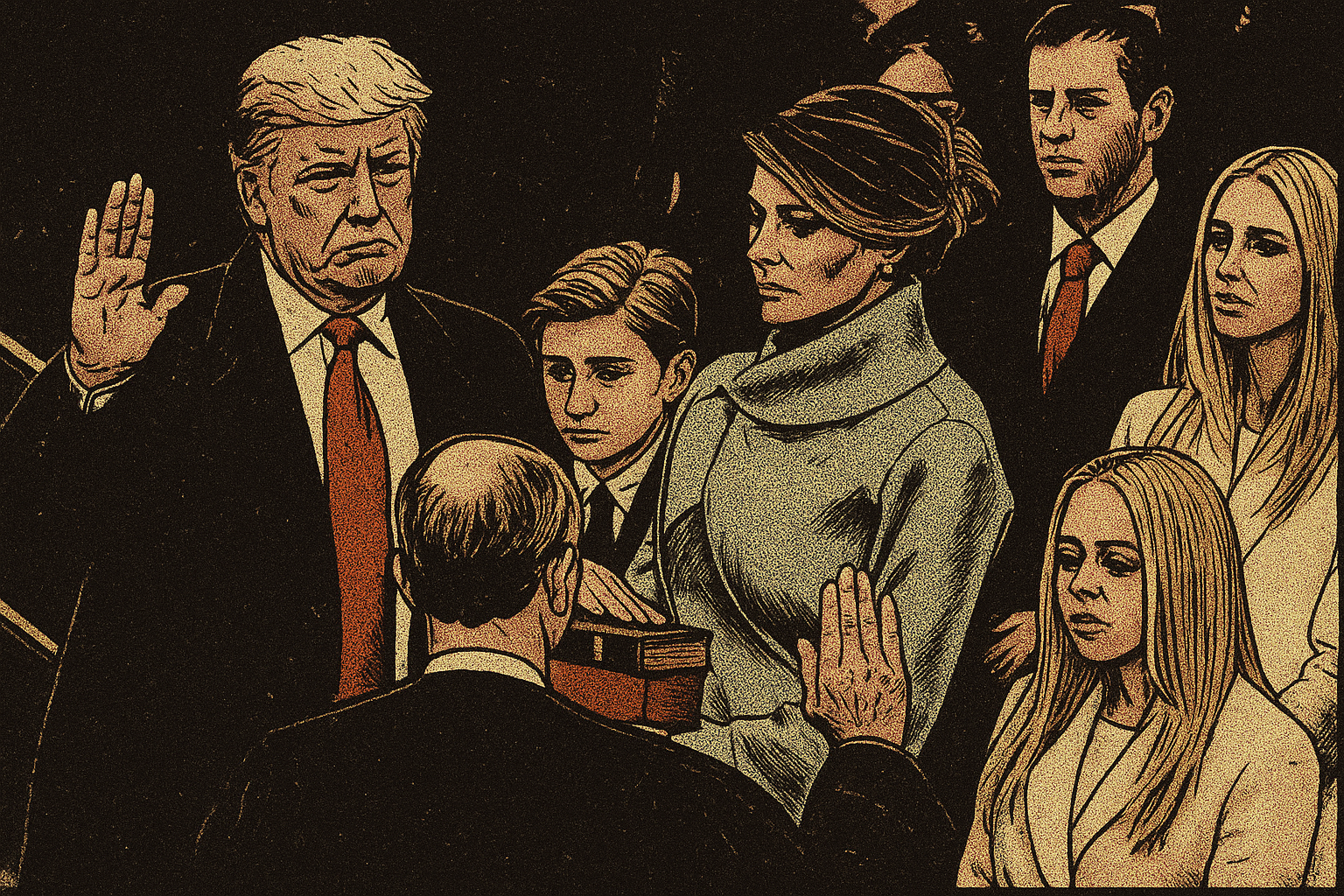
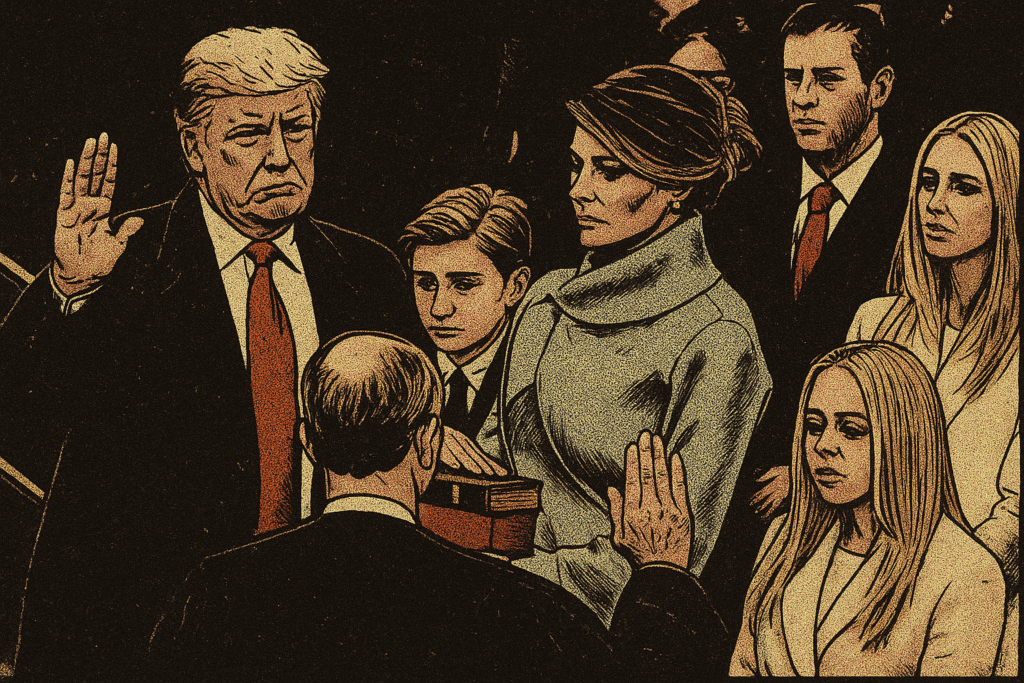
On January 20, 2017, Donald Trump took the oath of office on the west front of the U.S. Capitol, delivering an inaugural address that broke sharply with the bipartisan, unifying tone common to such moments. His speech painted a stark picture of “American carnage” — a nation beset by decaying infrastructure, shuttered factories, and communities left behind. It was a call to arms for his supporters, signaling that the outsider campaigner had no intention of softening into a conventional president.
The early weeks of the administration moved at breakneck speed. Trump signed a flurry of executive orders aimed at fulfilling campaign promises and signaling disruption: withdrawing from the Trans-Pacific Partnership trade deal, reinstating the “Mexico City” policy restricting foreign aid to groups that provide abortion counseling, and beginning the rollback of Obama-era environmental regulations.
Most controversial was the January 27, 2017 executive order banning travel from seven predominantly Muslim countries. Announced with little coordination across agencies, it triggered chaos at airports worldwide and mass protests in U.S. cities. The order was quickly challenged in court, setting the tone for a presidency defined by legal battles over the reach of executive power.
Trump’s governing style mirrored his campaign: highly personal, driven by instinct, and anchored in direct communication with the public via Twitter. Cabinet meetings, press conferences, and policy rollouts often carried the hallmarks of television staging, with the president as the central figure. His preference for loyalists over institutional expertise fueled turnover within the administration, as officials who clashed with his directives were replaced by those more willing to align with his approach.
The administration also moved swiftly to dismantle elements of the Affordable Care Act, enact aggressive immigration enforcement measures, and nominate Neil Gorsuch to the Supreme Court — a choice that energized conservatives and signaled a long-term shift in the judiciary.
The first months made clear that Trump’s White House would operate on a different rhythm from its predecessors — fast, combative, and willing to test the boundaries of presidential authority. For his base, this was evidence that he was delivering on his promise to shake up Washington. For critics, it was an early warning that the norms and guardrails of governance were being systematically eroded.
Legislative Battles and Power Consolidation
The first major test of Donald Trump’s legislative agenda came in the effort to repeal and replace the Affordable Care Act (ACA). Congressional Republicans, long united in opposition to the law, suddenly found themselves unable to agree on a replacement. After a series of high-profile failures in the Senate — culminating in John McCain’s dramatic thumbs-down vote in July 2017 — the repeal effort collapsed. The loss was a blow to Trump’s image as a dealmaker and underscored the limits of presidential influence when party factions were divided.
Still, Trump quickly pivoted to other priorities. Tax reform became the new legislative focus, and by December 2017, Congress passed the Tax Cuts and Jobs Act — the most significant overhaul of the U.S. tax code in three decades. The law slashed corporate tax rates, lowered individual rates, and eliminated the ACA’s individual mandate penalty. For Trump and Republican leadership, it was a major victory that delivered tangible benefits to businesses and wealthy individuals, while fueling debate over its long-term fiscal impact.
Beyond legislation, Trump devoted substantial energy to reshaping the federal judiciary. With the help of Senate Majority Leader Mitch McConnell, the administration confirmed a record number of federal judges in its first two years, including Supreme Court Justice Brett Kavanaugh in 2018. This judicial strategy — filling lifetime appointments with reliably conservative jurists — ensured that Trump’s influence would extend far beyond his presidency.
Immigration remained a central focus. The administration moved to end the Deferred Action for Childhood Arrivals (DACA) program, sought to reduce legal immigration through proposed changes to family-based visas, and escalated enforcement at the southern border. The “zero tolerance” policy in 2018 led to widespread family separations, sparking national outrage and international condemnation.
Internally, Trump tightened his grip on the executive branch. He replaced cabinet officials who resisted his directives with figures more closely aligned to his vision, blurring the lines between institutional governance and personal loyalty. National security and foreign policy saw a similar consolidation, with the president increasingly sidelining traditional interagency processes in favor of direct decision-making from the Oval Office.
By the midpoint of his term, Trump had shown an ability to rebound from legislative defeats by leveraging executive authority, judicial appointments, and administrative actions. For his allies, this was proof of adaptability and resilience. For his critics, it marked an erosion of checks and balances and a deliberate expansion of presidential power at the expense of democratic norms.
The Impeachment Saga
In the summer of 2019, Donald Trump faced the gravest challenge to his presidency yet: an impeachment inquiry stemming from a phone call with Ukrainian President Volodymyr Zelensky. A whistleblower complaint alleged that Trump had pressured Zelensky to announce investigations into former Vice President Joe Biden — a leading Democratic contender for 2020 — and his son, Hunter Biden.
The request was tied, implicitly and explicitly, to the release of nearly $400 million in congressionally approved military aid to Ukraine, a country embroiled in conflict with Russia. For Democrats, this was a textbook case of abuse of power: leveraging the foreign policy of the United States for personal political gain. For Trump and his allies, it was a “perfect call” — a legitimate discussion about corruption, mischaracterized by opponents seeking to overturn the results of the 2016 election.
The House of Representatives, controlled by Democrats, moved quickly. In December 2019, they approved two articles of impeachment: abuse of power and obstruction of Congress. The latter charge stemmed from the administration’s blanket refusal to comply with subpoenas or provide witnesses during the inquiry.
The Senate trial in early 2020 unfolded along partisan lines. Republican senators largely defended Trump’s actions or dismissed them as insufficient grounds for removal, while Democrats argued that acquittal would set a dangerous precedent for unchecked executive authority. On February 5, 2020, the Senate voted to acquit Trump on both counts. Only one Republican, Mitt Romney, broke ranks, voting to convict on the abuse of power charge.
The impeachment episode revealed the hardened political divisions of the Trump era. To his supporters, the acquittal was vindication and proof that the “deep state” and political establishment had overreached. To his opponents, it was evidence that partisan loyalty had eclipsed the constitutional role of Congress as a check on the presidency.
For Trump himself, the acquittal was not merely survival — it was an affirmation of his belief that defiance and counterattack were the most effective responses to political threats. The day after the Senate vote, he appeared before cameras, holding up a copy of The Washington Post with the headline “TRUMP ACQUITTED,” and declared victory.
Crisis and Opportunity in 2020
The final year of Donald Trump’s first term began with the glow of impeachment acquittal still fresh and the U.S. economy humming. Unemployment was at historic lows, stock markets were surging, and Trump entered the election year confident that his message of prosperity and disruption could carry him to a second term.
Then came the COVID-19 pandemic.
In January and February 2020, public health officials warned of the virus’s potential to spread rapidly, but Trump publicly downplayed its severity, suggesting it would “disappear” with warmer weather. His administration’s early response was fragmented, with conflicting messages from federal agencies and the White House. By March, as cases surged and states began imposing lockdowns, the pandemic became the defining crisis of his presidency.
Trump’s approach combined daily press briefings — often sprawling, contentious, and heavy on self-congratulation — with a shifting posture toward public health measures. He sparred with governors over mask mandates, business closures, and the distribution of critical medical supplies, casting himself as the defender of economic reopening against what he framed as excessive restrictions.
At the same time, he sought to control the political narrative. The administration promoted the rapid development of vaccines under “Operation Warp Speed,” a public-private partnership that would yield effective vaccines by year’s end. Yet Trump’s skepticism toward mask-wearing and his willingness to amplify unproven treatments deepened partisan divides over the pandemic response.
The summer of 2020 brought another flashpoint: nationwide protests following the killing of George Floyd by a Minneapolis police officer. Trump’s rhetoric was uncompromising, emphasizing “law and order” and condemning what he called “anarchists” and “agitators.” His decision to deploy federal forces to cities experiencing unrest, including the controversial clearing of Lafayette Square in Washington, D.C., to facilitate a photo opportunity outside St. John’s Church, intensified criticism from opponents who saw it as a politicization of federal law enforcement.
As the election approached, Trump framed the choice in apocalyptic terms, warning that a victory for Democratic nominee Joe Biden would mean the destruction of American prosperity and values. He cast himself as the only bulwark against socialism, chaos, and the erosion of national pride.
But the pandemic’s economic fallout, combined with disapproval of his handling of the crisis, eroded support among key demographics. When Trump himself contracted COVID-19 in October, requiring hospitalization at Walter Reed, it underscored the virus’s reach and the risks of his public defiance of health precautions.
On November 3, 2020, record numbers of Americans voted — many by mail due to the pandemic. Days later, media outlets projected Joe Biden as the winner. Trump refused to concede, alleging widespread fraud without providing evidence that could withstand judicial scrutiny. In the weeks that followed, his efforts to challenge the results would transform into a campaign not to govern, but to overturn — setting the stage for the most turbulent post-election period in modern U.S. history.