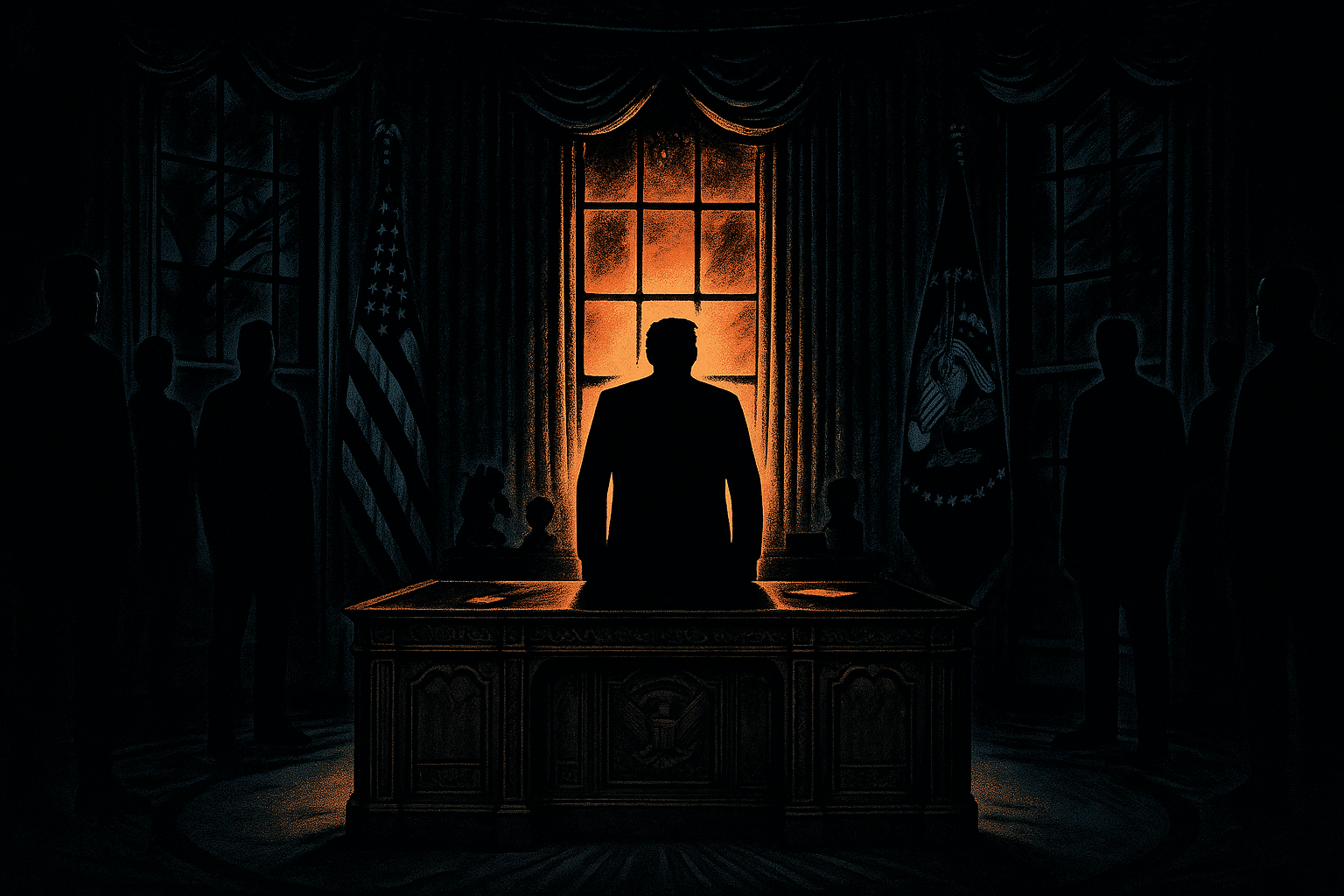
 A Second Ascendancy
Donald Trump’s return to the center of American politics was not a simple reentry — it was the culmination of years spent refining his grip on the Republican Party, shaping a political movement around his persona, and stress-testing the system for vulnerabilities. By the time the 2024 election year began, Trump no longer framed himself merely as a candidate; he was the indispensable leader of a cause, a role that blurred the line between political figure and movement icon.
The opening months of his renewed campaign showed a clear evolution in strategy. Gone was the outsider posture of 2016; in its place stood a figure who had already held the presidency, knew the levers of power intimately, and had learned how to bend them toward personal ends. His rhetoric was openly retributive — promising to root out “traitors” within the government, overhaul the civil service to install loyalists, and wield the Justice Department against those he claimed had targeted him.
Policy proposals, though often thin on detail, reflected a hardening of earlier positions. Immigration enforcement was to be more aggressive, trade policy more protectionist, and the presidency itself more centralized under his direct control. He made no secret of his intent to reshape the executive branch into a more pliant instrument of his will, dismissing the checks that had constrained him in his first term as obstacles to be removed.
Campaign rallies once again became focal points, drawing tens of thousands to stadiums and fairgrounds across the country. The atmosphere was a blend of political rally, entertainment spectacle, and loyalty ritual. Speeches veered from grievances about the past to apocalyptic visions of the future if his movement failed. Supporters were no longer just voting for a leader — they were pledging themselves to a mission.
Internationally, Trump’s rhetoric signaled a more transactional approach to alliances, framing foreign policy as a series of deals in which loyalty to U.S. priorities — as he defined them — was paramount. He hinted at reducing American commitments abroad unless partner nations contributed more, while suggesting a willingness to strike new bargains with adversaries if it served his conception of national interest.
The authoritarian tendencies critics had long warned about were now openly articulated as governing intentions. Trump’s second ascendancy was not about adapting to the system but about reshaping it entirely — consolidating authority, rewarding loyalists, and punishing dissent.
Governing Without Guardrails
In his earlier presidency, Donald Trump had often run headlong into the institutional guardrails of the American system — career civil servants, independent inspectors general, congressional oversight, and even members of his own party who balked at his demands. In his second ascendancy, those obstacles were fewer and weaker. This was by design.
From the outset, Trump moved to ensure that key positions across the executive branch were filled not with seasoned bureaucrats, but with individuals whose primary qualification was personal loyalty. The goal was to prevent the kind of internal resistance that had slowed or blocked his initiatives in the first term. Agencies that had once operated with a measure of independence found themselves increasingly tethered to the political agenda emanating from the Oval Office.
The Justice Department, in particular, became a central focus. Trump signaled that it would be used not just to enforce the law, but to advance his political objectives — from prosecuting political opponents to shielding allies from scrutiny. Critics decried the erosion of prosecutorial independence, while supporters applauded what they saw as the long-overdue dismantling of a “weaponized” bureaucracy.
Congress, too, found its oversight powers diminished. In a political climate where Republican lawmakers largely aligned with Trump’s agenda, investigative efforts into the administration’s conduct were rare and muted. Legislative priorities were increasingly shaped by the White House, and the traditional give-and-take between branches of government gave way to a top-down model in which loyalty to the president often outweighed loyalty to the institution.
Foreign policy further reflected the consolidation of decision-making. Negotiations, military postures, and diplomatic signals were often conducted directly by Trump or a small circle of trusted aides, bypassing the State Department’s formal processes. Alliances were transactional, adversaries were courted or confronted according to personal calculations, and long-standing diplomatic norms were treated as optional.
Domestically, dissent within the executive branch was less visible, not because disagreements had vanished, but because those who voiced them rarely remained in their positions for long. Whistleblower protections were undermined, internal dissent channels curtailed, and loyalty tests became a routine feature of senior appointments.
In this environment, the presidency began to resemble less a co-equal branch of government and more the central command of a personalized political enterprise. For Trump’s supporters, this was the fulfillment of his promise to “take control” and make government serve his vision. For his critics, it was the clearest sign yet that American governance was sliding toward a model in which power was concentrated in the hands of one man, unchecked and unaccountable.
The Machinery of Control
The durability of Trump’s second ascendancy rested not only on personal authority but on a carefully constructed machinery of control — an interlocking set of political, legal, and cultural levers that reinforced his position and made dissent increasingly costly.
At the political level, the Republican Party functioned less as an independent coalition and more as an extension of the president’s brand. Primaries were shaped by Trump’s endorsements, and incumbents knew that a single critical remark could invite a challenger backed by his formidable fundraising network. State-level party organizations were similarly aligned, with leadership posts often filled by figures openly committed to advancing his priorities and shielding him from internal opposition.
Legally, Trump sought to reshape the judiciary further, nominating judges who not only embraced conservative legal principles but were also sympathetic to an expansive view of presidential power. Court appointments became a strategic bulwark against challenges to executive actions, ensuring that disputes over controversial policies — from immigration crackdowns to expansive surveillance measures — would encounter a favorable bench.
The media environment was equally crucial. Conservative outlets amplified the administration’s narratives, while Trump’s own platforms — especially Truth Social — provided unfiltered channels to his supporters. This direct communication bypassed traditional gatekeepers, allowing him to frame events, discredit critics, and mobilize followers without the risk of editorial interference. At rallies, press sections were cast as adversaries, reinforcing a climate in which skepticism toward independent journalism became a badge of loyalty.
Federal agencies were harnessed to serve political aims. Regulatory bodies targeted industries and organizations perceived as hostile, while providing favorable rulings or contracts to allies. Intelligence and law enforcement agencies, once wary of political entanglement, were steered toward priorities that aligned with the White House’s messaging — from voter fraud investigations to probes of political opponents.
Culturally, Trump’s influence extended deep into the conservative grassroots. Churches, advocacy groups, and local media markets adopted his rhetoric wholesale, framing political disputes in existential terms. In this narrative, opposition to Trump was not merely political disagreement — it was betrayal of the nation itself. This framing both galvanized supporters and discouraged defection, as breaking ranks came with the risk of social ostracism, loss of livelihood, or even threats of violence.
The machinery was self-reinforcing: political loyalty ensured legal insulation, legal insulation protected political dominance, and media control kept the base mobilized and distrustful of alternative narratives. By mid-term, the president’s position was less a matter of winning individual policy battles and more about maintaining the system that made his authority unquestionable within his sphere.
Legacy and Reckoning
By the time Donald Trump’s second ascendancy reached its apex, the question was no longer whether he had transformed the American presidency, but whether the institution could ever fully revert to its pre-Trump form. The scope of his imprint extended far beyond the policies enacted or the judges appointed; it lay in the altered expectations of what a president could do, how power could be wielded, and what norms could be discarded without fatal consequence.
His allies pointed to economic gains in favored sectors, hardline immigration enforcement, renegotiated trade deals, and a more combative stance against perceived adversaries both foreign and domestic. They hailed his willingness to reject globalist frameworks, confront entrenched bureaucracies, and speak bluntly in ways that shattered diplomatic convention. For them, Trump’s legacy was a reclamation of national sovereignty and a model for unapologetic leadership.
For his critics, the same record told a different story: the corrosion of democratic institutions, the politicization of law enforcement, the subjugation of truth to propaganda, and a governing ethos that placed personal loyalty above constitutional duty. They argued that Trump had not merely tested the guardrails of democracy — he had demonstrated how fragile they were, and how easily they could be bent to the will of a determined leader with a loyal base.
The reckoning extended beyond Trump himself. His tenure had redefined the relationship between the presidency and the other branches of government, between the federal government and the states, and between leaders and the public. Political discourse became more tribal, less tethered to shared facts, and more prone to existential framing. Trust in institutions, already eroding before his rise, fractured further under the relentless strain of partisan warfare.
Internationally, America’s reputation shifted. Allies weighed U.S. commitments through the lens of personal politics, wary that future administrations might swing as dramatically as the Trump era had. Adversaries studied the internal divisions and governance shifts as opportunities to exploit. The perception of American stability — once a strategic advantage — was now tempered by the memory of rapid, personality-driven policy swings.
As Trump’s influence persisted — whether in office or as the central figure of a movement — the American political landscape entered an era in which the boundaries between campaigning and governing, truth and narrative, institution and personality were more blurred than at any point in modern history.
The legacy was thus twofold: a transformed presidency, and a transformed electorate. In reshaping one, Trump had irrevocably altered the other. The reckoning for both — how they would adapt, resist, or further evolve — would be the work of years, perhaps decades to come.