Revision 1
 I. Introduction & Framing
Robert Francis Kennedy, Jr. stands as one of the most polarizing public figures in twenty-first-century America. His trajectory—spanning environmental litigation, high-profile activism, and ultimately a disruptive presidential campaign—embodies both the legacy of the Kennedy family name and its fractures. Where John F. Kennedy projected Cold War liberal optimism and Robert F. Kennedy Sr. cultivated a reputation for moral courage and progressive reform, Robert F. Kennedy, Jr. carved out a far less predictable path, marked by moments of professional achievement, public controversy, and ideological drift across the political spectrum.
This biography examines the life and career of Kennedy in depth. It begins with his upbringing in the most famous political family of modern America, a household simultaneously steeped in privilege and marred by tragedy. It then turns to his early legal career, where Kennedy gained prominence as a leading environmental lawyer. From there, the narrative tracks his shift into vaccine skepticism and civil liberties litigation, culminating in his independent run for the presidency in 2024.
The analysis draws on verifiable records: court filings from Riverkeeper lawsuits, congressional testimony, archival news articles, campaign finance documents, and contemporaneous press coverage. The aim is neither hagiography nor condemnation but a clear-eyed account of how one individual, armed with the Kennedy name and an unconventional set of convictions, shaped national debates on environment, health policy, and political legitimacy.
II. Family Legacy & Early Life
Robert F. Kennedy, Jr. was born on January 17, 1954, in Washington, D.C., the third child of Robert Francis Kennedy and Ethel Skakel Kennedy. His father, then serving as U.S. Attorney General under President John F. Kennedy, was a central figure in American politics—advisor to the president, architect of the Justice Department’s civil rights initiatives, and a fierce opponent of organized crime.
The Kennedy family estate, Hickory Hill in McLean, Virginia, became the backdrop of Robert Jr.’s formative years. The property, often filled with cousins, siblings, and visiting dignitaries, was a blend of rambunctious family life and political theater. Visitors included civil rights leaders, cabinet officials, and cultural figures of the 1960s.
The weight of family legacy was evident from an early age. Robert Jr.’s uncle, President John F. Kennedy, was assassinated in 1963 when Robert Jr. was nine years old. Five years later, his father was murdered during his own presidential campaign. The trauma of these events, compounded by the constant public scrutiny surrounding the Kennedy name, shaped the worldview of the children who survived. Robert Jr. has described himself in later interviews as struggling to reconcile the public expectations of the Kennedy name with the personal grief that defined his adolescence.
His education reflected both privilege and instability. He attended private Catholic schools, then Harvard College, where his academic record was marked by interruptions tied to personal struggles. Later, he enrolled at the University of Virginia School of Law, where he obtained his Juris Doctor, and continued his studies at Pace University School of Law, earning an LL.M. in environmental law.
The turbulence of Robert Jr.’s youth culminated in a well-publicized arrest in 1983 for heroin possession. The case, covered extensively by the press, ended with probation and community service. For a Kennedy, the fall was spectacular; for Robert Jr., it became a turning point. His community service placement at Riverkeeper, then a small nonprofit battling industrial polluters along the Hudson River, introduced him to the work that would define his professional life for the next two decades.
III. Legal Career & Environmental Advocacy
Riverkeeper and the Hudson River Cases
Riverkeeper was founded in 1966 by a group of recreational and commercial fishermen on the Hudson River frustrated with decades of industrial pollution. By the 1980s, the Hudson was still plagued by raw sewage discharges, oil spills, and chemical effluents. Kennedy, fresh from his legal troubles, joined as a volunteer attorney and quickly became its chief prosecuting attorney.
Through Riverkeeper, Kennedy pursued litigation under the Clean Water Act, a statute empowering citizens to bring suits against polluters when state or federal authorities failed to act. Kennedy’s cases targeted industrial facilities discharging untreated waste, municipal sewage systems failing to meet federal standards, and companies overfishing or degrading the river’s ecology.
Notable victories included settlements with ExxonMobil and General Electric over river contamination, as well as injunctions against smaller polluters discharging toxic substances. These cases generated millions of dollars in penalties and restoration funds, which were redirected toward environmental remediation and Riverkeeper’s continued enforcement work.
Natural Resources Defense Council
In addition to his work with Riverkeeper, Kennedy served as a senior attorney for the Natural Resources Defense Council (NRDC), a national environmental advocacy organization. At NRDC, he expanded his focus beyond the Hudson River to national issues including mountaintop removal coal mining in Appalachia, mercury contamination from power plants, and fossil fuel infrastructure development. His work emphasized the linkage between environmental degradation and public health.
Kennedy was known for aggressive rhetoric, describing polluters as criminals and environmental enforcement as a matter of defending democracy itself. He framed environmental destruction not merely as an ecological issue but as a violation of human rights.
Teaching and the Environmental Litigation Clinic
At Pace University School of Law, Kennedy co-directed the Environmental Litigation Clinic, which functioned as a partnership between the law school and Riverkeeper. Students in the clinic prosecuted polluters under Kennedy’s supervision, drafting complaints, collecting evidence, and appearing in court. The clinic became a national model for practical environmental law training.
National Reputation
By the late 1990s and early 2000s, Kennedy had become one of the most recognizable environmental lawyers in the United States. He testified before Congress, published op-eds in major newspapers, and delivered speeches across the country. His books, including Crimes Against Nature (2004), argued that the Bush administration had subordinated environmental protections to corporate interests. Kennedy’s reputation as a fierce advocate for clean water and public health was, at that time, largely bipartisan.
IV. Vaccine Skepticism & Public Health Conflict
Robert F. Kennedy, Jr.’s transition from mainstream environmental lawyer to a central figure in vaccine skepticism represents the defining pivot of his public life. Beginning in the early 2000s, Kennedy increasingly shifted his focus from clean water litigation to questions of medical policy, corporate capture, and public health. What began as an investigation into mercury exposure expanded into a full-scale critique of vaccination programs and the agencies that administered them.
Early Concerns: Mercury and Thimerosal
The roots of Kennedy’s vaccine skepticism trace back to his longstanding concern with mercury pollution. In his environmental advocacy, Kennedy frequently highlighted the dangers of mercury emissions from coal-fired power plants and their effect on fisheries and human health. By the late 1990s, he became aware of thimerosal, a mercury-containing preservative used in some vaccines.
Kennedy argued that thimerosal posed neurological risks to children and contributed to rising autism diagnoses. Although major studies consistently failed to demonstrate a link, Kennedy became convinced that regulatory agencies and pharmaceutical companies were suppressing evidence of harm.
In 2005, Kennedy published an article titled Deadly Immunity in Rolling Stone and Salon. The piece alleged collusion between the Centers for Disease Control and Prevention (CDC), the Food and Drug Administration (FDA), and vaccine manufacturers to obscure the dangers of thimerosal. The article received wide circulation but was later retracted by Salon due to factual errors and disputed sourcing. Kennedy, however, stood by its central claims.
Children’s Health Defense
In 2011, Kennedy co-founded the World Mercury Project, which later evolved into Children’s Health Defense (CHD). The organization became a hub for advocacy against vaccines, electromagnetic fields, and other perceived environmental health threats. Its website and social media channels regularly published reports questioning vaccine safety, alleging corruption within the pharmaceutical industry, and challenging the integrity of regulatory science.
Children’s Health Defense grew rapidly during the 2010s, supported by donations and by Kennedy’s ability to leverage his family name. The organization engaged in litigation, lobbying, and public education campaigns. Critics, including medical associations and public health agencies, characterized CHD as one of the leading sources of vaccine misinformation in the United States.
Vaccine-Autism Debate
Central to Kennedy’s advocacy was the claim that vaccines contributed to autism spectrum disorders. This claim originated from the discredited 1998 study by Andrew Wakefield, which had been retracted and debunked. Nonetheless, Kennedy amplified the argument, insisting that federal agencies had failed to adequately investigate potential links.
Scientific consensus, reinforced by multiple large-scale epidemiological studies, consistently rejected the claim. Organizations including the National Academy of Sciences, the CDC, and the World Health Organization affirmed that vaccines did not cause autism. Despite this, Kennedy’s position attracted parents frustrated by rising autism diagnoses and distrustful of government assurances.
Confrontations with Public Health Institutions
Kennedy’s positions placed him in direct conflict with mainstream medical organizations. The American Academy of Pediatrics, the CDC, and leading universities issued statements refuting his claims. Kennedy, in turn, accused these institutions of regulatory capture and of acting to protect pharmaceutical profits rather than public health.
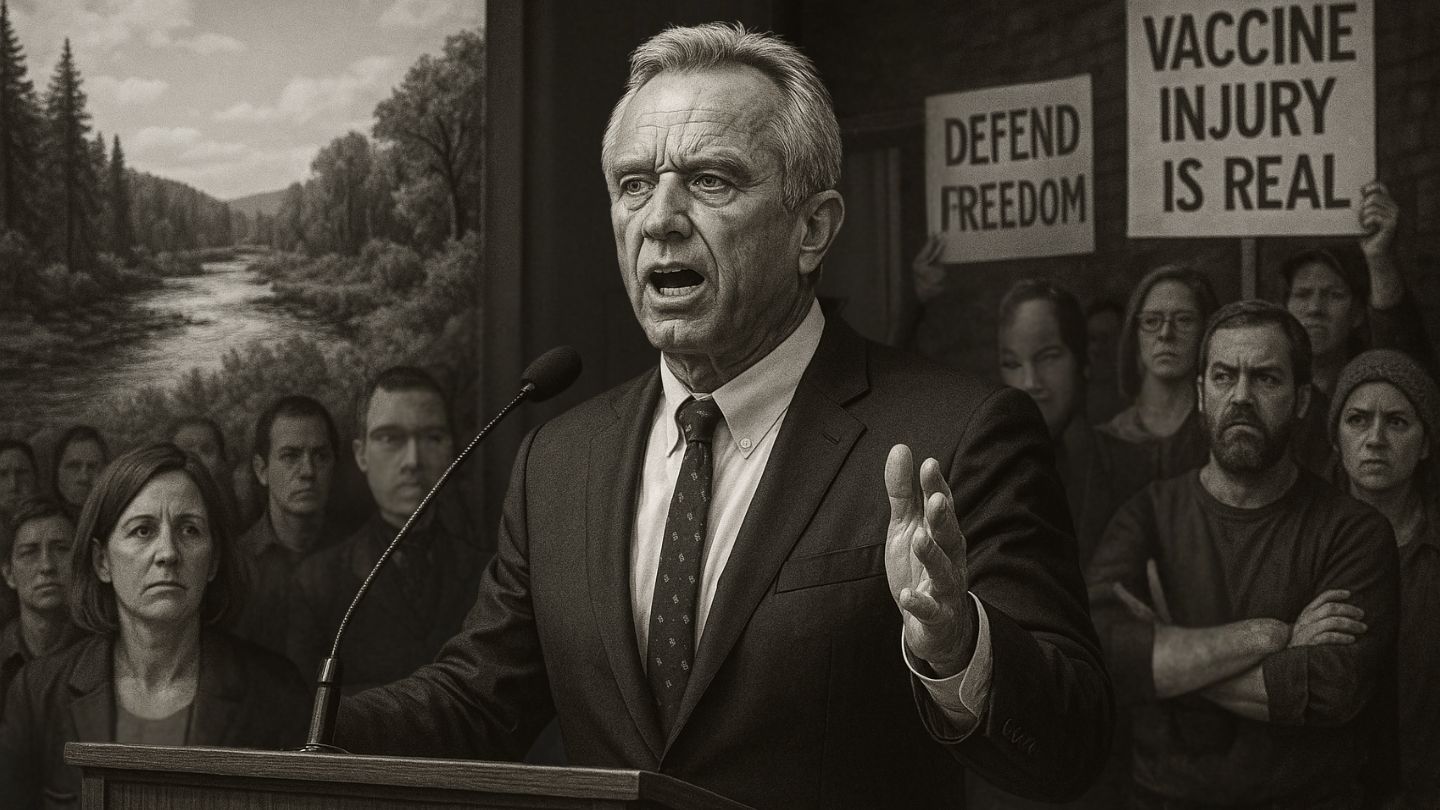
His rhetoric increasingly invoked constitutional language. Kennedy argued that parental rights and bodily autonomy were under assault by mandatory vaccination laws. He characterized exemptions as a matter of civil liberties and warned against what he saw as creeping authoritarianism in public health policy.
The COVID-19 Pandemic
The outbreak of COVID-19 in 2020 catapulted Kennedy into the center of global public health debates. As governments implemented lockdowns, mask mandates, and emergency vaccine authorizations, Kennedy became a leading voice of opposition.
Through Children’s Health Defense, Kennedy challenged government restrictions as unconstitutional, argued that mRNA vaccines had not been adequately tested, and claimed that pharmaceutical companies wielded excessive influence over policy. He filed lawsuits against federal agencies, alleging censorship of CHD content by social media platforms at the behest of government officials.
Kennedy’s speeches during this period framed the pandemic response as a battle between liberty and authoritarianism. At rallies in Washington, D.C., and other cities, he warned of government overreach and likened public health mandates to historical episodes of tyranny. His language drew criticism for invoking comparisons to Nazi Germany, which he later walked back but did not retract.
Litigation and Legal Arguments
Children’s Health Defense pursued litigation on multiple fronts. Cases alleged violations of the First Amendment, claiming that the federal government had pressured technology companies to suppress dissenting views about vaccines and public health. Other suits challenged state-level vaccine mandates for schools and healthcare workers.
While most cases were dismissed at early stages, they established Kennedy and CHD as central actors in the “censorship” debate surrounding COVID-19. Federal courts generally found that content moderation decisions by private companies did not constitute state action, though appeals continued into the mid-2020s.
Public Reception
Kennedy’s stance divided the public. To supporters, he was a courageous whistleblower standing against powerful corporate and governmental interests. To critics, he was a purveyor of dangerous misinformation whose claims undermined public trust and contributed to preventable deaths.
Polling during the pandemic revealed that Kennedy’s approval ratings were deeply polarized. Among Republicans skeptical of mandates, his favorability was high. Among Democrats and independents who accepted the scientific consensus, it was sharply negative.
Shift Toward Political Candidacy
By 2022, Kennedy’s prominence in public health debates had outgrown his earlier identity as an environmental lawyer. His base of support now included libertarian activists, vaccine skeptics, and populist conservatives. This coalition provided the foundation for his presidential campaign, formally announced in April 2023.
Kennedy’s embrace of vaccine skepticism ensured that his candidacy would remain controversial. While his campaign emphasized themes of transparency and freedom, vaccine policy remained a central issue for supporters and detractors alike. His speeches continued to frame the vaccine debate as part of a broader struggle against censorship and centralized control.
Legacy of Public Health Conflict
Kennedy’s advocacy reshaped his legacy. For decades, he had been celebrated as a defender of rivers, forests, and communities harmed by pollution. By the 2020s, his name was more closely associated with opposition to vaccines and government health mandates. Whether this shift represented principled continuity—extending his critique of corporate power into the medical realm—or a departure into conspiracy politics remains a subject of debate.
What is clear is that Kennedy’s voice, amplified by Children’s Health Defense, helped fuel one of the most consequential public debates of the early 21st century. At a time when public trust in institutions was already fragile, his claims contributed to a national polarization over science, liberty, and the role of government.
V. Political Trajectory & 2024 Presidential Campaign
Early Political Positioning
Before announcing his candidacy for president, Robert F. Kennedy, Jr. was already a familiar figure in political discourse. His family’s deep ties to Democratic politics positioned him as a natural inheritor of liberal traditions, but his public positions had, by the 2010s, placed him increasingly at odds with mainstream Democrats. While his environmental litigation aligned with progressive policy goals, his vaccine skepticism distanced him from the party’s public health agenda.
Throughout the early 2000s and 2010s, Kennedy endorsed Democratic candidates, appeared at party functions, and occasionally advised on environmental issues. Yet he was never a central figure in the Democratic establishment. His role was more symbolic: a Kennedy who remained active in politics but increasingly outside the party’s core consensus.
Announcement of Candidacy
On April 19, 2023, Kennedy formally announced his candidacy for the Democratic nomination for president. The launch took place in Boston, Massachusetts—a deliberate choice symbolizing continuity with his family’s political heritage. His campaign speech emphasized themes of freedom, transparency, and accountability. He criticized corporate influence, government censorship, and the erosion of civil liberties.
The announcement drew immediate media attention, both because of his surname and because of his high-profile positions on vaccines. Early coverage portrayed him as a long-shot candidate but noted that his entry reflected broader discontent within the Democratic electorate.
Campaign Themes
Kennedy’s campaign was organized around several core themes:
- Restoring Trust in Government: He argued that federal agencies, including the CDC, FDA, and EPA, had been compromised by corporate influence. His message resonated with voters who distrusted institutional authority.
- Freedom and Civil Liberties: Kennedy consistently invoked the Constitution, framing his opposition to vaccine mandates, censorship, and government overreach as a defense of personal freedom.
- Environmental Protection: He reaffirmed his long-standing commitment to environmental issues, though this was less central to his campaign than in his earlier career.
- Economic Populism: Kennedy criticized income inequality, corporate consolidation, and trade policies that he argued harmed American workers.
- Foreign Policy Restraint: He warned against military entanglements abroad, particularly in Ukraine, and called for reduced defense spending and greater diplomatic engagement.
Democratic Primary Campaign
Kennedy’s initial campaign targeted the Democratic electorate, but he quickly encountered resistance. Party officials, allied organizations, and mainstream Democratic voters were skeptical of his vaccine positions and his alignment with right-leaning populist rhetoric.
Polling in mid-2023 placed Kennedy at 10–15 percent support among Democratic primary voters, with higher numbers among independents. While these numbers were significant for an insurgent candidate, they were insufficient to challenge President Joe Biden, who announced his re-election bid.
Transition to Independent Candidacy
In October 2023, Kennedy declared that he would continue his campaign as an independent candidate. He cited structural barriers within the Democratic Party and accused party leadership of suppressing dissent. The decision was framed as a principled stand for democracy and political pluralism.
Running as an independent posed logistical challenges, including ballot access, fundraising, and debate inclusion. Kennedy’s campaign organized signature drives in key states and fought legal battles over ballot placement. The effort consumed significant resources but succeeded in securing access in most battleground states.
Coalition of Support
Kennedy’s independent campaign sought to build a coalition across ideological divides. His supporters included:
- Disaffected Democrats: particularly those skeptical of corporate influence or disillusioned with Biden.
- Libertarians: who appreciated his opposition to vaccine mandates, censorship, and military interventions.
- Populist Conservatives: drawn to his critiques of government overreach and his skepticism of establishment institutions.
- Environmentalists: though many had distanced themselves from his vaccine positions, some remained aligned with his anti-corporate rhetoric.
This coalition was diverse but unstable. It reflected broader trends in American politics, where distrust of institutions created new alliances across traditional party lines.
Campaign Organization and Strategy
Kennedy’s campaign leveraged alternative media, podcasts, and social platforms more heavily than traditional advertising. He made frequent appearances on long-form interview programs, including podcasts with wide audiences outside mainstream political coverage. This allowed him to bypass conventional media filters and speak directly to supporters.
The campaign also emphasized grassroots fundraising. Kennedy raised significant sums from small donors, though he also attracted large contributions from wealthy individuals sympathetic to his message. His fundraising totals lagged far behind Biden and Trump but exceeded expectations for an independent.
Media Coverage
Mainstream media coverage of Kennedy was dominated by his vaccine skepticism and his positions on public health. Outlets such as The New York Times, Washington Post, and major television networks frequently referred to him as a “conspiracy theorist” or “anti-vaccine activist.”
Alternative outlets, including independent podcasts, libertarian publications, and conservative media, provided more favorable coverage. This bifurcated media environment mirrored Kennedy’s polarizing public image.
Social media platforms became a central battleground. Kennedy accused companies of censoring his campaign, citing instances where Children’s Health Defense content had been restricted. Lawsuits alleging collusion between government agencies and platforms became part of his campaign narrative.
Debate Exclusion
Kennedy faced obstacles gaining access to presidential debates. The Commission on Presidential Debates and other organizing bodies set thresholds based on polling and party status. As an independent, Kennedy was excluded from most official debates, limiting his exposure to mainstream audiences. His campaign organized alternative debates and livestreamed events to maintain visibility.
Electoral Impact
In the November 2024 election, Kennedy did not win any states, but his candidacy drew measurable support. Nationally, he captured between 12 and 14 percent of the vote, depending on state reporting. His presence was most significant in battleground states, where margins between Biden and Trump were narrow. Analysts debated whether Kennedy functioned as a spoiler, drawing more votes from Biden or Trump.
Exit polls indicated that his supporters were split between former Democrats, independents, and Republicans dissatisfied with their nominees. The effect was to fragment an already polarized electorate.
Aftermath of the Campaign
Following the election, Kennedy’s campaign organization transitioned into a political advocacy network. Children’s Health Defense continued its operations, and Kennedy remained a prominent media figure. His campaign demonstrated that significant portions of the American electorate were willing to support an independent candidate with a message of anti-establishment populism.
Assessment of the 2024 Campaign
The 2024 campaign represented both continuity and rupture in Kennedy’s career. It continued his tradition of challenging entrenched power, whether industrial polluters, pharmaceutical companies, or political parties. But it also ruptured his ties to the Democratic legacy of his family, aligning him with movements historically opposed to liberal politics.
His candidacy underscored the volatility of American politics in the 2020s. The rise of independent and populist campaigns revealed deep fissures in institutional trust. Kennedy, leveraging both his family name and his outsider rhetoric, became a vessel for that distrust.
Historical Placement
In historical terms, Kennedy’s 2024 candidacy may be remembered less for electoral success than for its symbolic significance. It demonstrated the permeability of political boundaries, the power of alternative media, and the persistence of anti-establishment sentiment across ideological lines.
For the Kennedy dynasty, it marked a sharp departure. The family once symbolized liberal governance and party leadership. Robert F. Kennedy, Jr. embodied a new model: a Kennedy outside the party system, appealing not to the machinery of government but to a coalition of skeptics, dissidents, and populists.
VI. Relationship with Movements & Constituencies
Environmental Activists
In his early career, Robert F. Kennedy, Jr. was embraced by mainstream environmental organizations. Groups such as the Sierra Club, NRDC, and local waterkeeper chapters often collaborated with him or celebrated his litigation victories. His legal work along the Hudson River became a national model for grassroots environmental enforcement.
By the late 2000s, however, Kennedy’s credibility in these circles had diminished. His increasing focus on vaccine skepticism alienated many former allies. Major environmental nonprofits avoided association with him, wary that his positions on public health would damage their legitimacy. By the 2020s, Kennedy’s relationship with mainstream environmentalists was limited, though he retained respect among some activists who continued to admire his earlier litigation.
Vaccine-Skeptic and Health Freedom Movements
Kennedy became a central figure in the vaccine-skeptic movement. Parents of children with autism or chronic health conditions formed a core constituency, often citing Kennedy as a voice who validated their concerns. His speeches at rallies frequently drew audiences composed of families convinced that vaccines had harmed their children.
The health freedom movement expanded during the COVID-19 pandemic, encompassing opponents of mask mandates, lockdowns, and vaccine requirements. Kennedy’s rhetoric aligned with these groups, emphasizing bodily autonomy and opposition to government coercion. Organizations that had previously focused on alternative medicine or homeschooling became part of his coalition.
Libertarians
Kennedy’s emphasis on civil liberties resonated strongly with libertarian constituencies. His opposition to vaccine mandates, censorship, and foreign military intervention matched libertarian priorities. He appeared at libertarian conferences and was praised by figures within the movement for his willingness to challenge bipartisan consensus.
The Libertarian Party leadership considered his independent candidacy a threat, concerned that he would siphon support from their own efforts. Nonetheless, Kennedy drew significant backing from libertarian voters disillusioned with their party’s limited national presence.
Populist Conservatives
A surprising base of Kennedy’s support came from populist conservatives. Despite his family’s Democratic heritage, Kennedy’s critique of government institutions and his skepticism toward mainstream media mirrored themes promoted by conservative populists.
Kennedy’s appearances on conservative media outlets, including podcasts and talk shows, amplified his message to Republican audiences. Some voters who had supported Donald Trump in 2016 and 2020 shifted toward Kennedy in 2024, seeing him as an alternative outsider candidate who challenged elite power.
Progressive Democrats
Among progressive Democrats, Kennedy’s reception was mixed. On environmental and corporate accountability issues, his positions overlapped with progressive priorities. However, his vaccine skepticism and willingness to appear alongside right-wing figures alienated much of the progressive base.
Prominent progressive leaders distanced themselves from Kennedy, emphasizing the need to defend scientific consensus. For many on the left, Kennedy’s candidacy represented a betrayal of progressive ideals, diluting the Kennedy name’s historic association with liberal causes.
Grassroots Protest Movements
Kennedy frequently appeared at protest rallies across the political spectrum. During the pandemic, he spoke at demonstrations against lockdowns and vaccine mandates, sometimes sharing stages with far-right activists. This raised controversy, as critics argued that Kennedy’s presence legitimized extremist elements.
Kennedy defended his participation by framing it as solidarity with citizens exercising their constitutional rights. He argued that civil liberties required protection regardless of the ideological leanings of other participants.
Media-Based Constituencies
Kennedy’s coalition was shaped heavily by media ecosystems. Mainstream outlets portrayed him as a fringe candidate, but podcasts and alternative platforms gave him direct access to millions of listeners. This created an audience-driven constituency that was less tied to party identification and more to media consumption patterns.
Supporters often encountered Kennedy not at traditional campaign events but through interviews on long-form podcasts, livestreams, and independent news outlets. His ability to connect with these audiences reinforced his outsider brand.
The Contradictory Coalition
Kennedy’s coalition was striking for its contradictions. Environmentalists stood alongside libertarians; vaccine skeptics shared space with anti-war activists; disaffected Democrats overlapped with Trump-era populists. These groups did not share a common ideology but converged on distrust of government institutions, pharmaceutical companies, and mainstream media.
The instability of this coalition limited Kennedy’s electoral prospects. While it generated significant attention and fundraising, it lacked coherence beyond shared distrust. Voters who admired Kennedy’s environmental work often recoiled from his vaccine positions; those who supported his civil liberties rhetoric often disagreed with his environmental policies.
Impact on American Politics
Kennedy’s constituency demonstrated the fluidity of political alignments in the 2020s. Traditional partisan boundaries weakened as new coalitions formed around distrust and populist energy. Kennedy’s appeal illustrated how figures outside the two major parties could attract diverse support by emphasizing anti-establishment themes.
Whether his coalition represents a temporary alignment or a lasting realignment remains uncertain. What is clear is that Kennedy’s ability to draw from multiple, sometimes contradictory constituencies marked him as a unique figure in American politics—neither fully Democratic, Republican, libertarian, nor progressive, but a hybrid shaped by distrust of authority.
VII. Legal Battles, Litigation & Court Records
The Riverkeeper Era: Environmental Litigation
Kennedy’s first era of litigation centered on environmental law. Beginning in the 1980s, he built a formidable record of victories under the Clean Water Act. His lawsuits targeted industrial polluters, municipalities, and developers whose practices damaged the Hudson River and its tributaries.
One of the most notable victories came against General Electric over the discharge of polychlorinated biphenyls (PCBs) into the Hudson. While the litigation stretched for decades and involved multiple stakeholders, Kennedy’s advocacy was instrumental in maintaining pressure for cleanup. Additional cases against ExxonMobil and Con Edison secured millions in penalties and improvements to wastewater treatment infrastructure.
Kennedy’s strategy emphasized the citizen suit provisions of environmental law. By empowering local groups to initiate litigation, he helped decentralize enforcement, making it possible for communities to directly challenge polluters when state or federal regulators were inactive.
Court records from these cases reveal a consistent approach: aggressive discovery requests, reliance on scientific expert testimony, and pursuit of settlement funds earmarked for environmental restoration. By the 1990s, Kennedy was recognized as one of the most effective environmental litigators in the country.
The Vaccine Litigation Era
By the 2010s, Kennedy’s litigation portfolio shifted almost entirely to issues of vaccines and public health. Through Children’s Health Defense, he filed numerous lawsuits against federal agencies, pharmaceutical companies, and media platforms.
Key cases included:
- CHD v. Facebook (2020): Alleged that Facebook’s labeling of vaccine-related content as misinformation violated the First Amendment. The case was dismissed on grounds that Facebook was a private entity not bound by constitutional free speech protections.
- CHD v. FCC (2021): Challenged the Federal Communications Commission’s approval of 5G wireless infrastructure, citing health concerns. Courts rejected the case, finding insufficient evidence to overturn FCC determinations.
- CHD v. Biden Administration (2021–2023): Alleged that federal officials pressured social media platforms to censor vaccine-related content. Portions of the case advanced further than earlier suits, reflecting heightened judicial scrutiny of government–platform coordination. Appeals were ongoing into 2024.
- State-Level Mandate Challenges: Kennedy supported lawsuits in New York and California opposing elimination of religious exemptions for school vaccination. Courts upheld the state laws, citing compelling public health interests.
While Kennedy’s record in these cases was largely one of defeat, the filings served political purposes. They amplified his claims, attracted media coverage, and reinforced his position as a central figure in debates over censorship and public health.
Constitutional Arguments
Kennedy’s legal arguments often invoked the First Amendment. He contended that government involvement in content moderation—even when conducted through private companies—constituted unconstitutional censorship. This line of reasoning intersected with broader debates over Section 230 of the Communications Decency Act and the responsibilities of social media platforms.
He also framed vaccine mandates as violations of bodily autonomy and parental rights. While courts historically upheld mandates under precedents like Jacobson v. Massachusetts (1905), Kennedy sought to revisit these precedents in light of modern understandings of individual liberty.
Criticism from the Legal Community
Kennedy’s vaccine-related litigation drew sharp criticism from legal scholars and public health experts. Critics argued that his cases were poorly grounded in evidence, consumed judicial resources, and risked undermining public trust. Several courts sanctioned affiliated attorneys for procedural violations or frivolous claims.
Yet Kennedy’s defenders noted that litigation has historically been a tool for challenging entrenched authority. They compared his suits to early environmental cases, which were initially resisted by courts before gaining acceptance.
Mixed Legacy in the Courts
The contrast between Kennedy’s two eras of litigation is stark. His environmental cases left lasting legal and ecological impacts, including cleaner waterways and expanded citizen enforcement. His vaccine-related cases, by contrast, left few legal victories but had significant cultural impact, shaping debates on censorship, liberty, and science.
The court record illustrates Kennedy’s evolving priorities. From pollution and corporate accountability to vaccines and free speech, his use of litigation remained consistent: aggressive, symbolic, and oriented toward mobilizing public opinion as much as achieving courtroom victories.
Public Perception of His Legal Work
Among supporters, Kennedy’s lawsuits represented courage in the face of institutional corruption. Among critics, they symbolized the misuse of courts to promote unscientific claims. The duality mirrors his broader public image: respected environmental lawyer turned polarizing activist.
Ultimately, Kennedy’s legal career demonstrates both the potential and limits of litigation as a tool of political advocacy. His environmental work showed how the law could secure tangible improvements to public health. His vaccine work highlighted the difficulty of advancing claims rejected by scientific consensus. Both eras underscore Kennedy’s enduring reliance on the courtroom as an arena for political struggle.
VIII. Media Representation & Public Persona
Early Media Image: The Environmental Advocate
In the 1980s and 1990s, Robert F. Kennedy, Jr. was frequently profiled in mainstream media as an heir to his family’s political legacy and a force in environmental law. Feature stories in outlets like The New York Times, Washington Post, and Time highlighted his courtroom victories and his role at Riverkeeper. Coverage often framed him as a continuation of the Kennedy tradition—charismatic, articulate, and committed to public service.
Television appearances reinforced this image. Kennedy appeared on major news programs and environmental documentaries, where his legal work was portrayed as both technically skilled and morally urgent. During this period, his Kennedy surname functioned as an asset, lending credibility to his advocacy.
Shifting Narrative: The Vaccine Controversy
By the mid-2000s, Kennedy’s media image had shifted dramatically. His Rolling Stone and Salon article on thimerosal in vaccines drew critical coverage. Mainstream outlets increasingly referred to him as a “conspiracy theorist” or “anti-vaccine activist.” His once-favorable profile in major newspapers declined, replaced by skeptical or hostile reporting.
Television coverage of Kennedy’s vaccine claims often featured medical experts rebutting his positions. Programs such as those on CNN and MSNBC highlighted the scientific consensus against his arguments. The tone shifted from celebration of a Kennedy advocate to cautionary coverage of a Kennedy outlier.
Alternative Media Platforms
As mainstream coverage turned negative, Kennedy leaned into alternative platforms. He gave extensive interviews on podcasts, livestreams, and independent news outlets that bypassed traditional gatekeepers. Programs hosted by Joe Rogan and other high-profile podcasters introduced him to large audiences sympathetic to outsider perspectives.
This shift exemplified the fragmentation of the media landscape. Kennedy no longer depended on national newspapers or television networks; instead, he cultivated an audience that distrusted those very institutions. His public image diverged: marginalized in mainstream coverage but amplified in alternative media.
The Role of Social Media
Social media became a key battleground for Kennedy’s image. Platforms such as Facebook, Twitter (later X), and YouTube restricted or labeled content from Children’s Health Defense. Kennedy alleged censorship, framing these actions as evidence of collusion between government and private companies.
Supporters viewed him as a victim of suppression, while critics saw the restrictions as necessary to curb misinformation. Lawsuits filed by Kennedy and CHD against social media companies highlighted the centrality of these platforms in shaping his reputation.
Public Persona: The Voice and the Name
Kennedy’s distinctively raspy voice, the result of spasmodic dysphonia, became a hallmark of his public persona. While some commentators framed it as a liability—suggesting it distracted from his message—others saw it as an emblem of authenticity, signaling personal struggle and resilience.
The Kennedy name continued to shape perceptions. For some audiences, the name conferred credibility and historical gravitas. For others, it heightened scrutiny, with critics emphasizing the contrast between his positions and the liberal ideals associated with his father and uncle.
2024 Campaign Coverage
During his presidential campaign, media coverage reflected entrenched divides. Mainstream outlets focused heavily on his vaccine skepticism and association with conspiracy theories. Coverage often highlighted polling data showing his appeal among independents but skepticism among Democrats.
Conservative media offered a more favorable platform, praising his willingness to challenge government authority. Libertarian and populist outlets emphasized his critiques of censorship and foreign intervention. Podcasts and livestreams gave Kennedy long-form opportunities to articulate his views, reaching millions outside traditional networks.
Image Management and Symbolism
Kennedy’s campaign imagery invoked themes of independence, patriotism, and resistance to elites. Photographs often depicted him outdoors, echoing his environmental legacy, or speaking before crowds framed as grassroots movements. His rhetoric emphasized moral courage against entrenched power, drawing on the Kennedy tradition while redefining its meaning.
Divergent Narratives
By the mid-2020s, Kennedy existed in two parallel narratives:
- Mainstream Media Narrative: Kennedy as a discredited activist spreading misinformation.
- Alternative Media Narrative: Kennedy as a truth-teller silenced by corrupt institutions.
These narratives rarely intersected, reflecting the polarization of the American media environment. Kennedy’s supporters and critics inhabited different information ecosystems, shaping divergent perceptions of the same figure.
Historical Significance of His Media Image
Kennedy’s media trajectory illustrates broader changes in American journalism. In the 1990s, national outlets could elevate a public figure to prominence. By the 2020s, fragmented ecosystems allowed a figure marginalized in mainstream media to thrive through alternative channels.
Kennedy’s public persona—raspy-voiced, combative, populist—was both a product of his own strategy and a reflection of media polarization. His ability to maintain visibility despite negative coverage demonstrated the enduring power of alternative media in reshaping political discourse.
IX. Assessment of Influence & Legacy-in-Progress
Continuity and Rupture in the Kennedy Legacy
Robert F. Kennedy, Jr. occupies a complicated position within the broader Kennedy narrative. The family’s public identity has long been tied to Democratic Party leadership, liberal governance, and a rhetoric of civic duty. His uncle John F. Kennedy embodied Cold War liberalism and youthful optimism; his father Robert F. Kennedy Sr. was remembered for his advocacy of civil rights and opposition to the Vietnam War.
Robert Jr., by contrast, positioned himself outside the party framework. His environmental activism aligned with progressive values, but his vaccine skepticism and civil liberties campaigns broke with Democratic orthodoxy. This rupture redefined what it meant to be a Kennedy in public life: no longer a loyal Democrat, but an independent dissenter questioning the institutions his relatives once helped to build.
Achievements in Environmental Law
Kennedy’s environmental career stands as his most durable achievement. Through Riverkeeper and the Environmental Litigation Clinic at Pace University, he expanded the scope of citizen enforcement under the Clean Water Act. His litigation contributed to measurable improvements in water quality in the Hudson River and established precedents used nationwide.
Generations of law students trained under his supervision, extending his influence beyond his personal caseload. These accomplishments placed him firmly in the history of American environmental law, ensuring that his work will continue to be cited in legal education and case law.
Polarization in Public Health
Kennedy’s foray into vaccine skepticism reshaped his public image more than any courtroom victory. To supporters, he was a truth-teller exposing corruption. To critics, he was a source of misinformation whose claims undermined public trust.
The long-term impact of this phase of his career may depend less on courtroom outcomes—most of which ended in dismissal—and more on cultural influence. His rhetoric fueled skepticism of public health agencies, particularly during the COVID-19 pandemic, when distrust of government guidance reached new highs.
Whether Kennedy’s claims will be remembered as a dangerous distraction or as part of a broader reckoning with institutional trust remains unresolved. What is clear is that he played a major role in widening the gap between scientific consensus and public belief.
The 2024 Presidential Campaign as Symbol
Kennedy’s independent run for president in 2024 cemented his status as a political disruptor. Though unsuccessful electorally, his ability to capture double-digit support demonstrated the fragility of the two-party system. His campaign revealed that millions of Americans were willing to support a candidate outside the traditional structures of governance.
The campaign also highlighted the contradictions of his coalition. Environmentalists, libertarians, populist conservatives, and disaffected Democrats rarely found common ground, yet converged on Kennedy’s candidacy. This alignment illustrated the new populist landscape, defined less by ideology than by shared distrust of elites.
In historical perspective, Kennedy’s candidacy may be remembered not for its electoral tally but for its role in testing the permeability of party boundaries in an era of declining institutional trust.
Influence on Civil Liberties Debate
Kennedy’s emphasis on censorship and free speech tapped into a national conversation about the boundaries of government authority in the digital age. His lawsuits alleging collusion between federal agencies and social media platforms, though largely unsuccessful, highlighted growing concerns about information control.
By framing public health disputes as First Amendment conflicts, Kennedy helped shift the debate. Even as courts rejected many of his claims, policymakers and legal scholars grappled with questions about the relationship between government, private platforms, and free expression. His role in elevating these concerns ensured that his impact extended beyond his own litigation.
Legacy in Progress
Robert F. Kennedy, Jr.’s legacy is unsettled and likely to remain contested. He may be remembered in three overlapping ways:
- As an environmental lawyer who secured victories for clean water and trained future advocates.
- As a public health skeptic whose claims polarized the nation and fueled mistrust of scientific institutions.
- As a political candidate who tested the limits of the two-party system and embodied the populist realignment of the 2020s.
The balance among these legacies will depend on the trajectory of American politics. If distrust of institutions continues to grow, Kennedy may be seen as a prophetic outsider. If public health consensus and party loyalty rebound, he may be remembered as a cautionary tale of populist excess.
Historical Significance
In sum, Kennedy represents both continuity and rupture. He continued the family tradition of public engagement and legal advocacy but ruptured its political alignment and ideological commitments. His career reflects the volatility of American politics in the 21st century, where legacy names no longer guarantee party loyalty and where outsider campaigns can mobilize significant support.
His story is emblematic of broader currents: the decline of trust in institutions, the rise of alternative media, and the appeal of populist figures who reject established norms. Whether celebrated or condemned, Robert F. Kennedy, Jr. is certain to occupy a prominent place in the historical record of this era.
X. Conclusion & Synthesis
Robert F. Kennedy, Jr.’s life and career embody the contradictions of modern American politics. Born into one of the nation’s most famous political families, he inherited a name synonymous with liberal ideals, civic service, and the pursuit of justice. Yet his personal and professional journey carried him away from the political center his father and uncle once occupied, into a world defined by outsider advocacy, polarizing claims, and populist disruption.
A Career in Two Halves
The first half of Kennedy’s professional life established him as one of the nation’s most effective environmental lawyers. Through Riverkeeper, the Natural Resources Defense Council, and the Environmental Litigation Clinic at Pace University, he fought polluters in courtrooms and secured tangible victories for public health and ecological integrity. His litigation under the Clean Water Act revitalized the Hudson River, reshaped citizen enforcement, and trained a generation of legal advocates. These accomplishments remain durable, documented in case law, consent decrees, and water quality improvements.
The second half of his career shifted to vaccine skepticism and public health activism. Here, Kennedy’s reputation diverged sharply. His claims about thimerosal and autism, his opposition to COVID-19 vaccines and mandates, and his lawsuits alleging censorship placed him at odds with mainstream science and medical institutions. Courts repeatedly rejected his arguments, but his advocacy reshaped public debate, fueling distrust in government agencies and amplifying the “health freedom” movement.
The 2024 Presidential Campaign
Kennedy’s independent candidacy for president in 2024 marked the culmination of his outsider trajectory. Though he did not secure electoral victory, his campaign demonstrated the volatility of the electorate. By drawing support from libertarians, populist conservatives, disaffected Democrats, and vaccine-skeptic activists, he revealed a shifting landscape where distrust of institutions could override traditional party loyalty.
The campaign underscored both the possibilities and limits of populist insurgency. Kennedy captured millions of votes and significant media attention but struggled to unify a coalition with contradictory priorities. His exclusion from mainstream debates highlighted the challenges faced by independents in the American system, even as his media presence on podcasts and alternative platforms gave him visibility unmatched by prior third-party candidates.
Themes of Continuity and Rupture
Kennedy’s biography is best understood through the twin themes of continuity and rupture. He continued the Kennedy tradition of public advocacy, courtroom battles, and engagement with national issues. Yet he ruptured the family’s alignment with the Democratic Party, embracing positions that drew support from across the political spectrum but alienated many of his relatives’ traditional allies.
This duality makes Kennedy difficult to categorize. He is neither a conventional Democrat nor a reliable Republican. He is not strictly libertarian, though libertarians have claimed him. Instead, he embodies a form of twenty-first-century populism—rooted in distrust of institutions, fueled by alternative media, and carried forward by coalitions united more by grievance than ideology.
Media and Legacy
Kennedy’s legacy is inseparable from the media environments in which it developed. His early environmental advocacy flourished under mainstream coverage that cast him as a legal champion. His vaccine skepticism, by contrast, was vilified in those same outlets but thrived in podcasts, livestreams, and alternative platforms. The bifurcation of his public image mirrored the fragmentation of the American media landscape itself.
The lasting memory of Kennedy may therefore depend on which media ecosystem shapes the historical narrative. In scientific and mainstream archives, he may be remembered as a purveyor of misinformation. In alternative and populist circles, he may endure as a whistleblower who stood against powerful interests.
A Legacy in Motion
Robert F. Kennedy, Jr.’s story remains unfinished. His legal career, political candidacy, and activism continue to evolve. Children’s Health Defense pursues litigation, his public appearances draw crowds, and his campaign network remains active. At seventy-one years old in 2025, he continues to shape debates over public health, civil liberties, and the role of government.
Ultimately, Kennedy’s biography reflects broader truths about America in the early twenty-first century. Institutions once trusted are now questioned. Political loyalty is fractured. Media ecosystems are polarized. Outsider voices can mobilize significant followings, even when rejected by the establishment. Kennedy did not create these conditions, but he exemplified them.
In the historical record, Kennedy may stand as both an accomplished environmental lawyer and a controversial political dissenter. His career illustrates how legacy, advocacy, controversy, and populism intersected in an era of institutional mistrust. Whether his legacy will be defined more by the rivers he helped clean or the controversies he fueled will depend on how future generations interpret the currents of American political life.