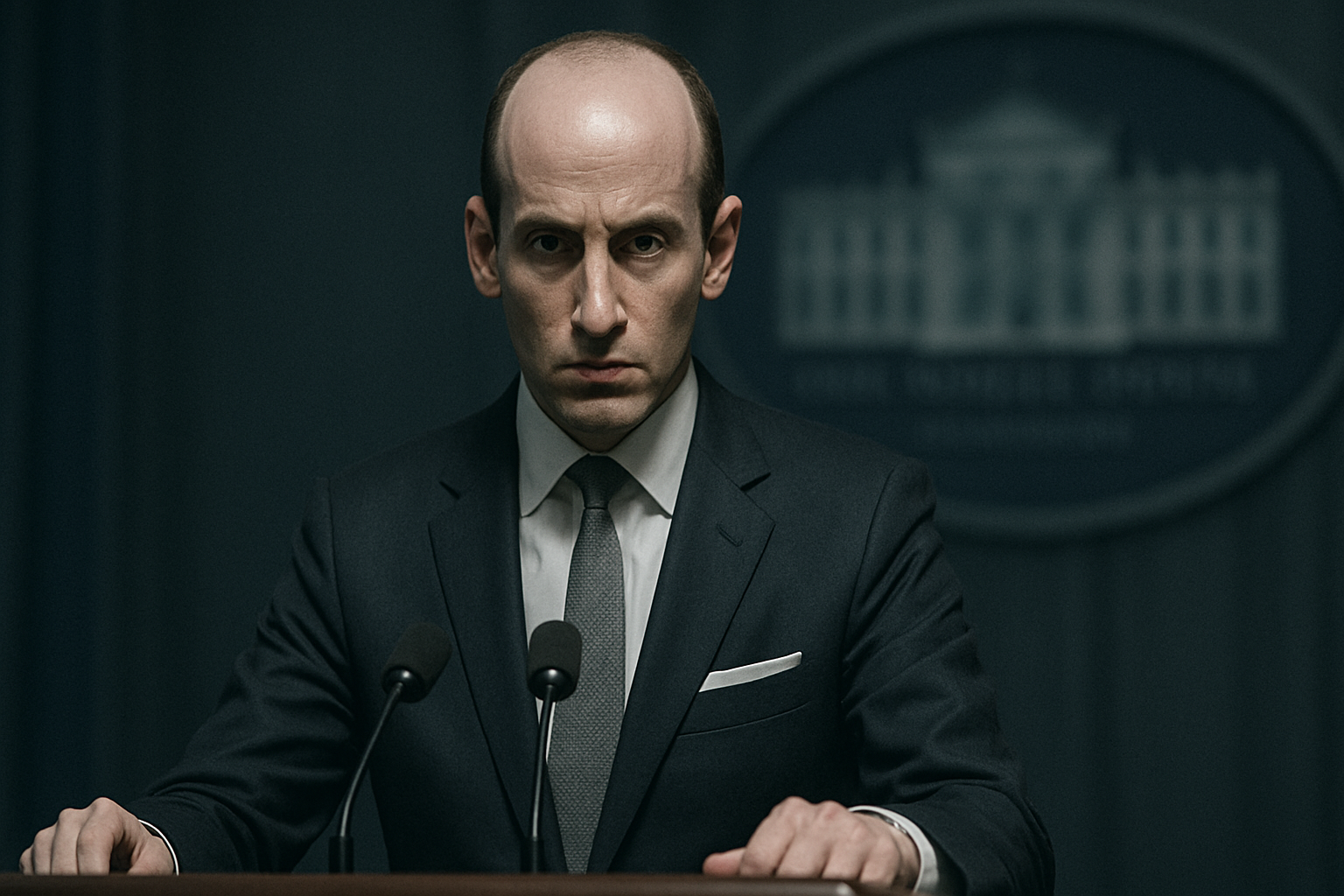
 Section I: Origins and Early Formation
Stephen Miller was born on August 23, 1985, in Santa Monica, California, into a family that embodied the paradoxes of American assimilation. His grandparents were Jewish immigrants who fled anti-Semitism in Eastern Europe, arriving in the United States at a time when restrictive quotas limited Jewish entry but did not eliminate it. Their story was one of upward mobility, shifting from immigrant precarity to middle-class stability through real estate and construction. This trajectory placed the Millers within a larger pattern: families that benefited from the postwar boom, the GI Bill, and expanding suburban development, but who later turned against the very pluralism and openness that had allowed them to thrive.
Santa Monica in the 1980s and 1990s was not a uniformly liberal enclave. While known today as a progressive bastion, the city contained deep inequalities. Wealthy beachfront neighborhoods coexisted with working-class Latino and Black communities. The Los Angeles riots of 1992 left a mark across Southern California, heightening racial tensions and anxieties among white suburbanites. For a boy growing up in a relatively privileged household, these events provided both exposure to diversity and a potential breeding ground for reactionary fears.
From an early age, Miller displayed a fascination with confrontation. Accounts from classmates at Roosevelt Elementary and later Santa Monica High School describe a boy who thrived on provoking reactions. Rather than seeking acceptance, he seemed to cultivate alienation as a badge of honor. In a community where many students were bilingual and teachers made accommodations for immigrant families, Miller railed against bilingual announcements and multicultural assemblies. He accused the school district of “coddling” students who, in his view, should assimilate to English and American norms.
These positions were not expressed in private or confined to dinner-table conversations. Miller sought a stage. He began writing columns for the school paper that blasted diversity initiatives, frequently positioning himself as the lone truth-teller surrounded by naïve liberals. The pieces were sharp in tone but shallow in reasoning, relying on caricatures rather than evidence. What mattered to Miller was the reaction: outrage from peers, exasperation from teachers, occasional approval from conservative adults who saw in him a precocious warrior against political correctness.
The Santa Monica years reveal three enduring traits. First, Miller embraced contrarianism as identity. His politics were less about coherent ideology than about defining himself in opposition to whatever he perceived as dominant culture. Second, he displayed an early instinct for media manipulation. Even at the high school level, he understood that controversy drew attention, and that attention conferred status. Third, he began constructing an ethnonationalist worldview in which American identity was fragile, threatened by immigration and diversity, and in need of aggressive defense.
Family context complicates the story. The Millers were not economic outsiders; they had benefitted directly from government contracts and real estate expansion. Nor were they religious traditionalists; their Jewish identity was cultural and familial rather than strictly observant. Yet Stephen Miller gravitated toward a political style that was hostile to the very pluralism his family’s survival had depended on. This contradiction — a Jewish grandson of immigrants championing policies that targeted immigrants — would become the defining paradox of his career.
By adolescence, Miller was also absorbing national conservative media. He listened to Rush Limbaugh, whose bombast modeled how grievance could be transformed into entertainment. He followed Larry Elder, the Los Angeles–based talk radio host who framed crime and welfare through a racialized lens. These influences taught Miller that politics could be a performance, and that performance could be monetized and weaponized. Unlike peers who consumed such media passively, Miller sought to reproduce it in his own voice, adopting its cadences and combative style.
His classmates recall a teenager who deliberately courted isolation. He broke with childhood friends who were Latino or liberal-leaning, declaring that he could no longer associate with them because of their politics. Teachers noted his insistence on speaking up in class to provoke debate, often steering discussions toward immigration or patriotism regardless of the subject at hand. Where others sought harmony, Miller sought friction.
This pattern raises an important implication: Miller’s radicalization was not the product of marginalization but of deliberate choice. He was not excluded from mainstream institutions; he was embedded in them. His radicalization was elective, a posture he constructed to carve out identity and influence. This would later make him an especially dangerous political actor: he knew how to operate from within, cloaking extremist impulses in the language of legitimacy.
High school also introduced Miller to the Horowitz network. David Horowitz, a former leftist turned right-wing polemicist, was mounting a campaign against what he called liberal domination of universities. Horowitz’s FrontPage Magazine published articles decrying affirmative action and multiculturalism, framing them as existential threats to Western civilization. Miller corresponded with Horowitz and began adopting his talking points. For a teenager in Santa Monica, this connection provided validation: he was not just an isolated crank but part of a national movement.
By graduation in 2002, Miller had fashioned himself as a conservative firebrand in miniature. He was featured in local press for his contrarian views, and he carried himself with the confidence of someone who believed controversy was a form of power. College would provide him with a larger stage, but the essential pattern was already fixed: use provocation to draw attention, frame diversity as decline, and cultivate alliances with older ideologues eager for youthful disciples.
Thematic Implications
The formative period of Stephen Miller’s life illustrates several broader dynamics in American politics:
- Contradictions of Assimilation: Miller’s immigrant-descended background mirrors a broader trend in which families who benefited from openness turn against it in pursuit of status or security. This paradox has fueled segments of nativist politics, where personal history is suppressed or reframed to justify exclusion.
- Media as Radicalizer: The role of talk radio in Miller’s adolescence highlights how mass media ecosystems of the 1990s and early 2000s radicalized listeners. Limbaugh and Elder did not merely entertain; they cultivated a worldview of siege and resentment that Miller absorbed wholesale.
- Youth as Performance: Miller’s provocations were not spontaneous but performative. He understood early that outrage generated recognition. This foreshadowed his later ability to script lines for Trump that would dominate news cycles, regardless of factual grounding.
- Ideology as Weapon: By connecting with Horowitz, Miller tapped into a network that viewed universities as battlegrounds in a culture war. His later focus on immigration drew from this model: target institutions, delegitimize diversity, frame everything as existential conflict.
- Elective Radicalization: Unlike individuals radicalized by economic despair or social exclusion, Miller chose his path from a position of security. This matters because it reveals his motivation was not grievance over deprivation but ambition for power through controversy.
Section II: Duke Years and the Road to Extremist Legitimacy
When Stephen Miller arrived at Duke University in 2003, he entered an institution already wrestling with its reputation. Duke was simultaneously a Southern private university with a patrician heritage and a nationally competitive school with increasing diversity among its student body. It had a culture that combined elite entitlement with athletic notoriety and an evolving academic climate that leaned toward liberalism in the humanities. For Miller, Duke was a stage far larger than Santa Monica High School, and he approached it with the same instinct: controversy as power.
Early Moves: A Columnist in Training
From his first year, Miller carved out a place in Duke’s public sphere by becoming a regular columnist for The Chronicle, the student newspaper. His writing attacked what he labeled as “campus liberal orthodoxy.” The themes were familiar extensions of his high school crusades: denunciations of multicultural programs, objections to diversity initiatives, and demands for rigid assimilationist norms. But in the context of Duke, these views carried greater weight because they challenged an institution eager to advertise its inclusiveness.
Miller’s columns lacked empirical grounding but were saturated with polemic. He accused professors of indoctrination, described minority outreach as unfair favoritism, and portrayed himself as a persecuted minority voice. He also began honing a rhetorical device that would define his later career: reframing equality measures as assaults on freedom. Where others saw diversity initiatives as attempts to broaden opportunity, Miller framed them as acts of censorship or discrimination against whites. This inversion became a cornerstone of his politics: weaponizing the language of victimhood for dominant groups.
The Horowitz Connection and the Campus Wars
During his sophomore year, Miller deepened his connection with David Horowitz, the far-right polemicist who was then campaigning aggressively against perceived liberal dominance in academia. Horowitz’s FrontPage Magazine gave Miller a platform beyond campus, publishing his op-eds and showcasing him as a youthful dissenter from political correctness.
At Duke, Miller became one of the most visible organizers against the university’s diversity policies. He invited Horowitz to campus, lending legitimacy to claims that universities were hostile to free speech and conservative ideas. These events drew protests, but protests only amplified Miller’s stature. He thrived on the spectacle: a lone student challenging the institution, backed by national voices eager to frame him as a martyr for conservative truth.
Partnership with Richard Spencer
Perhaps the most consequential relationship Miller formed at Duke was with Richard Spencer, then a graduate student in the humanities. Spencer, who would later become one of America’s most prominent white nationalists, described Miller as an eager collaborator in his efforts to push back against campus multiculturalism. Together, they organized speaking events, invited controversial figures, and framed themselves as defenders of Western civilization.
While Miller has later distanced himself from Spencer, denying ideological alignment, the record shows collaboration at precisely the moment when Spencer was moving toward overt white nationalism. That Miller chose to align himself with Spencer demonstrates not only a tolerance for extremist associations but a strategic willingness to use them for visibility. He did not need to adopt Spencer’s language outright; by appearing on the same stage, he signaled overlap without direct ownership.
The Lacrosse Case and Media Savvy
Miller’s time at Duke coincided with the 2006 Duke Lacrosse scandal, in which members of the lacrosse team were falsely accused of sexual assault. While many students and faculty urged caution, Miller seized the moment to frame the accused as victims of a politically correct witch-hunt. He wrote columns portraying the players as innocent men persecuted by liberal faculty and media bias.
This episode was pivotal because it revealed Miller’s instinct for seizing controversy not to clarify truth but to weaponize it against cultural enemies. When later evidence exonerated the players, Miller claimed vindication — not for truth’s sake but as proof that liberal elites rushed to judgment. This pattern — turning scandals into evidence of systemic liberal malice — became a template he would carry into national politics.
Media Appearances and the Performance of Combat
Beyond print, Miller cultivated a reputation as a performer. He appeared on local and regional radio, adopting the tone and cadence of conservative talk hosts. His voice was strident, his arguments rehearsed, his persona combative. He rarely sought dialogue; his goal was dominance. He framed opponents as naïve or malicious, cast himself as the embattled truth-teller, and reveled in provoking outrage.
What distinguished Miller from other campus conservatives was his tireless pursuit of publicity. He was not content to debate in student government or publish occasional essays. He sought every available microphone, maximizing controversy to ensure his name circulated. By graduation, he had achieved that goal: he was known beyond Duke, cited by Horowitz and other right-wing outlets as a campus warrior.
Patterns Emerging at Duke
Several critical patterns emerged during Miller’s Duke years that foreshadowed his future career:
- Alliance with Extremists: Miller demonstrated willingness to work with figures like Richard Spencer, signaling that ideological purity mattered less to him than strategic collaboration.
- Weaponization of Victimhood: He perfected the rhetorical inversion of framing dominant groups as oppressed, a tactic he later used to argue that immigration endangered rather than enriched America.
- Media Manipulation: Miller proved adept at leveraging campus controversies into national media opportunities, an ability he later used to script soundbites for Trump.
- Scandal Exploitation: The Duke Lacrosse case highlighted his instinct to exploit crises not to uncover truth but to indict liberalism as corrupt.
- Performance Politics: His emphasis on appearances, radio spots, and staged debates revealed a politician-in-training who understood that performance often outweighed policy substance.
Implications Beyond Campus
Miller’s Duke trajectory is significant not just for what it says about him but for what it reveals about the broader political ecosystem. The early 2000s saw conservative operatives recognizing the utility of campus politics as a training ground. By elevating young provocateurs, networks like Horowitz’s could frame universities as breeding grounds of liberal tyranny. Miller was both product and partner in this strategy.
The partnership with Spencer also illustrates how mainstream conservatism and white nationalism overlapped in the incubators of the early 2000s. While Spencer moved on to open white supremacy, Miller moved into Washington politics. The overlap was not accidental; it reflected a shared worldview about the threat of diversity and the need to reassert Western dominance. Miller’s later denials cannot erase the reality that his formative years were intertwined with extremist currents.
Preparing for Washington
By the time Miller graduated in 2007, he had achieved three things. First, he had constructed a national persona as a young conservative warrior. Second, he had embedded himself in a network of right-wing ideologues eager to channel him into Washington politics. Third, he had refined a method of turning outrage into legitimacy. These three assets made him a natural candidate for work on Capitol Hill, where the battle over immigration was intensifying.
His resume boasted connections to Horowitz, a portfolio of combative columns, and a reputation for unflinching opposition to liberal orthodoxy. For many young graduates, Duke was a springboard to finance or law. For Miller, it was an audition — one that caught the attention of politicians searching for staffers who could fight the culture wars with zeal.
Thematic Implications
The Duke period crystallizes Miller’s approach to politics as a performance of siege. He framed himself as besieged by liberal elites, aligned with extremists when convenient, and exploited scandals to prove systemic bias. These methods, once confined to a campus of 6,000 undergraduates, would later be applied to a nation of 330 million. The implications are profound: if college was a proving ground, the presidency became the theater where these tactics would be scaled nationally.
Section III: Capitol Hill Apprenticeship
Stephen Miller graduated from Duke in 2007 with a bachelor’s degree in political science and a résumé less defined by academic distinction than by his reputation as a provocateur. He did not head to graduate school or law school, as many of his peers did. Instead, he went directly to Washington, D.C., to translate his combative style into policy warfare. What followed was a decade-long apprenticeship that honed his skills, embedded him in institutional politics, and positioned him as one of the most consequential architects of nativism in modern American governance.
Early Internships and Staff Roles
Miller’s first roles in Washington were internships and junior staff assignments. He briefly worked in the office of then-Representative Michele Bachmann of Minnesota, one of the most visible figures of the Tea Party wave that would crest a few years later. He also served as press secretary for Representative John Shadegg of Arizona, a Republican known for his staunch opposition to federal regulation. These early positions taught him two critical lessons:
- Message Control: In communications roles, Miller learned that shaping the narrative was often more powerful than drafting legislation. He saw firsthand how carefully crafted talking points could dominate a news cycle.
- Nativism as Mobilizer: Working with lawmakers from border-adjacent states like Arizona exposed him to the salience of immigration as a wedge issue. Arizona had already become a testing ground for restrictive immigration laws, foreshadowing national battles to come.
But Miller’s true apprenticeship began when he joined the office of Senator Jeff Sessions of Alabama.
Aligning with Jeff Sessions
Sessions had been in the Senate since 1997 and was a reliable hardliner on immigration. While many Republicans supported business-friendly guest worker programs or spoke of balancing border security with reform, Sessions was unyielding. He opposed comprehensive immigration bills, refugee resettlement programs, and anything that hinted at “amnesty.”
Miller entered Sessions’s office in 2009 as a communications director and soon became indispensable. He brought not just competence but zeal. Sessions provided Miller with a platform, but Miller provided Sessions with a language that could resonate beyond Alabama. He sharpened speeches, drafted op-eds, and pushed Sessions into the spotlight as the Senate’s premier anti-immigration crusader.
The alliance was symbiotic. Sessions offered Miller legitimacy and access; Miller offered Sessions the combative style needed to break through in an increasingly polarized media environment.
Shaping the Immigration Debate
The most defining battle of this period came in 2013, when the bipartisan “Gang of Eight” introduced a comprehensive immigration reform bill. The legislation proposed a pathway to citizenship for millions of undocumented immigrants, paired with border security enhancements. It had the backing of both Republican senators like John McCain and Marco Rubio and Democratic leaders including Chuck Schumer.
Miller helped orchestrate Sessions’s opposition. He crafted talking points that painted the bill not as reform but as betrayal. He emphasized the word “amnesty” relentlessly, framing the legislation as a threat to American workers and sovereignty. He worked behind the scenes to feed these narratives to talk radio hosts, conservative media outlets, and grassroots organizations.
This period marked the consolidation of a feedback loop that would define Miller’s career:
- Think tanks like the Center for Immigration Studies and Federation for American Immigration Reform supplied research.
- Miller distilled it into soundbites.
- Talk radio hosts amplified the message, reaching millions.
- Sessions delivered the polished arguments on the Senate floor, lending institutional authority.
The effort succeeded. The “Gang of Eight” bill passed the Senate but stalled in the House under pressure from conservative activists, effectively killing comprehensive reform for the foreseeable future.
The Media Ecosystem and Miller’s Hand
Miller was not simply a staffer; he was a conduit. He maintained constant contact with radio personalities, feeding them material and ensuring that Sessions’s speeches reverberated across the conservative ecosystem. This role taught him how to weaponize outrage as strategy. Sessions’s floor speeches rarely swayed votes directly, but they generated headlines and fueled grassroots mobilization.
By 2014, Miller had become known among conservatives as one of the most effective communications staffers in Washington. He was young, aggressive, and relentless. For immigration hardliners, he was an asset; for Democrats and even moderate Republicans, he was a rising antagonist.
The Battle Against Refugees
In addition to opposing immigration reform, Miller focused on limiting refugee resettlement. He helped craft narratives portraying refugees as potential security threats, particularly in the wake of terrorist attacks in Europe. This was a striking rhetorical maneuver: transforming humanitarian programs into existential dangers.
The approach foreshadowed the Muslim ban Miller would later script in the Trump administration. By equating refugee admission with national vulnerability, Miller reframed compassion as recklessness. This tactic resonated with portions of the public who feared terrorism and with lawmakers eager to demonstrate toughness.
Relationships with Anti-Immigration Networks
Miller’s tenure in Sessions’s office also deepened his ties with the broader restrictionist movement. He collaborated with groups such as NumbersUSA, FAIR, and CIS, which supplied data and policy drafts. These organizations had long histories of advocating for reduced immigration, often couched in economic or environmental arguments but rooted in nativist impulses.
By aligning with them, Miller embedded himself in a network that operated on the margins of mainstream conservatism but wielded significant influence. He acted as the bridge between think tank rhetoric and senatorial authority, legitimizing arguments that might otherwise have been dismissed as fringe.
Mastering the Siege Mentality
During these years, Miller perfected what might be called the siege mentality framework. Every policy debate was cast as existential: America under threat, sovereignty under assault, identity at risk. This framing did not require nuanced evidence; it required emotional impact. By constantly positioning immigration as crisis, Miller and Sessions ensured the issue remained at the forefront of conservative politics.
This mentality had downstream consequences. It hardened Republican opposition to reform, polarized public opinion, and set the stage for the emergence of a presidential candidate who could embody grievance politics at a national level. That candidate, of course, was Donald Trump.
Implications of the Apprenticeship
Miller’s Capitol Hill years reveal more than personal ambition; they illuminate the infrastructure of modern nativism. Three implications stand out:
- Institutional Entrenchment: Miller showed that extremist ideas could enter the mainstream by being laundered through congressional offices. By scripting a senator’s speeches, he normalized arguments that once lived on the fringes.
- Media Conduits: The coordination between staff, think tanks, and media demonstrated the power of message discipline. Policy debates became less about data than about controlling narrative.
- Policy Legacy: The defeat of comprehensive immigration reform in 2013 was not just a legislative outcome; it reshaped the trajectory of American politics. By killing the bill, Miller and his allies preserved immigration as a perpetual culture-war battlefield.
Preparing the Ground for Trump
By 2015, Miller was ready for a larger stage. He had built networks among immigration hardliners, mastered media manipulation, and proven his ability to weaponize fear. When Donald Trump descended the escalator in June 2015, railing against Mexican immigrants, Miller recognized the moment as the culmination of everything he had worked toward.
Trump needed a strategist who could translate raw grievance into structured messaging. Miller was prepared. The Capitol Hill apprenticeship had not only given him the tools but had also primed him to believe that America was ready for an outsider who could embody nativism as a governing principle.
Section IV: The Trump Campaign and Miller’s Rise (2015–2016)
Entering the Campaign
In June 2015, Donald J. Trump descended the escalator at Trump Tower and announced his candidacy for president with remarks that instantly defined the campaign: Mexico, he declared, was sending “rapists” and criminals across the border. The political establishment recoiled, but for Stephen Miller — still serving in Jeff Sessions’s office — the speech was a signal. Everything he had labored toward for nearly a decade had just been elevated from the Senate margins to center stage.
Miller formally joined Trump’s campaign later that year as senior policy adviser and quickly became indispensable. Unlike seasoned operatives accustomed to moderating rhetoric for general elections, Miller recognized that Trump’s blunt xenophobia was not a liability but the essence of his appeal. Where others urged recalibration, Miller doubled down. He supplied the talking points, scripted speeches, and coached Trump on how to frame immigration not as one issue among many but as the defining struggle for the nation’s survival.
Shaping the Message
Miller’s role was twofold: ideologue and technician. He provided the ideological scaffolding for Trump’s nationalist message and the technical skill to translate it into speeches, debates, and rallies.
- Ideological scaffolding: Miller emphasized a narrative of national decline caused by elites, foreigners, and weak leaders. He cast Trump as the singular figure who could restore sovereignty and control.
- Technical delivery: Miller wrote lines that would ricochet across media, ensuring coverage even when factually baseless. The aim was not persuasion through accuracy but domination through repetition.
One of Miller’s hallmarks was his ability to weaponize fear in simple language. For instance, when Trump warned of “bad hombres,” the phrasing may have been Trump’s improvisation, but the thematic groundwork — immigrants as dangerous outsiders — was Miller’s.
The Rally Circuit and Miller as Performer
Miller did not stay in the background. He frequently took the stage at Trump rallies, warming up crowds with speeches that mirrored the style of talk radio: combative, apocalyptic, and drenched in nationalism. He told audiences that America was under siege, that elites were betraying them, and that only Trump had the courage to fight back.
His presence signaled a departure from the traditional staffer role. Most campaign advisers remained invisible, scripting lines for candidates but avoiding the spotlight. Miller craved the stage. He relished being booed by protesters and cheered by supporters. His performance reinforced the campaign’s core identity: grievance was not to be apologized for but celebrated.
Policy Proposals: The “Muslim Ban” and Beyond
Perhaps the most notorious policy Miller helped craft during the campaign was the call for a “total and complete shutdown of Muslims entering the United States”, first announced in December 2015. Though the proposal shocked many, it electrified Trump’s base. Miller’s fingerprints were evident: the language framed the policy not as prejudice but as national defense, leveraging fear of terrorism to justify sweeping exclusion.
This was not an isolated example. Miller also contributed to proposals for building a border wall, ending birthright citizenship, and massively reducing refugee admissions. These were not idle campaign lines; they reflected a blueprint Miller had been assembling for years through his work with Sessions and restrictionist networks. The campaign simply provided the platform to broadcast them nationally.
Relationship with the Candidate
Miller’s relationship with Trump was complex. Trump thrived on improvisation, often discarding prepared remarks. But Miller learned to accommodate this unpredictability. He wrote speeches filled with provocative lines that Trump could lift verbatim or riff upon. He supplied the skeleton; Trump supplied the spectacle.
Over time, Trump came to value Miller’s discipline. Unlike other staffers who sought to moderate the candidate or steer him toward conventional policy, Miller reinforced Trump’s instincts. He told him that his bluntness was a strength, not a weakness. This feedback loop emboldened Trump and deepened Miller’s influence.
Internal Campaign Dynamics
The Trump campaign was notorious for its chaos, with frequent staff shakeups and rivalries. Miller, however, survived every purge. His utility was undeniable: he could write, he could perform, and he could articulate Trump’s message in ways that resonated with both candidate and base.
When Paul Manafort was ousted and Steve Bannon elevated, Miller found himself working alongside another figure steeped in nationalist ideology. The pairing was consequential: Bannon provided the strategic vision of populist revolt; Miller provided the policy language and communications discipline. Together, they helped craft the final stretch of Trump’s insurgent campaign.
The RNC Speech and the National Stage
Miller’s most prominent moment of the campaign came at the Republican National Convention in Cleveland in July 2016, where he delivered a prime-time speech introducing Trump. His delivery was stiff and theatrical, criticized by some commentators as overwrought, but it showcased his commitment to apocalyptic framing. He told Americans they were on the brink of losing their country, that only Trump could restore safety and greatness.
Though mocked for his robotic style, the speech cemented Miller’s identity as more than a staffer. He was a movement figure in his own right, a propagandist who embodied the message as much as he crafted it.
Crafting the Closing Argument
In the final weeks of the campaign, Miller helped script Trump’s closing argument: a dark vision of “American carnage,” with immigrants and elites portrayed as dual threats to national survival. This rhetoric stood in stark contrast to traditional optimistic appeals at the end of campaigns. But it worked. Trump’s narrow victories in states like Michigan, Wisconsin, and Pennsylvania showed that fear-driven messaging could mobilize disaffected voters.
Miller celebrated the upset as vindication of his method. What had once been derided as fringe — wall building, refugee bans, Muslim exclusions — had become the winning message of a presidential campaign. For him, the lesson was clear: extremism, packaged with discipline, could capture power at the highest level.
Implications of the Campaign Period
The Trump campaign revealed the scalability of Miller’s tactics. What he had practiced on a high school newspaper page and at Duke debates could now be applied nationally. Several implications stand out:
- Normalization of Extremism: Proposals once confined to white nationalist chat rooms entered mainstream debate, legitimized by the presence of a major-party candidate.
- Performance Politics Ascendant: Miller demonstrated that rallies and soundbites could eclipse traditional policy platforms, shifting the campaign from persuasion to mobilization.
- Institutional Capture: By aligning with Trump, Miller positioned himself to bring fringe restrictionist ideas directly into the White House.
- Strategic Reinforcement of Instincts: Rather than temper Trump, Miller amplified him, ensuring that the most inflammatory positions became campaign staples.
Preparing for Governing
As Trump shocked the world with his victory in November 2016, Miller prepared for the next stage. He was not merely a campaign aide; he was poised to become a senior White House adviser. The ideas he had been refining since Santa Monica — from anti-bilingual rhetoric to alarmist immigration framing — would now inform federal policy. For Miller, the campaign was not the end but the gateway: proof that grievance politics could seize the highest office in the land.
Section V: The White House Years (2017–2021)
Stephen Miller entered the White House on January 20, 2017, as Senior Advisor to the President. At 31, he was among the youngest people to hold such a position. But unlike many staffers who cycle through administrations with a focus on policy implementation, Miller carried an agenda that was both ideological and personal. The White House became the stage upon which he sought to institutionalize the nativist politics he had cultivated since adolescence.
Early Influence and the “American Carnage” Agenda
Trump’s inaugural address — remembered for its bleak invocation of “American carnage” — bore Miller’s fingerprints. The language was apocalyptic, portraying the United States as a nation in ruin, beset by crime, drugs, and foreign threats. This was not the aspirational tone of past inaugurals but the siege mentality Miller had honed for years. By scripting the speech, Miller signaled that his worldview would guide the administration from day one.
Inside the West Wing, Miller quickly became known for his proximity to Trump and his command of rhetoric. He was not an administrator of process or policy detail in the conventional sense. Rather, he was the ideological enforcer, ensuring that Trump’s instincts were translated into words and directives consistent with a nationalist framework.
The Muslim Ban
The first and most defining policy initiative of the Trump administration was the executive order temporarily banning entry from several Muslim-majority countries, signed on January 27, 2017. Miller, working closely with Steve Bannon, drafted the order. The rollout was chaotic, with travelers detained at airports, protests erupting nationwide, and courts quickly intervening.
Yet the symbolism mattered more than the logistics. The ban delivered on one of Trump’s most inflammatory campaign promises, and Miller defended it vigorously. In television interviews, he declared that “the powers of the president to protect our country are very substantial and will not be questioned.” The phrasing was chilling: a White House adviser asserting that presidential authority was beyond scrutiny.
Though courts struck down the initial order, Miller shepherded revised versions until a narrowed version was upheld by the Supreme Court in 2018. The outcome revealed Miller’s persistence: he understood that even legally vulnerable policies could succeed if pursued relentlessly and reframed strategically.
Zero Tolerance and Family Separation
Perhaps the most infamous policy associated with Miller was the “zero tolerance” immigration policy announced in 2018, which resulted in the separation of thousands of children from their parents at the U.S.-Mexico border. The policy mandated criminal prosecution of all adults crossing illegally, which in turn required separating children because minors could not be held in federal jails.
Internal reports later revealed Miller as the policy’s most ardent advocate. While some officials raised humanitarian and political concerns, Miller pressed forward, arguing that separations would serve as a deterrent. He dismissed criticism as weakness and insisted that harshness was necessary to restore control.
The images of children in cages provoked international outrage, lawsuits, and eventual reversal of the policy. But for Miller, the episode was proof of concept: the administration could push the boundaries of legality and morality, embed nativist policies into practice, and force opponents into defensive battles.
Refugee Caps and Asylum Restrictions
Beyond headline policies, Miller systematically dismantled America’s refugee and asylum systems. He pushed for annual refugee caps at record lows, slashing admissions from 110,000 under Obama to as few as 15,000. He engineered regulations making asylum harder to claim, expanding “safe third country” agreements and instituting the “Remain in Mexico” program that forced asylum seekers to wait in dangerous border towns.
These moves were not spontaneous but carefully constructed. Miller had long argued that humanitarian programs served as loopholes for mass migration. By narrowing definitions, imposing bureaucratic hurdles, and reducing numbers, he sought to close those avenues.
DACA and the Attack on Dreamers
Miller also targeted the Deferred Action for Childhood Arrivals (DACA) program, which provided protection for undocumented immigrants brought to the U.S. as children. He pressed Trump to end the program in 2017, triggering a legal battle that went to the Supreme Court. Although the Court blocked the rescission in 2020, Miller’s efforts kept Dreamers in perpetual uncertainty. The episode revealed his strategy: even when direct elimination failed, undermining stability and security could achieve deterrent effects.
Internal Power Dynamics
Within the administration, Miller outlasted many senior advisers. Steve Bannon was ousted by summer 2017, but Miller remained. His survival owed to several factors:
- Alignment with Trump’s instincts: Miller reinforced rather than restrained Trump’s nativism.
- Mastery of rhetoric: He could produce speeches and soundbites on demand, feeding Trump’s appetite for media domination.
- Low-profile operations: Unlike Bannon, who courted the spotlight, Miller often worked quietly, making him less of a target for rivals.
Colleagues described him as relentless, sometimes obsessive. He fixated on immigration above all else, often pressing policy proposals late into the night. Cabinet officials occasionally balked at his demands, but Trump valued his loyalty and ideological consistency.
The Pandemic and Immigration Controls
The COVID-19 pandemic in 2020 provided Miller an opening to further restrict immigration. Under his guidance, the administration invoked public health authority (Title 42) to expel migrants at the border without normal asylum processing. What began as a temporary measure persisted throughout the administration, effectively shutting down the asylum system.
Miller also advocated for broader immigration freezes, citing economic downturn as justification. Though not all proposals were enacted, the crisis reinforced his narrative: in times of uncertainty, closing borders was both logical and necessary.
Media Presence and Defenses
Throughout these years, Miller became a public face of the administration. His television appearances were marked by combative exchanges, particularly with hostile interviewers. His style was rigid, declarative, and dismissive of opposition. He rarely engaged in dialogue, preferring monologues that projected confidence and inevitability.
These performances reinforced his role as propagandist-in-chief. While Trump commanded rallies, Miller provided the intellectual veneer, reciting historical or constitutional justifications for policies that critics viewed as discriminatory. The pairing was symbiotic: Trump embodied visceral anger, Miller supplied ideological scaffolding.
Institutional Consequences
The legacy of Miller’s White House years is measurable in several dimensions:
- Policy Architecture: He left behind a dense web of regulations, executive orders, and administrative procedures that reshaped immigration. Even after reversals, many measures influenced enforcement practices.
- Judicial Precedents: By pushing cases through the courts, Miller helped establish rulings that expanded executive authority in immigration matters.
- Cultural Impact: He mainstreamed rhetoric once confined to fringe groups, embedding it in the daily discourse of presidential politics.
Implications
Miller’s tenure demonstrated how a single adviser, without electoral mandate, could exert disproportionate influence. He transformed immigration from a contested policy area into the centerpiece of a presidential identity. By weaponizing executive authority, he showed that administrative power could bypass congressional gridlock, achieving sweeping change without legislative approval.
For critics, this represented democratic erosion: policies with profound humanitarian consequences were enacted without broad deliberation. For Miller, it was vindication of his life’s work: proving that nativism could govern, not just agitate.
Section VI: Networks and Outside Groups
Stephen Miller’s influence in the White House was not built in isolation. While he became the face of restrictionist policy inside government, his ideas were continuously fed, validated, and reinforced by an ecosystem of outside groups, think tanks, and media outlets that had been cultivating anti-immigration ideology for decades. Understanding these networks is crucial to understanding Miller himself, because his power derived not only from his position but from his ability to act as a conduit between extremist currents and institutional authority.
The Restrictionist Infrastructure
The restrictionist movement in the United States had deep roots long before Miller emerged. In the 1970s, Michigan ophthalmologist John Tanton began building organizations dedicated to reducing immigration levels, often cloaking demographic anxieties in the language of environmentalism or economic security. From his efforts grew three of the most influential groups:
- Federation for American Immigration Reform (FAIR) — founded in 1979, advocating for steep reductions in legal immigration and aggressive border enforcement.
- Center for Immigration Studies (CIS) — established in 1985 as a think tank producing studies critical of immigration, often citing inflated costs or alleged crime impacts.
- NumbersUSA — created in 1996, focusing on grassroots mobilization against comprehensive immigration reform.
By the time Miller entered Sessions’s office in 2009, these organizations had decades of experience shaping discourse. They provided the “research” that lawmakers could cite, the talking points that radio hosts could amplify, and the grassroots pressure that killed legislation.
Miller as Bridge
Miller’s genius — and danger — lay in his ability to bridge the gap between these groups and federal power. While FAIR or CIS could publish reports, they often lacked mainstream legitimacy. By inserting their data and rhetoric into Jeff Sessions’s speeches and later White House policy memos, Miller laundered their arguments through the respectability of government. What had once been fringe could now be cited as official concern.
Emails and reporting later revealed Miller’s routine circulation of CIS and Breitbart articles to colleagues. His ability to shuttle material from the outer edges of the movement into the halls of power blurred the line between advocacy group and government office.
VDARE and White Nationalist Circulation
Beyond the established restrictionist organizations, Miller also intersected with openly white nationalist platforms. VDARE, founded by Peter Brimelow in 1999, explicitly framed immigration as a threat to white identity. While Miller has denied formal association, investigative reporting uncovered emails he sent to Breitbart editors in 2015–2016 citing VDARE articles and recommending coverage.
This does not mean Miller endorsed every extremist position. But his willingness to source material from sites like VDARE demonstrates his pragmatism: if an argument served his cause, its origin did not disqualify it. The effect was insidious — language and frames from explicitly racist platforms seeped into mainstream discourse through Miller’s mediation.
Breitbart and the Propaganda Loop
Miller’s relationship with Breitbart News deserves special attention. Under Steve Bannon’s leadership, Breitbart became a hub for nationalist populism. Miller communicated regularly with Breitbart reporters, feeding them storylines that supported Sessions’s and later Trump’s positions. In return, Breitbart amplified those narratives, creating a feedback loop:
- Miller supplied content → Breitbart published stories → Talk radio amplified → Trump referenced coverage → Policy proposals gained traction.
This loop illustrates the merging of media and governance in the populist era. Policy was not shaped by internal deliberation alone but by a constant dialogue between advisers and partisan media outlets, each validating the other.
Ties to Conservative Foundations
Miller’s networks extended beyond immigration groups. He drew support from conservative legal foundations and advocacy groups eager to roll back civil rights frameworks. For example:
- The Heritage Foundation produced immigration policy blueprints that echoed Miller’s preferences.
- Judicial Crisis Network and similar organizations supported judicial appointments sympathetic to expansive executive power on immigration.
By aligning with these groups, Miller situated his work within a broader conservative project: not merely to restrict immigration but to redefine the scope of executive authority, weaken judicial checks, and consolidate power.
Think Tank Collaboration: Case Studies
- CIS Reports on Crime: CIS repeatedly published studies claiming disproportionate crime among immigrants. Though widely criticized for methodological flaws, Miller used these reports to justify harsher enforcement. By citing “independent research,” he masked ideology as evidence.
- FAIR’s Border Crisis Narratives: During surges in migration, FAIR issued press releases warning of overwhelmed systems. Miller echoed this language in press briefings, amplifying a sense of emergency that justified extraordinary measures like the deployment of troops to the border.
- NumbersUSA Mobilization: Whenever comprehensive reform appeared viable, NumbersUSA activated phone banks and grassroots campaigns. Miller worked to ensure that Sessions’s office was the Senate anchor for this pressure.
Symbiosis with Outside Groups
The relationship was symbiotic:
- Miller needed their material to legitimize his proposals.
- They needed his access to embed their ideas into actual government policy.
This symbiosis raises important implications. Normally, advocacy groups lobby government; Miller inverted the process by acting as a government official lobbying on behalf of advocacy groups. The boundary between policymaker and activist dissolved.
International Connections
Miller’s network was not purely domestic. He intersected with European far-right movements, often indirectly through shared platforms and figures. Breitbart’s London bureau, for example, connected American restrictionism with European anti-immigrant parties like the UK Independence Party (UKIP) and France’s National Front. By sharing narratives about migration “crises,” these groups created a transatlantic ecosystem of ethnonationalist politics.
Critics and Exposure
Civil rights organizations, including the Southern Poverty Law Center (SPLC), documented Miller’s ties to extremist networks. In 2019, SPLC published a cache of emails Miller had sent to Breitbart, revealing his frequent references to white nationalist sources. While the White House dismissed the revelations, they confirmed what many had long suspected: Miller was not merely adjacent to extremist ideas but actively circulated them.
The exposure did little to diminish his influence within the administration. Trump valued his loyalty and effectiveness, while the Republican Party, increasingly reliant on restrictionist politics, lacked incentive to disavow him. This underscores another implication: institutional tolerance of extremism when it serves electoral utility.
The Broader Ecosystem
The Miller story highlights how fringe movements can achieve mainstream dominance through intermediaries. Without organizations like FAIR and media outlets like Breitbart, Miller would have lacked material. Without Miller, those groups would have remained peripheral. Together, they forged a movement that reshaped American immigration policy and redefined political discourse.
Thematic Implications
- Normalization of Extremism: By inserting fringe arguments into policy, Miller blurred the line between legitimate debate and racist ideology.
- Media-Government Fusion: The collaboration between Miller and Breitbart exemplified how governance and propaganda could merge into a single process.
- Institutional Capture: Restrictionist networks achieved influence not by winning elections directly but by embedding operatives like Miller within government.
- Internationalization of Nativism: Shared narratives connected American restrictionism to European far-right movements, creating a global discourse of demographic fear.
Section VII: After January 6 and the Interregnum (2021–2024)
The end of Donald Trump’s first term did not mark the end of Stephen Miller’s influence. Instead, the period from January 2021 through January 2025 — the interregnum years — provided Miller with space to reconfigure, expand his networks, and ensure his ideological project survived outside the White House. While Trump left office in disgrace after the January 6 attack on the Capitol, Miller did not retreat into obscurity. He adapted, using litigation, media, and movement infrastructure to maintain relevance and prepare for a possible return to power.
January 6, 2021: Shock and Survival
The insurrection at the U.S. Capitol was a turning point for many Trump loyalists. Some faced prosecution, others distanced themselves, and still others doubled down. Miller chose a careful middle path. He did not publicly endorse the attack, nor did he openly denounce Trump. Instead, he framed January 6 as an aberration — tragic, but irrelevant to the broader “America First” policy agenda.
This positioning allowed him to avoid personal culpability while preserving access to the base. Where Bannon leaned into insurrectionist rhetoric and others like Kellyanne Conway pivoted to rehabilitation, Miller charted a steady course: immigration and sovereignty remained the central issues, regardless of political turbulence.
Founding of America First Legal
In April 2021, Miller launched America First Legal (AFL), a nonprofit litigation outfit modeled explicitly on the ACLU but devoted to right-wing causes. With former Trump White House colleagues, Miller built AFL into a vehicle for challenging Biden administration policies in court.
- Immigration Focus: AFL sued over Biden’s attempts to roll back “Remain in Mexico,” Title 42 expulsions, and other restrictive measures Miller had designed.
- Civil Rights Inversion: AFL filed suits claiming that diversity and equity initiatives discriminated against whites, reframing civil rights law as a tool for majority grievance.
- Publicity Strategy: AFL press releases and filings were written as much for media consumption as for courts, ensuring that conservative outlets could frame them as evidence of resistance.
Through AFL, Miller achieved two goals. He kept himself in the headlines, and he ensured that Biden’s policies faced constant legal obstacles. Even when AFL lost in court, the suits delayed implementation and provided rallying points for conservative media.
Litigation as Political Strategy
AFL represented a new chapter in Miller’s career: the transformation from policy drafter to movement litigator. This role capitalized on two realities:
- Judicial Capture: With a conservative Supreme Court and many Trump-appointed lower-court judges, litigation became a promising battlefield. Miller understood that lawsuits could achieve through injunctions what elections could not.
- Narrative Value: Each lawsuit became a news story, reinforcing the image of Biden as lawless and conservatives as defenders of order.
The lawsuits also extended Miller’s reach beyond immigration. AFL challenged vaccine mandates, environmental regulations, and voting rights initiatives, embedding Miller more deeply in the conservative legal ecosystem.
Media Presence and Strategic Visibility
Throughout 2021–2024, Miller remained a frequent guest on Fox News, Newsmax, and conservative podcasts. His appearances followed a consistent formula:
- Denounce Biden as weak on borders.
- Frame diversity initiatives as anti-white discrimination.
- Portray Trump-era policies as successful models undone by ideology.
Unlike Trump, who thrived on spectacle, Miller projected severity and intellectualism. He positioned himself not as a showman but as the architect of a coherent nationalist vision. This differentiation was deliberate: he avoided overexposure while ensuring his voice remained central in policy debates.
Building Infrastructure for 2024
By 2022, speculation about Trump’s return dominated Republican politics. Miller placed himself at the nexus of preparation. AFL was not just a litigation shop; it became a policy bank, drafting memos that could be reactivated if Republicans retook power.
He also coordinated with broader projects, such as Heritage Foundation’s “Project 2025,” which aimed to stockpile personnel and policy for a second Trump term. Though not the face of the initiative, Miller’s influence was visible in its immigration chapters and civil service overhaul plans.
This dual approach — legal battles in the present, policy planning for the future — ensured that Miller remained indispensable to any Trump comeback.
Personal Branding and Discipline
Unlike other Trump-world figures entangled in scandal, Miller maintained an image of discipline. He avoided flamboyant rallies, business ventures, or infighting that consumed figures like Rudy Giuliani or Sidney Powell. Instead, he cultivated the persona of a serious strategist. His marriage in 2020 to Katie Waldman (a former DHS spokesperson) reinforced this image: a young family man, professionally rooted in policy work rather than scandal-mongering.
This discipline extended to his digital presence. While Trump ranted on Truth Social and allies fumed on fringe platforms, Miller preferred op-eds, legal briefs, and interviews. The tone was austere, as if to contrast his seriousness with the chaos of the broader movement.
Reaction to Biden Policies
Miller’s interregnum years were defined by his relentless opposition to the Biden administration’s immigration agenda. He accused Biden of opening the border, enabling crime, and betraying national sovereignty. AFL filed or supported dozens of lawsuits challenging everything from deportation priorities to refugee admissions.
In reality, Biden retained many Miller-era policies under political pressure, particularly Title 42 expulsions. But Miller claimed credit for forcing those continuities, framing them as proof of AFL’s effectiveness.
Positioning for Trump’s Return
As the 2024 campaign season approached, Miller was well positioned. He was one of the few original advisers still in Trump’s orbit, respected for his consistency and ideological clarity. Trump valued loyalty, and Miller had never wavered.
Reports indicated that Miller drafted immigration policy planks for Trump’s 2024 campaign, echoing the same themes he had pushed since 2015: border wall expansion, mass deportations, and limits on legal immigration. In debates over strategy, Miller’s hardline positions consistently prevailed, reflecting the degree to which the Republican Party had absorbed his worldview.
Implications of the Interregnum
The 2021–2024 period reveals several key implications:
- Institutionalization of Nativism: Through AFL and allied groups, Miller ensured that restrictionist policy became a permanent feature of conservative politics, not a passing phase.
- Legal Battlefield as Politics: By using lawsuits as weapons, Miller extended his reach beyond the executive branch, embedding himself in judicial and legislative arenas.
- Durability of Extremism: While January 6 discredited some figures, Miller emerged largely unscathed, demonstrating that extremism could be repackaged as disciplined legal advocacy.
- Preparation for Authoritarianism: The policy blueprints Miller helped craft went beyond immigration. They included strategies to expand executive authority, weaken bureaucratic resistance, and consolidate presidential power — an authoritarian roadmap waiting for activation.
Section VIII: Return Under Trump II (2025–Present)
Stephen Miller’s reentry into the White House in January 2025 marked the culmination of a twenty-year project. From the high school polemics of Santa Monica to Duke’s campus wars, from Jeff Sessions’s Senate office to America First Legal, Miller had spent his career building the scaffolding of a nationalist state. Trump’s reelection gave him the opportunity not merely to influence policy but to institutionalize a governing philosophy rooted in exclusion, executive centralization, and permanent culture war.
The Return of a Trusted Adviser
Trump entered office for his second term surrounded by a smaller, more ideologically homogenous circle of advisers. Many establishment Republicans who had tolerated him in 2017 were absent in 2025, either alienated by January 6 or sidelined by the dominance of hardliners. Miller, however, was indispensable.
Unlike Steve Bannon, who had flamed out in 2017, or Rudy Giuliani, whose credibility was shattered by lawsuits and disciplinary proceedings, Miller maintained a reputation for loyalty and competence. He was welcomed back not as a controversial figure but as a proven architect of Trumpism. His title — Senior Advisor — remained the same, but his influence was magnified by the vacuum of moderating voices.
Immigration as First Priority
From day one of Trump’s return, immigration was again front and center, with Miller shaping the agenda. Executive orders issued in January 2025 bore his ideological stamp:
- Ending birthright citizenship by proclamation — long a Miller aspiration, now pursued directly.
- Designation of cartels as foreign terrorist organizations — expanding executive authority over the border.
- Severe restrictions on asylum — narrowing claims to the point of near-elimination.
- Expanded refugee caps in reverse — not only lowering admissions but treating humanitarian entry as a national security loophole.
Miller framed these measures as the completion of unfinished business from Trump’s first term. While critics decried them as unconstitutional, the administration’s strategy was clear: implement immediately, litigate later. Courts could slow but not stop policy, and Miller knew how to weaponize delay as victory.
Institutional Reengineering
Beyond immigration, Miller pushed for structural changes designed to consolidate executive power. Working with allies in the Heritage Foundation’s Project 2025 network, he advanced plans to purge the federal bureaucracy of perceived “deep state” resistance. This included:
- Reinstating Schedule F-style reclassification, allowing mass dismissal of career civil servants.
- Installing political loyalists in key agencies, especially DHS, DOJ, and the Department of War (the rebranded Defense Department).
- Directing communications to ensure message discipline across agencies, minimizing leaks or dissent.
These efforts reflected Miller’s long-held belief that the executive should be unconstrained by bureaucratic inertia or judicial interference. In his view, the presidency was not just a branch of government but the embodiment of national will.
The Department of War and Narrative Control
The rebranding of the Defense Department as the Department of War in September 2025 was emblematic of Miller’s approach. Though not his initiative alone, the rhetorical shift aligned perfectly with his worldview. By reviving the language of “war,” the administration reframed security not as defense against external threats but as an ongoing offensive struggle against enemies — foreign and domestic.
Miller was quick to operationalize the rhetoric, linking immigration enforcement to the “war on cartels” and casting asylum seekers as infiltrators. By embedding immigration in a war framework, he further militarized policy discourse, justifying extraordinary measures as acts of national survival.
Media Strategy: Controlled Visibility
Miller’s media presence in Trump’s second term has been carefully calibrated. Unlike 2017–2020, when he appeared frequently on Sunday shows, Miller now chooses fewer but more strategic platforms. His interviews project severity, not spectacle. He delivers talking points with legalistic precision, leaving the theatrical flourishes to Trump.
Behind the scenes, however, Miller oversees message coordination. He ensures that agencies echo the White House narrative, that allied media outlets receive consistent framing, and that conservative influencers have talking points ready. This fusion of governance and propaganda — honed during the first term — has become even tighter in the second.
Conflict with Institutions
Miller’s renewed influence has intensified clashes with Congress, the judiciary, and the press. Congressional Democrats denounce his role as evidence of creeping authoritarianism, while even some Republicans express unease at the breadth of executive claims. Legal challenges have piled up against the administration’s immigration orders.
Miller welcomes the conflict. He frames opposition as proof of correctness, feeding the narrative of elites versus the people. Every lawsuit becomes evidence that the establishment fears sovereignty; every protest validates the claim that national identity is under siege.
The Role of America First Legal
Even from within government, Miller maintains close ties with America First Legal, the group he founded in 2021. AFL now functions as both external validator and auxiliary litigation arm. Policies crafted inside the White House are defended in court by AFL lawyers, blurring lines between government action and partisan advocacy.
This arrangement underscores Miller’s strategy of redundancy: ideas are advanced simultaneously through executive orders, litigation, and media, ensuring they persist even when one pathway falters.
Implications of the Return
The first year of Trump’s second term demonstrates that Miller’s project has matured from policy battles into institutional transformation. Several implications are clear:
- Consolidation of Executive Authority: Immigration policy is now explicitly framed as a presidential prerogative, insulated from congressional compromise.
- Permanent Culture War: By embedding immigration, diversity initiatives, and bureaucratic purges into a single framework, Miller has transformed politics into an endless struggle rather than a debate over policy.
- Normalization of Militarized Language: The rebranding of defense as war, and migration as infiltration, shifts discourse toward permanent conflict.
- Judicial Confrontation: By daring courts to intervene, Miller has elevated executive defiance as a governing norm, raising the stakes for constitutional balance.
Historical Resonance
Miller’s return under Trump II highlights the durability of his influence. Unlike many advisers who fade after a term, Miller has reentered with even greater authority. The trajectory evokes historical analogies to propagandists and policy architects in other regimes who, after initial experimentation, used a second chapter to institutionalize ideology.
For Miller, the lesson of 2017–2020 was clear: boldness pays, backlash is survivable, and persistence ensures eventual normalization. In 2025, those lessons are being applied with precision, and the implications for American democracy are profound.
Section IX: Deep Implications
Stephen Miller’s career cannot be reduced to policy memos, soundbites, or executive orders. To understand his historical significance, it is necessary to explore the deep implications of his work — the structural, cultural, and democratic consequences of embedding nativism, executive centralization, and perpetual grievance into the machinery of American governance.
- Authoritarian Drift
Miller’s influence is most evident in the way he has advanced an authoritarian conception of executive power.
- Unchecked Authority: From his 2017 claim that the president’s powers “will not be questioned” to his 2025 efforts to consolidate Schedule F and purge civil servants, Miller consistently pushes a model where presidential will overrides institutional constraints.
- Emergency as Norm: By framing immigration as an existential crisis, Miller normalizes emergency powers — treating perpetual crisis as justification for perpetual executive dominance.
- Judicial Strategy: Even when courts resist, Miller’s persistence creates new precedents. His willingness to lose battles in order to move the line incrementally reflects a strategic patience unusual in modern politics.
Implication: The presidency is no longer one branch of government but is increasingly positioned as the sovereign core, with other institutions relegated to reactive roles.
- Demographic Strategy
Miller’s policies reveal a demographic logic: preserve the dominance of a shrinking white majority by restricting pathways of entry, citizenship, and political participation.
- Immigration Restriction: By lowering refugee caps, narrowing asylum, and seeking to end birthright citizenship, Miller attacks the demographic replenishment that has historically sustained American growth.
- Voting Implications: Reduced naturalization and permanent precarity for immigrants weaken the potential voting base of minority communities, tilting electoral balance.
- Generational Impact: Policies targeting Dreamers and family-based immigration disrupt the generational transmission of security and opportunity, creating cycles of instability.
Implication: Miller’s project is not short-term politics but demographic engineering, seeking to freeze America in a racialized status quo rather than allowing pluralism to unfold.
- Media Manipulation as Governance
Miller embodies the fusion of propaganda and policy. His method is not simply to design rules but to design narratives that justify and perpetuate them.
- Soundbite Politics: From “American carnage” to “Remain in Mexico,” Miller crafts phrases that function simultaneously as legal programs and media slogans.
- Feedback Loops: He operationalizes a cycle — advocacy groups produce material → Miller packages it → partisan media amplifies it → Trump repeats it → courts or agencies embed it.
- Spectacle over Substance: Many policies are less about measurable outcomes than symbolic demonstration. Family separations, for example, were defended not as effective but as deterrent theater.
Implication: Governance becomes indistinguishable from propaganda, with the performance of toughness outweighing empirical assessment of policy outcomes.
- Institutional Erosion
Miller’s approach corrodes institutional norms by subordinating agencies, civil servants, and independent bodies to ideological directives.
- Bureaucratic Purges: His push to reclassify federal employees demonstrates hostility to the very idea of an independent civil service.
- Legal Cynicism: Lawsuits are pursued less to win definitively than to delay, confuse, and delegitimize opponents. Law becomes not a framework but a weapon.
- Foreign Policy Crossovers: By framing immigration as national security and linking cartels to terrorism, Miller blurs civilian and military spheres, eroding the line between domestic law enforcement and wartime powers.
Implication: Rule of law is transformed into rule by power — where institutions serve as instruments of executive agenda rather than checks upon it.
- Cultural Shifts and Normalization
Perhaps Miller’s most enduring legacy is cultural: ideas once confined to extremist margins are now part of mainstream discourse.
- From Fringe to Normal: Concepts like banning Muslims, ending birthright citizenship, or militarizing immigration enforcement were once unthinkable. After Miller, they are policy proposals debated on cable news.
- Language of Infiltration: By portraying immigrants as invaders or infiltrators, Miller recasts demographic change as an act of war. This language echoes across school board fights, state legislatures, and social media.
- Legitimacy of White Nationalist Tropes: Through his Breitbart and VDARE citations, Miller mainstreamed arguments rooted in white replacement fears. Even when sanitized, their origins persist.
Implication: The cultural spectrum shifts rightward, with each cycle of provocation normalizing previously unthinkable ideas.
- Lessons for Authoritarian Movements
Miller’s career offers a case study in how authoritarian movements succeed in democratic contexts:
- Elective Radicalization: Unlike ideologues formed in poverty or oppression, Miller chose radicalism from privilege, demonstrating that authoritarian impulses can thrive in stability.
- Strategic Persistence: He illustrates how losing battles can serve long-term strategy by shifting the Overton window.
- Institutional Capture through Language: By scripting the president’s speeches, Miller ensured that extremist frames entered the highest office, showing the power of words as institutional tools.
- International Resonance
Miller’s strategies echo beyond U.S. borders. European far-right parties borrow from his framing, while American allies observe how legal maneuvers can entrench exclusionary policies even in pluralistic societies. His blending of emergency powers, media manipulation, and bureaucratic purges mirrors tactics seen in Hungary, Poland, and other illiberal democracies.
Implication: Miller is not merely an American figure but part of a transnational authoritarian trend where ethnonationalism cloaks itself in legality and democratic procedure while eroding both.
- Human Costs
Beyond structures and narratives, Miller’s policies inflicted direct human consequences:
- Children separated from parents, some never reunited.
- Refugees stranded in dangerous limbo.
- Dreamers living in perpetual uncertainty.
- Families deterred from seeking asylum despite credible fears of persecution.
For Miller, these outcomes were features, not bugs. Suffering was recast as deterrence, cruelty as necessity. The implication is stark: human rights are subordinated to demographic and ideological engineering.
- Historical Parallels
Miller’s role evokes comparisons to propagandists and ideologues in other historical contexts who shaped language to justify exclusion. While America’s institutions differ, the parallels — use of crisis rhetoric, redefinition of sovereignty, manipulation of legality — are instructive. Miller illustrates how authoritarian projects often advance not through coups but through the steady erosion of norms by disciplined operatives.
Implications in Summary
- Democracy Recast as Executive Will
- Demographics Weaponized as Policy Objective
- Propaganda Embedded as Governance
- Institutions Hollowed by Ideological Capture
- Extremist Tropes Normalized in Mainstream
- Global Illiberalism Strengthened by American Precedent
- Human Rights Subordinated to Demographic Engineering
Section X: Conclusion — Historical Role and Legacy
Stephen Miller’s trajectory — from a contrarian teenager in Santa Monica to senior adviser in two Trump White Houses — represents not just a personal ascent but a transformation of American politics. His career illustrates how ideas once confined to the margins of discourse can become governing policy when carried by disciplined operatives embedded within institutions.
A Career in Stages
- Origins (1985–2003): A privileged youth who embraced contrarianism and discovered that provocation generated attention.
- Duke University (2003–2007): An undergraduate career defined by alliances with extremist figures and the weaponization of scandal into political theater.
- Capitol Hill Apprenticeship (2007–2015): The translation of restrictionist ideology into Senate communications, culminating in the defeat of comprehensive immigration reform.
- The Trump Campaign (2015–2016): Transformation of nativist rhetoric into a presidential message, mainstreaming xenophobia as electoral strategy.
- First White House (2017–2021): Institutionalization of extremist ideas — Muslim bans, family separations, refugee reductions — into federal policy.
- Interregnum (2021–2024): Expansion of influence through litigation and policy planning, keeping the movement alive during exile.
- Return under Trump II (2025–): Consolidation of power, embedding nativism in executive authority and aligning governance with permanent culture war.
Enduring Themes
- Contradiction as Foundation
Miller, a Jewish grandson of immigrants, devoted his career to dismantling the very openness that enabled his family’s survival. This paradox underscores the elective nature of his radicalism: his choices were not born of exclusion but of ambition. - Language as Weapon
From “American carnage” to “Remain in Mexico,” Miller showed that words could shape institutions as effectively as laws. His speeches were not ornament but infrastructure, embedding crisis rhetoric into governance. - Normalization of Extremism
By bridging fringe networks with federal power, Miller blurred the distinction between mainstream policy debate and white nationalist tropes. His work demonstrates how extremism gains legitimacy not through open revolution but through institutional adoption. - Institutional Hollowing
Miller’s career illustrates the fragility of bureaucratic and legal safeguards. By reclassifying civil servants, weaponizing litigation, and treating law as obstruction to overcome rather than framework to respect, he revealed how easily institutions can be bent to ideological ends. - Persistence as Strategy
Miller lost battles — courts blocked orders, policies provoked outrage — yet he persisted until partial victories accumulated. His lesson: endurance, not consensus, reshapes norms.
Human Consequences
Beyond abstractions, Miller’s legacy is written in human suffering. Families separated, refugees stranded, asylum seekers returned to danger, Dreamers left in limbo — these are not collateral effects but the intended outcomes of policies designed for deterrence through cruelty. Miller’s worldview treats suffering as evidence of effectiveness, a chilling inversion of humanitarian principle.
Historical Placement
In the long arc of American history, Miller occupies a place alongside figures who reshaped political discourse through exclusionary rhetoric — from 19th-century nativists who opposed Catholic immigration to 20th-century segregationists who framed civil rights as tyranny. His innovation was to marry those traditions with modern media ecosystems, legal strategies, and executive power.
The comparison to propagandists in illiberal regimes abroad is instructive: like them, Miller sought not to persuade broadly but to mobilize a base, polarize opposition, and embed authoritarian logic within democratic institutions.
Legacy in Motion
As of 2025, Miller remains an active figure, his influence still unfolding. Whether Trump’s second term endures or collapses under legal and political pressures, Miller has already succeeded in reshaping the terrain:
- Immigration restriction is now central to Republican identity.
- Executive overreach is normalized as strategy.
- Extremist narratives circulate in mainstream political debate.
Even if removed from power tomorrow, Miller’s imprint would persist. Policy infrastructures, judicial precedents, and cultural shifts outlast individuals.
Final Assessment
Stephen Miller’s life demonstrates how democracy erodes not only through charismatic leaders but through disciplined advisers. He is not the loudest voice of Trumpism, nor its most visible face. But he may be its most consequential engineer. His work reveals the mechanics of authoritarian drift: crisis rhetoric, demographic manipulation, institutional capture, and cultural normalization.
In the story of early 21st-century America, Miller stands as both symptom and architect — a figure who chose radicalism from comfort, who wielded words as weapons, and who demonstrated that extremism could govern. His legacy is not just what he achieved but what he revealed: the vulnerability of democratic institutions to those willing to exploit them from within.
Bibliography
Books and Monographs
- Blumenthal, Max. Republican Gomorrah: Inside the Movement That Shattered the Party. Nation Books, 2009.
- Brimelow, Peter. Alien Nation: Common Sense About America’s Immigration Disaster. Random House, 1995.
- Horowitz, David. The Professors: The 101 Most Dangerous Academics in America. Regnery Publishing, 2006.
- Kretsedemas, Philip, and Jorge Capetillo-Ponce, eds. Immigration Policy in the Age of Punishment. Columbia University Press, 2015.
- Mayer, Jane. Dark Money: The Hidden History of the Billionaires Behind the Rise of the Radical Right. Doubleday, 2016.
- Stanley, Jason. How Fascism Works: The Politics of Us and Them. Random House, 2018.
- Tanton, John. The Social Contract Press publications (multiple, 1980s–2000s).
News Reporting and Investigative Journalism
- “Emails Show Stephen Miller Promoted White Nationalist Literature.” Southern Poverty Law Center, Nov. 2019.
- Davis, Julie Hirschfeld, and Michael D. Shear. “How Stephen Miller Seized the Moment to Battle Immigration.” New York Times, Feb. 2017.
- Dawsey, Josh. “Stephen Miller, the Architect of Trump’s Immigration Agenda, Is Hardening His Stance.” Washington Post, Apr. 2018.
- Fernandez, Manny, and Caitlin Dickerson. “How Trump Came to Enforce a Practice of Separating Migrant Families.” New York Times, June 2018.
- Fisher, Marc. “The Radicalization of Stephen Miller.” Washington Post, Nov. 2019.
- Green, Joshua. “Inside the Mind of Trump’s Immigration Czar.” Bloomberg Businessweek, Aug. 2017.
- Linskey, Annie, and Nick Miroff. “Miller Took Credit for Trump’s Hardline Immigration Moves.” Washington Post, July 2020.
- Rucker, Philip, and Carol Leonnig. A Very Stable Genius: Donald J. Trump’s Testing of America. Penguin Press, 2020.
- Woodward, Bob, and Robert Costa. Peril. Simon & Schuster, 2021.
Government Records and Legal Documents
- Executive Order 13769: “Protecting the Nation from Foreign Terrorist Entry into the United States.” Jan. 27, 2017.
- Executive Order 13841: “Affording Congress an Opportunity to Address Family Separation.” June 20, 2018.
- Supreme Court of the United States, Trump v. Hawaii, 585 U.S. ___ (2018).
- Department of Homeland Security Memoranda on DACA rescission (2017).
- CDC Order under 42 U.S.C. § 265: Public Health Determination for Expulsion of Migrants (March 2020).
- White House Press Releases (2017–2021; 2025).
- Senate Judiciary Committee Hearings (2013, 2015) on immigration reform debates.
Policy and Advocacy Reports
- Center for Immigration Studies (CIS). “The Costs of Immigration.” CIS Reports, 2010–2019.
- Federation for American Immigration Reform (FAIR). “The Impact of Illegal Immigration on Public Services.” FAIR Reports, 2005–2020.
- NumbersUSA. “Action Alerts Against Amnesty Bills.” 2013.
- Heritage Foundation. “Mandate for Leadership: Project 2025.” Heritage Foundation, 2023.
- America First Legal. “Case Filings and Press Releases.” AFL, 2021–2025.
Scholarly Articles
- Chacón, Jennifer M. “Immigration Detention: No Turning Back?” Immigration Law Review, vol. 21, no. 2, 2018.
- Motomura, Hiroshi. “Immigration Outside the Law.” Columbia Law Review, vol. 108, 2009.
- Ngai, Mae M. “The Architecture of Race in American Immigration Law: A Reexamination of the Immigration Act of 1924.” Journal of American History, vol. 86, 1999.
- Varsanyi, Monica W. “Immigration Policing Through the Backdoor: City Ordinances, the ‘Right to the City,’ and the Exclusion of Undocumented Day Laborers.” Urban Geography, 2008.
International Context
- Mudde, Cas. The Far Right Today. Polity Press, 2019.
- Norris, Pippa, and Ronald Inglehart. Cultural Backlash: Trump, Brexit, and Authoritarian Populism. Cambridge University Press, 2019.
- Reports on European far-right parties’ positions on migration (UKIP, National Front, Alternative für Deutschland).