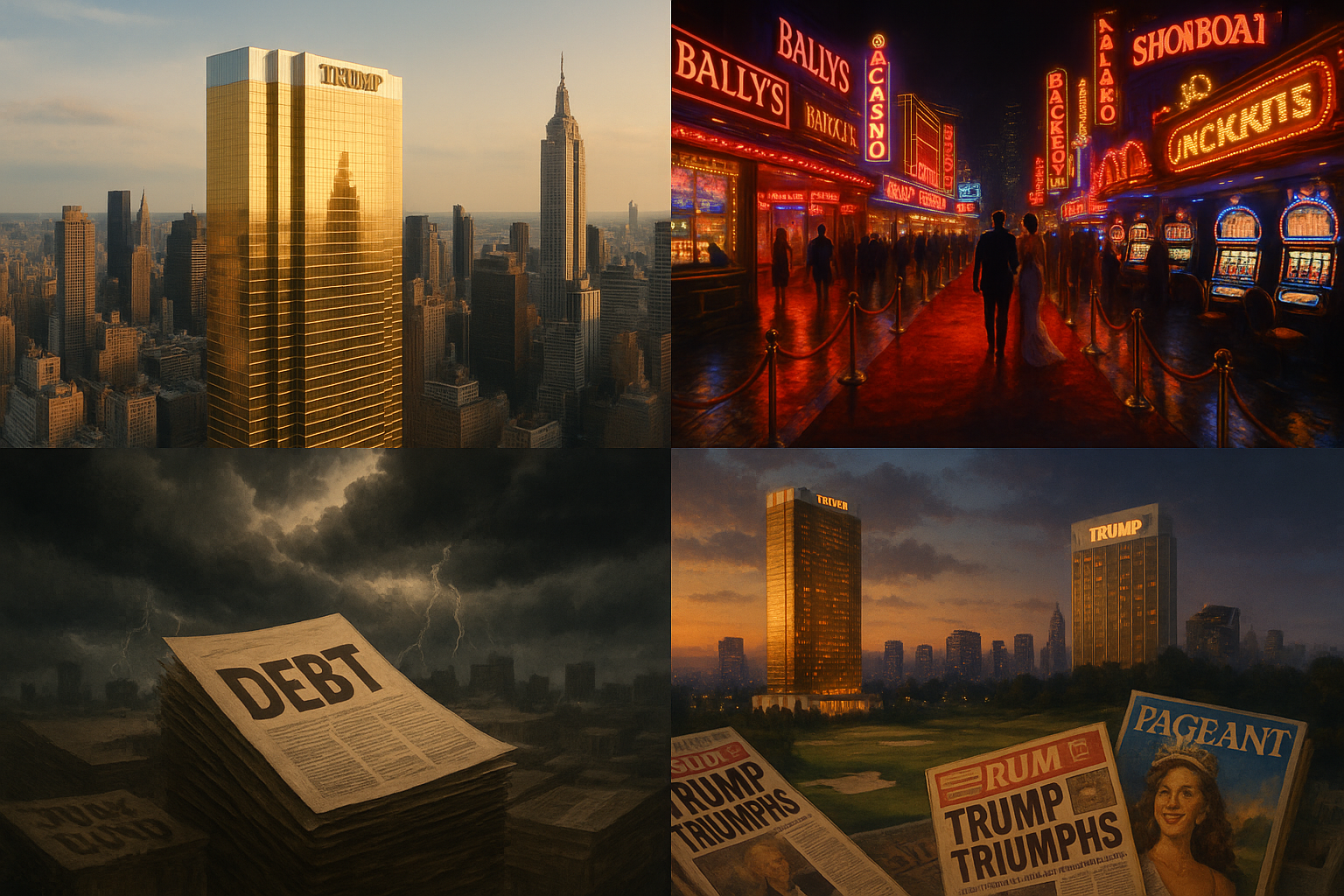
 Trump Tower and the Manhattan Crown
In 1983, Donald Trump opened the doors of Trump Tower, a 58-story glass and steel monument on Fifth Avenue that crystallized his vision of real estate as theater. The building’s shimmering bronze-tinted façade caught the light — and the cameras — while its atrium, clad in pink marble with a cascading waterfall, functioned as a public stage set.
Trump Tower was more than an office-and-residential building; it was a statement piece, designed to embody success in its purest, most ostentatious form. Its retail space lured luxury brands, its penthouses commanded record-breaking prices, and its central location placed it at the beating heart of Manhattan’s power and prestige.
Every design choice was calibrated for impact. The materials were expensive, the finishes lavish, the sightlines dramatic. Trump understood that a building could sell a lifestyle as much as a square footage — and that lifestyle, under his brand, was about victory, status, and exclusivity.
The media took the bait. Coverage of Trump Tower doubled as coverage of Trump himself, painting him as a new kind of developer — part mogul, part celebrity. For Donald, this was no accident; it was the strategy. He toured journalists through the tower’s gleaming interiors, staged ribbon-cuttings with maximum fanfare, and made himself inseparable from the structure in the public imagination.
The project’s success emboldened him to think even bigger. If Manhattan could be conquered with glass, marble, and relentless publicity, other industries — other arenas — might be ripe for the same treatment. And in the early 1980s, no arena in America combined money, glamour, and risk quite like the casino business in Atlantic City.
Rolling the Dice in Atlantic City
By the mid-1980s, Atlantic City was being touted as the East Coast’s answer to Las Vegas — a gambling mecca rejuvenating a once-fading resort town. For Donald Trump, it was a natural next conquest: high stakes, media attention, and an opportunity to attach his name to a business where spectacle was part of the product.
He began with the Trump Plaza Hotel and Casino, which opened in 1984. Built in partnership with Harrah’s, the property was designed to be the most luxurious in town, with high-limit gaming rooms, lavish suites, and a design language that screamed exclusivity. From the start, Trump positioned the casino not merely as a gambling venue, but as a destination for the rich and powerful — a place where winning was an aesthetic as much as an outcome.
But partnership was never Donald’s preferred arrangement. Within a year, he bought out Harrah’s stake, rebranding the property entirely under his name. The move fit a pattern: consolidate control, maximize brand visibility, and ensure that every success — and every risk — carried the Trump imprimatur.
From there, expansion came quickly. In 1985, he acquired the Hilton Hotel and Casino (later renamed Trump Castle) after the property lost its gaming license under previous ownership. The deal showcased another Trump hallmark: seizing opportunities when competitors stumbled, and turning their misfortune into his gain.
The crown jewel would be the Trump Taj Mahal, announced with characteristic hyperbole as “the eighth wonder of the world.” Acquired from Resorts International in 1988, the project was massive, ornate, and financed with a complex web of junk bonds — high-yield, high-risk debt instruments that reflected both Trump’s appetite for leverage and the era’s financial excess.
Each casino opening was treated as a Hollywood premiere. Celebrities walked the floors, cameras flashed, and Trump himself played the role of master of ceremonies. The events reinforced his personal mythology: here was a man who didn’t just build businesses — he built experiences that embodied winning itself.
Yet the economics of Atlantic City were shifting. Competition was fierce, operating costs were high, and the very debt that financed Trump’s rapid expansion left the empire vulnerable to downturns. Still, in the late ’80s, the warning signs were easy to dismiss. Revenues were flowing, the brand was glowing, and the image of Trump as the ultimate dealmaker was cementing itself in the American consciousness.
The Debt Trap and the Art of Survival
By the end of the 1980s, Donald Trump’s public image was at its zenith. He had conquered Manhattan with Trump Tower, planted his flag in Atlantic City with a trio of casinos, and expanded into airlines, professional sports, and publishing. He was a best-selling author, a regular on talk shows, and a fixture in gossip columns.
But behind the golden façade, the numbers were becoming perilous. The same high-leverage financing that had fueled his rise now left him dangerously exposed. The Taj Mahal alone carried nearly a billion dollars in debt, much of it at double-digit interest rates. The broader economy was softening, and Atlantic City’s casino market was oversaturated.
Trump’s operating style — aggressive borrowing paired with aggressive expansion — had been sustainable in a bull market. In a downturn, it became a liability. By 1990, revenues at his properties were falling short of projections, and debt payments loomed like an immovable tide. Wall Street began to question the Trump myth, and news outlets that had once chronicled his every triumph now reported on the cracks in his empire.
Yet Trump’s instinct for survival matched his instinct for promotion. He entered into complex negotiations with banks, trading equity stakes and personal guarantees in exchange for restructured loans. The deals often kept him in control of his properties while reducing his personal exposure — a maneuver that required both leverage and a willingness to let lenders believe they had more to lose if Trump failed than if they worked with him.
Publicly, he maintained the image of the consummate winner, even as he ceded ground in private. This dual track — projecting dominance while negotiating from weakness — became a recurring feature of his career. It allowed him to weather periods that might have ended other developers, and it reinforced his belief that perception could be as powerful a survival tool as cash flow.
By the early 1990s, Trump had divested from the airline, sold his yacht, and trimmed other non-core holdings. The casinos remained, but they were now under tighter financial scrutiny, with lenders keeping a close watch. The aura of invincibility had dimmed, but it had not disappeared. Trump was still in the game, and in his mind, that was the ultimate definition of winning.
Reinvention in the Late ’90s
By the mid-1990s, Donald Trump was no longer the unassailable mogul of the previous decade. His real estate holdings had been pared down, his casino empire was under the watchful eyes of creditors, and his name no longer guaranteed the unquestioned glamour it once had. But Trump understood something that kept him from fading into the background: in America, the perception of relevance can be as valuable as relevance itself.
He leaned into his public persona with renewed vigor. He made frequent appearances in the New York tabloids, where his personal life — divorces, affairs, and high-profile romances — played out like serialized entertainment. He cultivated an image that blurred the line between businessman and celebrity, making himself as much a fixture of pop culture as of the business pages.
At the same time, he pursued projects that kept the Trump brand in the headlines even when the financial returns were modest. Golf courses, beauty pageants, and licensing deals allowed him to place his name on ventures without committing the same level of capital risk that had nearly sunk him earlier in the decade. These deals also fed into a narrative he was careful to promote: that Trump was still expanding, still winning, still a force to be reckoned with.
The late ’90s brought a modest resurgence. The U.S. economy was booming, stock markets were soaring, and the appetite for luxury was returning. Trump leveraged this environment to refinance debt, secure new development opportunities, and reassert his presence in Manhattan. The opening of the Trump International Hotel and Tower at Columbus Circle in 1997 signaled that he was still capable of high-profile, high-visibility projects in the city’s most competitive market.
More importantly, he had mastered a formula that would serve him in the years ahead: use media saturation to maintain the brand’s aura, keep capital exposure limited when possible, and position every public appearance as evidence of continued success. The man who had once staked everything on bricks, mortar, and borrowed billions was now laying the groundwork for a different kind of empire — one built on personality, image, and the power of the Trump name itself.
By the close of the millennium, Donald Trump had survived debt crises, market downturns, and the erosion of his once-untouchable reputation. What remained was a sharper, more media-savvy figure, one who understood that winning in the public eye could be as decisive as winning on a balance sheet. The stage was set for his next transformation — from embattled mogul to television star and cultural icon.